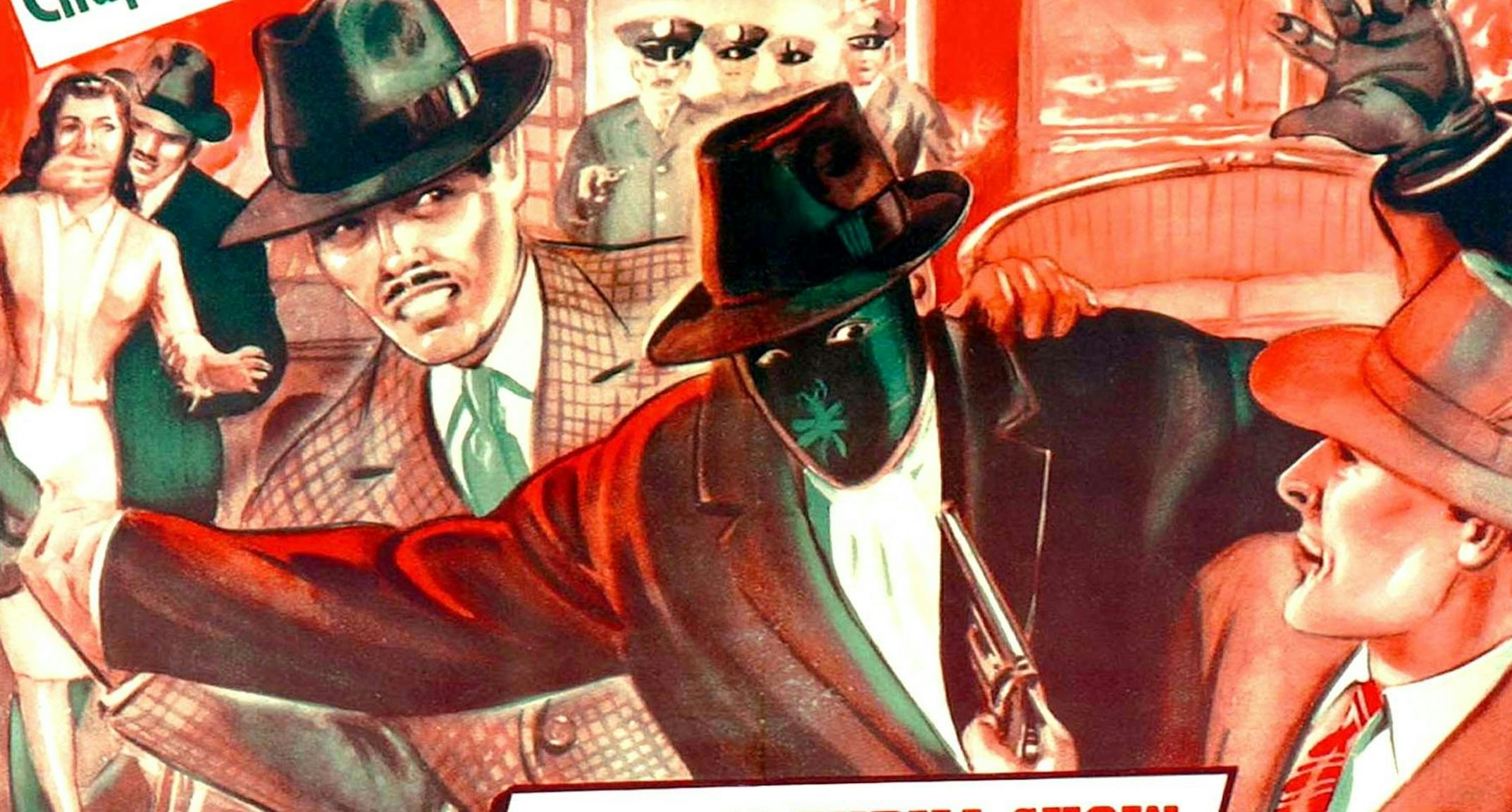
The history of superheroes often begins with pulp novels and comic strips, but what truly made superheroes mainstream was the twin episodic media of radio and serial films. Characters like the Shadow ruled the radio starting in 1932, but by 1941, one radio superhero was so popular that he was already getting a reboot by his second film serial. It wasn’t Buck Rogers or Flash Gordon or any of DC’s heroes, but a masked vigilante known as the Green Hornet. And 85 years ago, on January 4, 1941, the second serial focused on this character hit theaters with the hyperbolic title The Green Hornet Strikes Again!
Watching The Green Hornet Strikes Again! today will likely elicit two contradictory reactions. On the one hand, it’s shocking how well it holds up, and just how much modern superhero and sci-fi narratives owe to it. But this superhero romp is also mired in the strange narrative obsessions of its era, making it feel like an overly long superhero crime show that’s lacking a main character.

Created by Fran Striker and George W. Trendle, the Green Hornet began his life in 1936 as a radio character. Despite later associations with Batman, owing to the 1966 Green Hornet TV series being a sister series to the 1966 Batman, the character and his sidekick Kato aren’t DC comics characters, but rather part of The Lone Ranger extended canon. Really! In the radio show, Britt Reid (aka the Green Hornet) is the son of Dan Reid Jr., the nephew of the original Lone Ranger. Yes, even back in the 1930s and ‘40s, superheroes had interconnected mythologies and unnecessarily confusing canon.
By 1941, the popularity of The Green Hornet radio show led to a successful movie serial, also called The Green Hornet. It starred Gordon Jones in the title role, but with his voice dubbed over by radio actor Al Hodge, which would be like if Ashley Eckstein’s voice had replaced Rosario Dawson’s for Star Wars: Ahsoka. But by 1941, The Green Hornet Strikes Again! recast the title character, replacing Jones with Warren Hull as a slightly friendlier version of Britt Reid, a kind of George Clooney Batman versus Val Kilmer Batman.

The Green Hornet Strikes Again!, both as a piece of superhero history and as something you binge late at night on Tubi, is a better watch than many of its contemporary superhero stories, because the story is so simple and the Green Hornet is, oddly, believable. Batman may have been edgy because the police think he’s a criminal, but the Green Hornet takes it one step further: he also makes the criminals think he’s a criminal, which makes his ability to blackmail and strong-arm people a little more plausible.
Like many Golden Age comic book characters, Britt Reid is a newspaperman, which in The Green Hornet Strikes Again! is the least interesting thing about him. The idea that the press is directly connected and controlled by a mafia-type racketeering ring is silly at best and, throughout the serial’s 15 installments, very repetitive. Like many old serials, there’s a need for the Green Hornet to not make too much progress, so that the cliffhanger comes easier. He may don his mask and gas pistol often, and every episode says “the Green Hornet Strikes Again!”, but the truth is that he spends most of his time getting his ass kicked.
This is the double-edged charm of The Green Hornet Strikes Again!. It's fun to watch the circular plots of the Green Hornet trying to foil each member of the racketeering ring, because the stakes are low enough to let you fold your laundry while it's happening. But then you remember that these serials were, for their time, gripping and inventive.
Like the era’s Flash Gordon serials, The Green Hornet Strikes Again! uses a text crawl recap at the beginning of each episode, which now retroactively scans as Star Wars. It’s set in a cramped city, but if you feel like there’s a hidden space opera flair in the tone of The Green Hornet Strikes Again!, you’re not wrong. The serial was edited by Saul A. Goodkind, who also edited the 1939 Buck Rogers and the final 1940 Flash Gordon serial, Flash Gordon Conquers the Universe, while co-director Ford Beebe tackled Flash Gordon’s Trip to Mars in 1938. The Green Hornet’s world might have been confined to some vague version of reality, but the theatricality of the storytelling is closely linked with old-school science fiction.

By 1966, The Green Hornet TV series starring Van Williams and Bruce Lee recreated the characters of Britt and Kato in a way that hasn’t been topped. Keye Luke is solid as Kato in The Green Hornet Strikes Again!, but Bruce Lee is Bruce Lee, and that 1960s version is simply cooler and more fun than its 1930s and 1940s antecedents.
Still, the foundation for bringing this radio hero to the screen started with the movie serials. And in The Green Hornet Strikes Again!, a connoisseur of adventure narratives and pulp fiction will find much to love. This wasn’t the greatest hero of them all, but it was equal parts weird and exciting. What more can you ask from something released 85 years ago?