
Get all your news in one place.
100's of premium titles.
One app.
Start reading
Golf Monthly
Golf Monthly
Sport
Rob Spedding

8 Reasons High-Handicappers Shouldn't Be Scared Of A Club Fitting

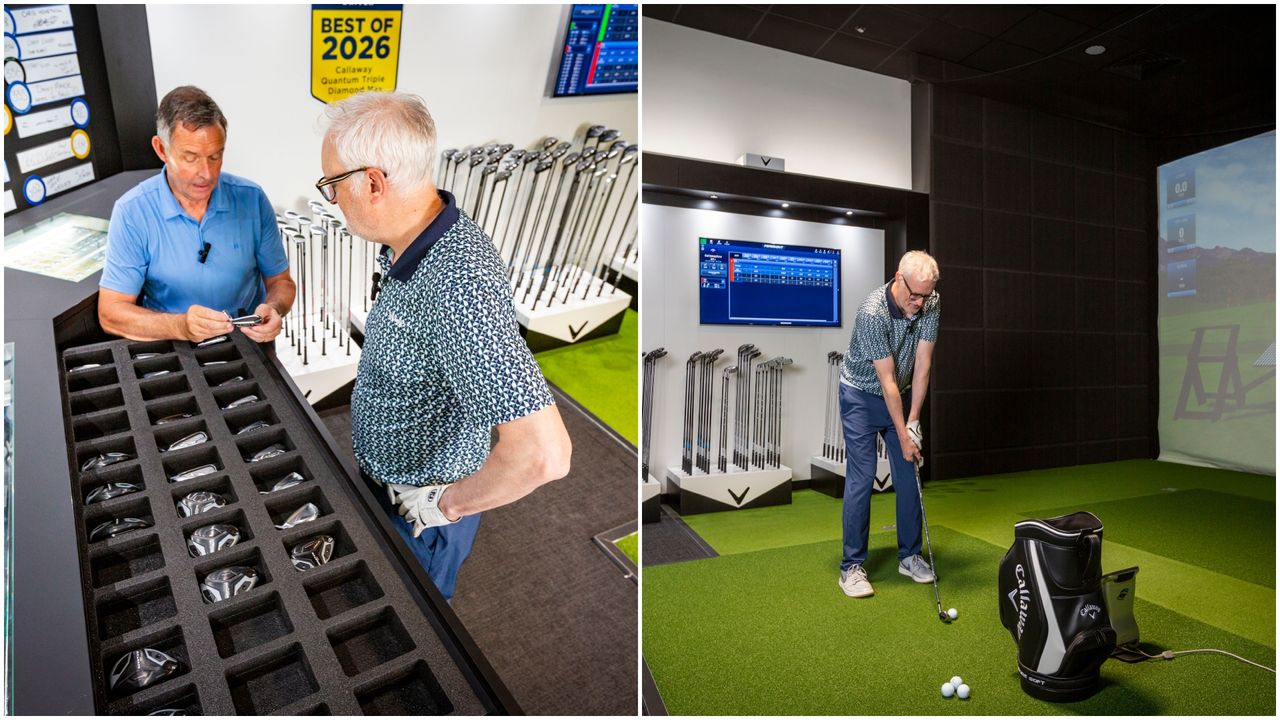
Collage showing Rob Spedding having a custom club fitting withCallaway.

I know it doesn’t look like it, but I’ve been a sports journalist for just about 27 years. And in that over-a-quarter of a century I have been lucky enough to get ‘fitted’ for a few different things with the aim of making me better at the sport I was writing about. This has included custom-moulded insoles for running shoes and fancy road bikes.

I’d even include undergoing strenuous, vomit inducing scientific tests to help create running and cycling training plans as a form of ‘fitting’. Oh, and there was the time I undertook a ‘scrawny to brawny’ body transformation for a men’s health magazine. (Got a spray tan from the wife of an ex-England cricketer…)

The thing is, I went into all of the above – apart, perhaps, from the spray tan – feeling very much within my comfort zone. I can’t say that I carried the same confidence heading into my first ever fitting for a set of golf clubs.

As I’ve mentioned in my articles on the golf lessons I’m currently taking with Golf Monthly Top 50 coach Josh Mayo, I am a relatively new ‘serious’ golfer. I’ve only had my (high) handicap for a year or so and I’m struggling to lower it thanks to my incredibly inconsistent game.

As a result, I arrived at Callaway’s European Performance Centre in Surrey very much not in my comfort zone – surely a golf club fitting really isn’t the kind of thing a golfer like me should bother with. I should really wait until my handicap is far more respectable or that I’ve earned the right to call myself a ‘proper golfer’.

The fitting session is carried out by Callaway’s master fitter Keith Simmonds – who has years of experience fitting golfers of all levels, and is a PGA Professional coach to boot – in a state-of-the-art simulator equipped with Foresight hardware and software that uses sensors on the Callaway clubs to deliver more information about my golf than I thought possible.

All of this gadgetry doesn’t calm my nerves. Every time I go near a sim I’m convinced that’ll I shank a ball into the display on the wall or, worse, the £20k or so launch monitor.

So, was I right to worry? In the first of a short series on my fitting experience with Callaway, here’s what I learned…

A fitting is (mainly) all about you

Keith starts the session by talking to me about my golf and taking a look through my bag which is a mishmash of two package sets, a Honma driver and some wedges handed down to me by other GM team members, and a second-hand Callaway 5-wood that I recently purchased to replace one that I, erm, accidentally snapped.

“Fitting isn't just about looking at numbers,” explains Keith. “I follow a specific order when I’m working with someone and the the player’s feedback is prioritised at the top. Your personal feedback — how a club looks, feels and even sounds to you — is often more important than the technical data. The data is important of course, so your feedback is followed by analysing ball flight and strike data. This maintains the fitting process hierachy of player-ball flight-strike."

At least I had one Callaway club in my own bag! (Image credit: Andrew Sydenham)

You definitely don’t need to be a low-handicap golfer to get fitted

During our initial conversation I mention to Keith that I’m worried that I’m not yet good enough to warrant a fitting. Thankfully he doesn’t buy this. “There is a common misconception that fittings are only for elite players, " he says, "The perception is, 'Oh, I'm not good enough to get a fitting.' But everyone, regardless of skill level, can benefit from having equipment that fits their individual build and swing.”

Golf is supposed to be fun, and using clubs fitted to you can only increase your enjoyment

I also admit to Keith that, like many newer golfers, I can get incredibly frustrated – angry even – with my golf. “The clubs in your hand should make you enjoy the game first”, he tells me. “Hopefully, as we go through the fitting process it’ll help you understand your game better and that will then make frustrating moments on the course more manageable.” As Keith cleverly pointed out, if you’re in the game for the long run – it’s got me, I am – then a fitting is simply “a long term investment in enjoyment!”

"The goal of a fitting is to match you with the equipment that works with your current, natural swing, not to fix your mechanics.”

Keith Simmonds, Callaway Master Fitter

Some of my numbers were surprisingly average (Image credit: Andrew Sydenham)

You get the opportunity to experiment with different equipment builds…

I wasn’t being modest earlier when I said I was worried about defiling Callaway’s fitting studio. And things didn’t get off to a great start when Keith asked me to hit some balls with the ‘trusty’ 7-iron from my bag. Keith uses the seven as the ‘control’ club on which to base all of the irons, so I was convinced that my spraying it around was going to make his life very difficult!

Luckily Keith is a patient man, and eventually I calmed down and the Foresight equipment could record some base numbers which would allow Keith to compare my current club with different combinations of Callaway heads and shafts – there are drawers and drawers of the brand’s hardware to sample in the studio.

…And that experimentation is eye-opening

As I said at the start, my core irons are a genuine ‘mixed bag’ – a combination of steel shafted MacGregors and Cleveland irons with graphite shafts. I tell Keith that I feel more comfortable hitting the graphite clubs. “That makes sense - generally, much less shock is transmitted back through a graphite shaft and they can help performance if you have a lower swing speed.”

However, Keith then explains that just because a shaft is graphite, it doesn’t mean it’s the right graphite shaft for you. “One of the biggest influences on the weight of a golf club is the shaft,” he explains. “If a shaft is too light for you it can lead to you releasing the club too early which will have a negative impact on your ball strike.”

Using the data from my 7-iron, Keith suggested that we tried heavier shafts. At the same time – and this is another benefit of a fitting – Keith swapped between Quantum Max and Apex AI clubheads. Being able, in real time, to feel the differences between the different combinations, and confirm genuine improvements was impressive.

This is so much better than my kitchen drawers (Image credit: Andrew Sydenham)

A fitting can boost your confidence (and your ball speed)

After the irons, we moved to the woods. I hit my pre-owned Callaway 5-wood – coincidentally, considering my location, the club I’m most confident with – and started to find my groove. As with the irons, Keith tried combinations of shaft weights with different Quantum Max heads and I’ve got to admit I fell a little bit in love with the kit I was trying. From 3-wood upwards the trace on the simulator was making me feel like peak Xander Schauffele. And the data was backing up my feelings.

“Wow, look at the numbers on the screen,” said Keith. “They’re pretty impressive – you’ve increased the ball speed by 10mph, a pro would be happy with that kind of improvement!” Not only that, Keith pointed to my swing path numbers. “You're only one or two degrees either side of a neutral swing path. That’s a really solid foundation. Once you’ve got your new clubs, you can stop worrying about the mechanics of the path and work with your coach on stabilising the club face alignment at impact.”

I've never seen myself concentrating this hard before (Image credit: Andrew Sydenham)

Fitting isn’t a coaching lesson

While Keith is an experienced PGA Pro and offered some very welcome words of wisdom, he was keen to point out that his role wasn’t to watch me swing and then pick my game apart. “It’s very much about trying to fit you as a person,” he explains. ‘The goal of a fitting is to match you with the equipment that works with your current, natural swing, not to fix your mechanics.”

"A golf club fitting is a long term investment in enjoyment."

Keith Simmonds, Callaway Master Fitter

You might walk away surprised with what ends up in your bag

It’s always good to end on a cliffhanger right? Once my new set of clubs arrive, I’ll explain more but the findings from my time in the main fitting studio with Keith mean I’ll be carrying a bag with a slightly non-traditional make up, with the potential for me to - at a later date - really mess with tradition. And I haven’t even mentioned what happened when I went next door for a putter fitting!

Sign up to read this article
Read news from 100's of titles, curated specifically for you.
Already a member? Sign in here
Related Stories
Top stories on inkl right now
One subscription that gives you access to news from hundreds of sites
Already a member? Sign in here
Our Picks
Fourteen days free
Download the app
One app. One membership.
100+ trusted global sources.