Get all your news in one place.
100's of premium titles.
One app.
Start reading
The Economic Times
The Economic Times
Team Global

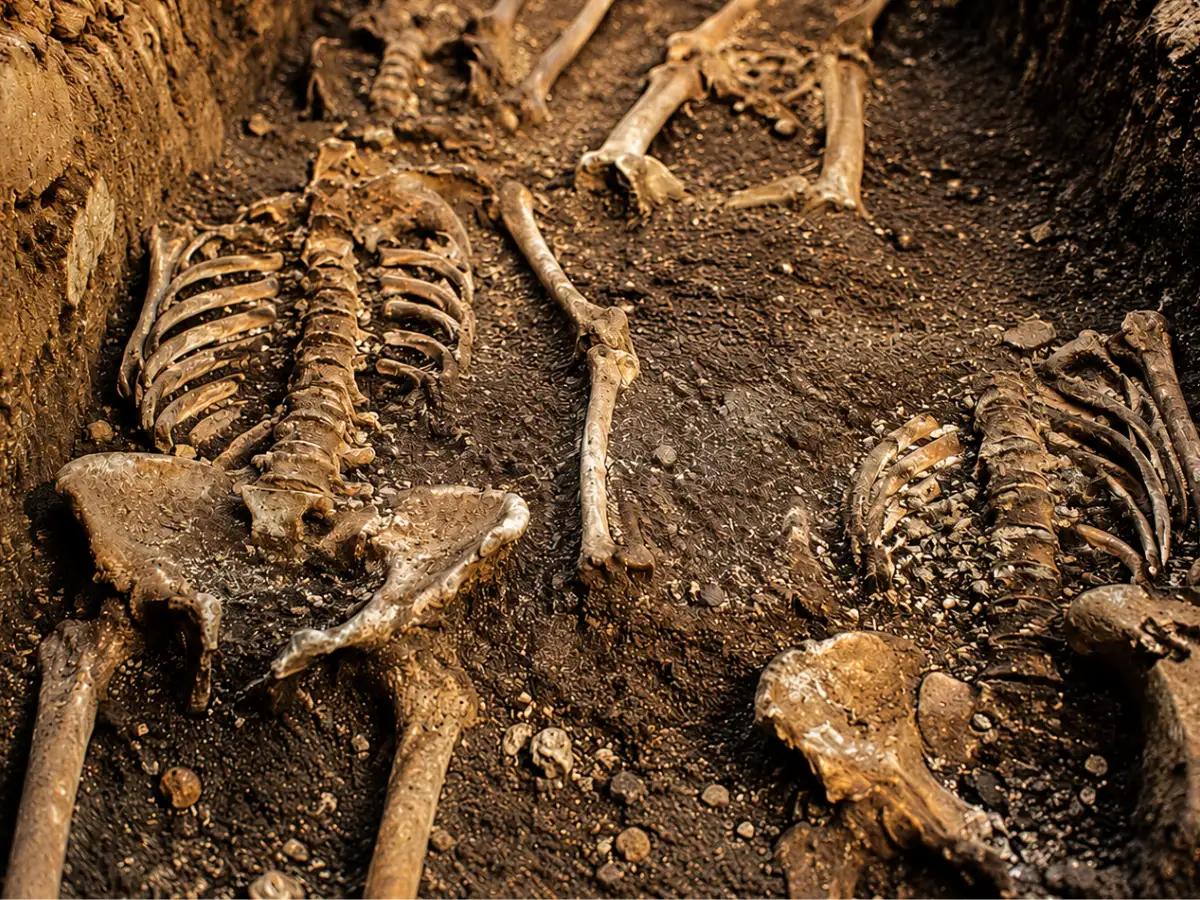
77 headless skeletons found in a 7,000-year-old ditch in Slovakia, and the only skull left belonged to a child

Suppose you are an archaeologist in a quiet corner of southwestern Slovakia and you start uncovering human skeletons. Dozens of them, stacked on each other, crammed into a ditch. And none of them have a head.

That’s precisely what researchers at Kiel University and the Slovak Academy of Sciences have been gazing at since 2022, at a location called Vráble, one of the most important Neolithic villages ever discovered in Central Europe. The site was first investigated way back in 2012, but it’s the ditch excavations that have really upended our understanding of Stone Age life.

According to a study published in the Proceedings of the Prehistoric Society by lead author Martin Furholt and his team at Kiel University, excavations unearthed at least 78 individuals deposited in and around the ditch, with 77 missing their skulls altogether. Four pairs of headless skeletons were discovered close to the ditch entrance, along with a mass burial of a minimum of 77 headless individuals. The only exception to the missing heads? A child, the only skeleton with its head still attached.

The site is about 5250–4950 B.C., so these remains are more than 7,000 years old. And yet they ask questions that feel startlingly modern: what did these people believe about death? What does it mean to detach a person from their head? And who exactly were these ancient communities?

This was not a massacre; this was something much more deliberate

The first thing that might come to your mind is a brutal killing. A war. A sacrifice. A dark ritual gone wrong. But the evidence, the researchers say, suggests something quite different.

Biological anthropologist Katharina Fuchs, co-author of the study, studied the cut marks on the skeletons’ upper neck vertebrae. The skulls were not hacked off in a frenzy. They had been removed carefully, with sharp tools, in what appears to be a skillful, deliberate process almost certainly after the people were already dead. In other words, this looks like post-mortem decapitation, not execution.

Sign up to read this article
Read news from 100's of titles, curated specifically for you.
Already a member? Sign in here
Related Stories
Top stories on inkl right now
Our Picks
Fourteen days free
Download the app
One app. One membership.
100+ trusted global sources.