Get all your news in one place.
100's of premium titles.
One app.
Start reading
The Conversation
The Conversation
Sumit Ganguly, Distinguished Professor of Political Science and the Tagore Chair in Indian Cultures and Civilizations, Indiana University

75 years ago, Britain's plan for Pakistani and Indian independence left unresolved conflicts on both sides – especially when it comes to Kashmir

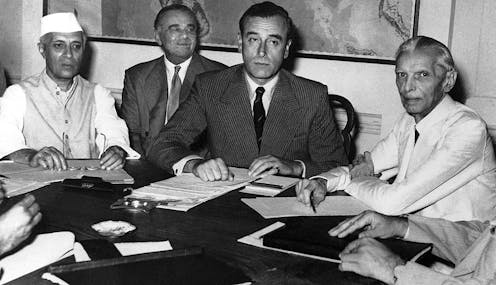
Leaders in New Delhi agree on the plan to partition India: from left, Jawaharlal Nehru, Hastings Ismay, Louis Mountbatten and Ali Jinnah. Keystone-France/Gamma-Keystone via Getty Images

In 1947, the United Kingdom was exhausted. World War II had ravaged its military and economy, and anti-colonial movements had begun to challenge empires. Within the Indian subcontinent, the U.K. faced two powerful, seemingly irreconcilable nationalist movements: one calling for the creation of Pakistan, a homeland for the Muslims of South Asia; the other for India, a pluralist democracy.

The U.K. chose to partition the region and withdraw. Under the terms of the Indian Independence Act, the subcontinent was formally divided into two new dominions at midnight of Aug. 14, 1947 – 75 years ago this month.

Sign up to read this article
Read news from 100's of titles, curated specifically for you.
Already a member? Sign in here
Related Stories
Top stories on inkl right now
One subscription that gives you access to news from hundreds of sites
Already a member? Sign in here
Our Picks
Fourteen days free
Download the app
One app. One membership.
100+ trusted global sources.