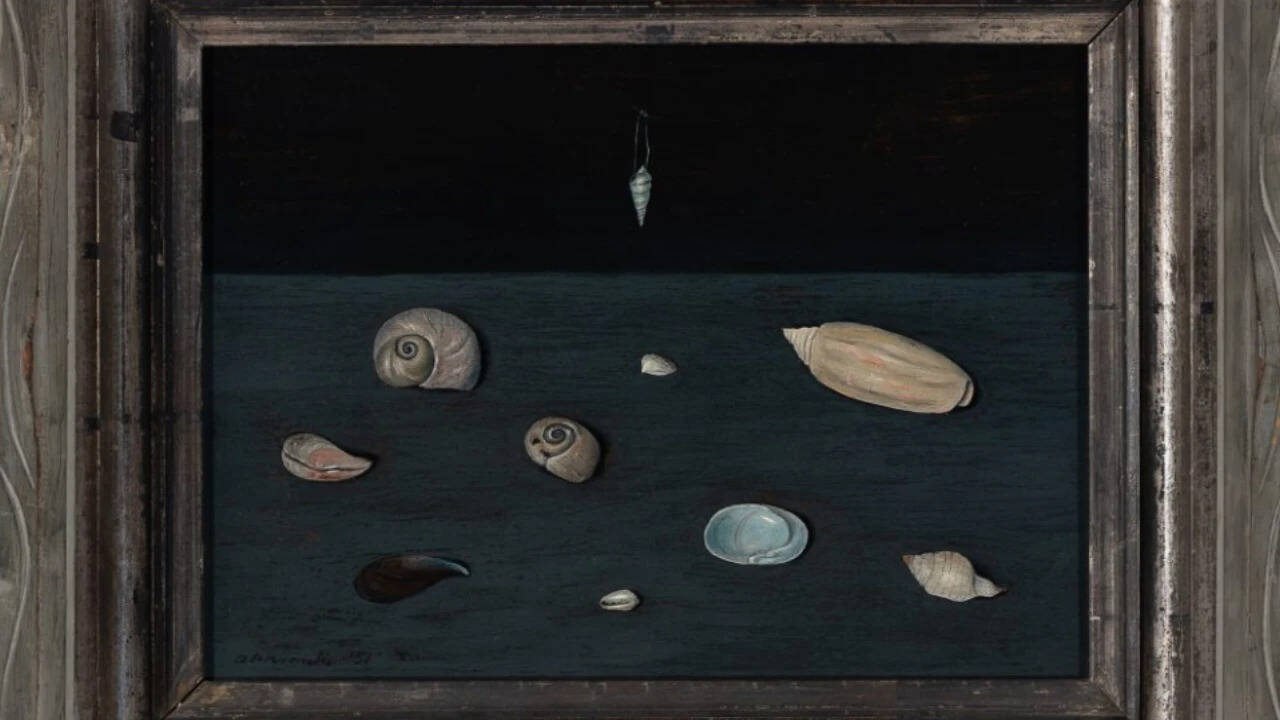
A Michigan collector paid just $30 for a painting at an estate sale, not knowing that the work had been out of public view for about 75 years. The 1951 painting by American Surrealist Gertrude Abercrombie has since been authenticated and is now estimated to sell for $150,000 to $250,000 at Freeman’s New York on October 1.
Get breaking news anytime, anywhere. Download the TOI app now!
The painting, Alderman Merriam’s Shells, was found earlier this year at an estate sale in Michigan, according to Art Net News. The collector, who usually searches for vinyl records and mid-century furniture, spotted the work in a dark hallway leading towards a garage. A signature reading “abercrombie ’51” caught the collector’s attention, leading to the $30 purchase.
The discovery became more significant when the new owner visited the Milwaukee Art Museum’s exhibition Gertrude Abercrombie: The Whole World Is a Mystery. While looking through the exhibition catalogue, the collector found an archival photograph of the same painting. The photograph had appeared in a September 1952 Chicago Tribune review of Abercrombie’s exhibition at Newman Brown Gallery in Chicago.
The owner then contacted Dr Susan Weininger, a leading scholar of Abercrombie, who authenticated the painting. The work was identified as Alderman Merriam’s Shells, painted in 1951. It will now be among the highlights of Freeman’s Post-War & Contemporary Art auction in New York.
Painting remained hidden for 75 years
The painting had a documented history before it disappeared from public view. Abercrombie gave it to Dr John Reynolds of Kalamazoo, Michigan, in early 1952 in exchange for medical services. It remained with Reynolds for the rest of his life and later passed through his estate and family.
Before disappearing from public view, the painting had been exhibited several times. Freeman’s said it appeared in six solo exhibitions during 1952 and 1953. These included exhibitions at Newman Brown Gallery and Steven Gross Studios in Chicago, Edwin Hewitt Gallery in New York, Bresler Gallery in Milwaukee, Contemporary Arts Gallery in Evanston and Illinois Design Center in Chicago.
The painting shows nine seashells arranged across a slate-grey surface. Another conical shell hangs from a thread against a black wall, appearing to float above the other shells.
The work is unusual in Abercrombie’s career because it was painted directly from real objects. Freeman’s said the shells belonged to Robert Merriam, an alderman from Chicago’s Hyde Park neighbourhood, where Abercrombie lived and worked.
Shells gave clue to Abercrombie’s work
The painting also offers clues about Abercrombie’s recurring use of shells in her work. At the centre is a small nautilus shell with a hole and a crack. Freeman’s said similar details appear in some of her later paintings of solitary shells, which were long believed to have been invented.
The rediscovered work suggests that at least some of these details were based on direct observation and memory. Shells held a particular symbolic meaning in Abercrombie’s art. Freeman’s said they represented protection and confinement, while their spiral shape could also act as a symbol of friendship that Abercrombie gave to people close to her.
Zack Wirsum, senior vice president and head of the Post-War and Contemporary Art department at Freeman’s, described the discovery as an important moment for the auction house.
“Little did I know that one of those 'once in a while's would occur less than a month later,” Wirsum said. He was referring to a comment he had made to visitors on an exhibition tour, when he said Abercrombie paintings still occasionally surfaced at estate sales.
“We could not be more thrilled to now steward this magnificent rediscovery to the next chapter of its fascinating story,” he said.
From estate sale to auction
The collector’s discovery also came at a time when interest in Abercrombie’s work has increased. Artnet News reported that the artist’s reputation and market have grown following gallery and museum exhibitions since 2018.
Abercrombie was a Chicago-based artist who did not have gallery representation and instead sold her works directly to collectors or gave them to friends. That history helps explain why some of her paintings can still emerge from private collections, according to Artnet News.
Her work was largely overlooked for decades. In 2018, Karma gallery exhibited Abercrombie, describing her as an important but under-considered figure in mid-century American Surrealism. Museum exhibitions followed, bringing renewed attention to her paintings.
Artnet’s Price Database shows the change in her art market. In the year before the 2018 Karma exhibition, Abercrombie’s paintings generated less than $75,000 in total sales, with prices generally around $10,000. Since then, 80 of her paintings have sold for more than $100,000, while 83% of works exceeded their high estimates.
In November last year, Message for Mercy (1950), which features a cat in a stark interior, became the first Abercrombie painting to sell for more than $1 million. It sold at Sotheby’s New York for more than three times its high estimate.
Artnet reported that Abercrombie’s four most expensive works have all been sold since 2024, while her total annual sales have repeatedly exceeded $3.5 million.
Freeman’s auction includes other major works
Alderman Merriam’s Shells is part of Freeman’s Post-War & Contemporary Art auction, scheduled for October 1 at its New York saleroom. The sale will include works from several collections and periods of post-war American art.
The auction will also feature sculptures by British artist Henry Moore from the collection of the Brooklyn Museum. These works include Two Piece Reclining Figure #6 from 1964, estimated at $30,000 to $50,000, and Slow Form: Tortoise from 1962, estimated at $20,000 to $30,000.