What better way to see the world than through the eyes of our favorite tastemakers? In Hidden Trails, we look at the places that feel most like home to our community of design insiders — wherever those might be — to help you uncover what their cities have in store for you.
Should you be looking for evidence that Salù Iwadi Studio, the interdisciplinary design practice that architect, designer, and artist Toluwalase Rufai and creative strategist and curator Sandia Nassila set up between Nigeria, Senegal, and Marrakech in 2023, looks at Dakar as "one of its anchors, an important part of how we think about ourselves as Pan-African," as the two tell me over email, you'll likely find it in the porous essence and unconventional silhouettes of their functional, spatial, and experiential designs.
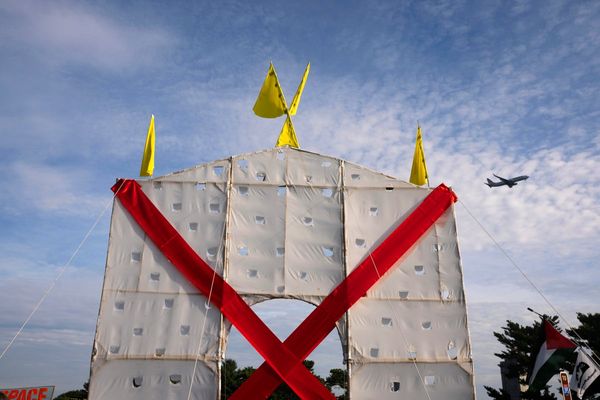
Standing out for their intricate geometrical structures and their ability to bring people closer together, the works of the two, which span anything from furniture to retail interiors and public art installations, promote "the belief that design is a powerful medium for storytelling and connection". "Working between three African cities allows us to move between different cultures, materials, craft traditions, and ways of living, while looking for the links that exist between them," Rufai and Nassila explain.
Dakar holds a special place in their heart. Their very first object, the Patewo Chair, was made here using metal, "a traditional material long associated with Senegal", while theirWater Basin Totem, unveiled during the OFF programme of the Dakar Biennale in 2022, "generated important conversations around water pollution and the transformation of everyday objects".
What they love most about Dakar is that "inspiration rarely exists only within designated creative spaces," say Rufai and Nassila. "You encounter it in its architecture, markets, workshops, textiles, street furniture, fishing boats, and everyday rituals. That process of observing what already exists and understanding the histories embedded within it is central to Salù Iwadi Studio and to the idea of iwadi: research, investigation, and a return to the source."
This very continuum between past, present, and future, nature and human-made architecture, also characterizes most of their favorite things to see and do in Dakar, which you can find below.
What to Do in Dakar, Senegal
Become Part of Dakar's Art Community at RAW Material Company
Villa 2a ZONE B, Dakar, Senegal
RAW Material Company is one of our favorite places for experiencing Dakar's contemporary art scene. It is as much a space for research and conversation as it is for exhibitions, bringing together artists, thinkers, and curators from across the continent and beyond. It was founded by the late Koyo Kouoh, who curated the 2025 Venice Biennale. We love its intellectual energy and the way its program feels deeply connected to Dakar while constantly opening conversations with the wider world. Their curatorial team — mostly women — does an incredible job.
Get a Glimpse Into the City's Dream of the Future at CICES
VDN x Route de l'Aéroport, Dakar, Senegal
The Centre International du Commerce Extérieur du Sénégal (CICES) is one of Dakar's most fascinating architectural landmarks. Built in the 1970s for the Dakar International Fair, the complex is a remarkable expression of Senegalese modernism, with bold geometries, sculptural volumes, and decorative details rooted in local visual languages. We love what it represents: a period when newly independent Senegal was actively imagining and expressing its own architectural and cultural identity.
Step Inside a Truly Unexpected Architectural Gem at Église Sainte-Épiphanie-du-Seigneur
A little outside Dakar, on the Petite-Côte, the Église Sainte-Épiphanie-du-Seigneur in Nianing is well worth the journey. Its extraordinary architecture takes inspiration from the spiral form of a shell found along the Senegalese coast.
We love how the building responds to its environment, from its sculptural succession of vaults to the natural ventilation created through its orientation and bell tower. It is a beautiful example of contemporary architecture drawing from place, climate, and local references without becoming literal.
Feel Energized and Inspired at Ban Café
23A Rue OKM 452, Dakar, Senegal
Ban Café is one of our favorite addresses in Dakar for its relaxed atmosphere, thoughtful food that uses local and seasonal ingredients, and understated setting. The kitchen is run by chef Aida and is the sister space of Ban Workshop, a pottery studio offering classes to explore making with clay.
We love this connection between food, craft, and creativity. More than a coffee shop, Ban Café is an active part of Dakar's growing community of independent creative spaces.
Savor the Dakar Coastline Along the Corniche
Route de la Corniche, Dakar, Senegal
The Corniche is one of our favorite ways to experience Dakar outdoors, whether for a morning run or a long walk toward the end of the day. With the Atlantic almost constantly in view, it offers a different perspective on the city and its rhythm. We love how alive it feels — especially around sunset, when people come out to exercise, gather, and enjoy the ocean.
Get to Know a Staple of Dakar's Indie Fashion With TONGORO
TONGORO embodies a side of Dakar we find particularly exciting: confident, creative, and outward-looking. Founded in the city, the fashion label has developed a strong visual identity while building an international presence from the African continent. We admire that ambition and its founder, Sarah Diouf, who is a visionary. The brand speaks to a generation of African creatives who are defining their own language locally and allowing it to resonate globally.
One (Lesser Known) Thing to Note
One of the things we find fascinating about Dakar is its architectural heritage from the decades following independence.
Beyond the landmarks most visitors know, there are remarkable examples of Senegalese modernism throughout the city, where modernist principles meet local geometries, climatic considerations, and decorative languages. CICES is perhaps one of the strongest examples.
These buildings tell the story of a period when architecture and design were part of a much larger project of imagining what a modern, independent Senegal could look like. Looking at Dakar through this lens completely changes the way you experience the city.
Interested in more travel guides?
Revisit our previously published The Weekend Itinerary, or see how many of this year's biggest travel trends 2026 you are familiar with for more design-worthy destinations.
Don't forget to subscribe to the Livingetc newsletter for weekly updates on the latest openings and happenings across interiors, culture, and hospitality.