
Get all your news in one place.
100’s of premium titles.
One app.
Start reading
Times Life
Times Life
Nidhi

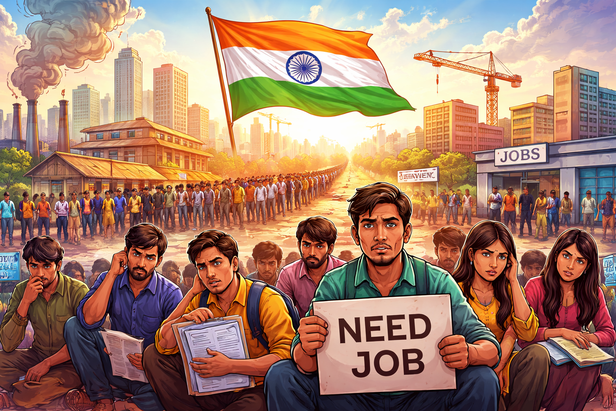
7 Reasons Why Unemployment in India Is Rising Faster Than Ever

India continues to grow at an estimated 6.5-7% GDP rate in FY 2025-26, positioning itself among the fastest-growing major economies. However, employment growth has not kept equal pace with economic expansion. According to the latest Periodic Labour Force Survey (PLFS) released by the Ministry of Statistics and Programme Implementation, the overall unemployment rate in 2025-26 stands around 4.5-5% (usual status, age 15+). While this appears moderate globally, in a country of over 1.4 billion people, even a 1% change represents millions of individuals.

The deeper concern lies not in overall unemployment alone, but in youth, educated, and urban unemployment, which remain significantly higher than the national average.

1. Youth Unemployment Is the Core Problem

Harnessing Indias youth boom as unemployment rates drop
New Delhi, Dec 10 (IANS) India has the worlds largest youth population, where 371 million aged between 15 and 29 years constitutes about 27 per cent of the total. This population, often referred to as a demographic dividend, presents a significant opportunity for economic growth by expanding the workforce and reducing dependency ratios.

India adds roughly 10–12 million young people to the labour force every year. However, job creation does not fully absorb this influx.

  • Youth unemployment (15–29 years): 12–15% nationally
  • Urban youth unemployment: Often higher than 18–20%
  • Some states report youth unemployment exceeding 20%

This gap between new job seekers and available jobs creates intense competition, delayed employment, and growing frustration among young graduates.

2. Educated Individuals Are More Unemployed Than the Uneducated

One of the most striking 2026 trends is that graduates face higher unemployment rates than those with minimal schooling.

  • Graduate unemployment (15–29 years): 15–25%
  • Unemployment among less-educated workers: Often below 5%

This happens because:

  • Less-educated workers quickly take informal or manual jobs.
  • Educated youth seek formal sector or government employment.
  • There is a mismatch between degrees and industry demand.

India is therefore facing an educated unemployment crisis, not merely a lack of jobs.

3. Labour Force Growth Outpaces Job Creation

Labour
Womens vital work remains unrecognized.

India’s working-age population (15–59 years) continues to expand rapidly. While Labour Force Participation Rate (LFPR) has slightly improved — especially among women — job growth still struggles to match population growth.

In simple terms:

  • Required annual job creation: 10–12 million jobs
  • Estimated formal job additions: Significantly lower

This structural imbalance keeps unemployment pressure high, even during periods of economic growth.

4. Informal Sector Dominates Employment

More than 80% of India’s workforce is engaged in informal employment. These include

  • Agricultural labour
  • Daily wage workers
  • Gig economy participants
  • Small self-employed traders

Many individuals are technically “employed,” but:

  • Work fewer hours than desired
  • Earn unstable incomes
  • Lack job security and benefits

This leads to underemployment, which is not fully reflected in official unemployment statistics.

5. Automation and Capital-Intensive Growth

India’s growth sectors - IT services, finance, digital platforms, and advanced manufacturing — are increasingly capital-intensive rather than labour-intensive.

Government initiatives such as:

  • Make in India
  • Production Linked Incentive Scheme

have boosted industrial output. However, automation limits large-scale hiring, especially for low- and mid-skill workers. Economic growth is rising, but employment elasticity remains weak.

6. Skill Mismatch and Employability Issues

AI Really Taking Our Jobs
The fear feels real but is it the full story?

India produces millions of graduates every year, yet employers consistently report skill gaps.

Common gaps include:

  • Lack of practical industry exposure
  • Weak technical proficiency
  • Poor communication skills
  • Limited digital adaptability

Government programs like:

  • Skill India Mission
  • Pradhan Mantri Kaushal Vikas Yojana

aim to bridge this gap, but employability concerns remain a major bottleneck in converting education into employment.

7. Government Job Preference and Limited Openings

Government jobs remain highly attractive due to stability and benefits. However:

  • Lakhs to crores of applicants compete for limited vacancies
  • Recruitment cycles are slow and highly competitive.

At the same time, rural employment support through:

  • Mahatma Gandhi National Rural Employment Guarantee Act

provides wage employment security but does not generate permanent career opportunities.

Who Is More Unemployed in 2026?

Data clearly indicates that

educated youth — particularly urban graduates — face higher unemployment than the uneducated population

.

The reasons are structural:

  • Aspirational job preferences
  • Degree inflation
  • Limited formal sector capacity
  • Skill-market mismatch

Meanwhile, uneducated workers enter informal sectors quickly, reducing their official unemployment rate.

Sign up to read this article
Read news from 100’s of titles, curated specifically for you.
Already a member? Sign in here
Related Stories
Top stories on inkl right now
One subscription that gives you access to news from hundreds of sites
Already a member? Sign in here
Our Picks
Fourteen days free
Download the app
One app. One membership.
100+ trusted global sources.