
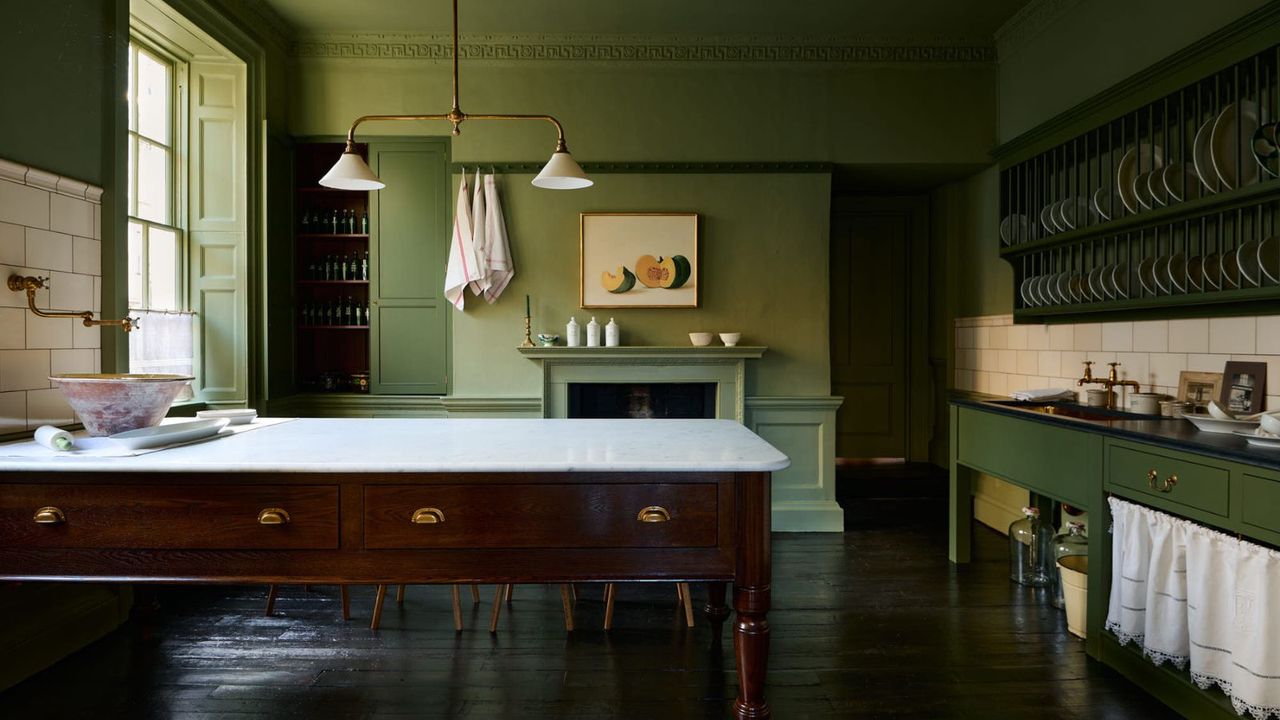
As kitchen trends continue to move away from rigid, wall-to-wall cabinetry, a more relaxed and characterful approach is taking centre stage. Designers are increasingly embracing freestanding kitchen furniture – from antique dressers and shelving units to farmhouse tables and standalone pantries – to create spaces that feel collected rather than constructed.
Unlike fitted cabinetry, freestanding pieces bring flexibility, personality, and a sense of history. They blur the boundaries between kitchen and living spaces, helping rooms feel warmer, more individual, and far less utilitarian. Whether you're renovating a period property or looking to soften a contemporary scheme, these kitchens offer a compelling case for taking a more furniture-led approach to kitchen design.

1. A Pantry Cupboard with Antique Presence
The resurgence of the pantry cupboard is perhaps the clearest sign that kitchens are moving away from fitted cabinetry. In deVOL's Heirloom Collection, the freestanding pantry becomes both a practical kitchen storage solution and a decorative focal point, introducing the charm of antique furniture without sacrificing functionality.
'The very essence of deVOL is traditional freestanding furniture,' says Helen Parker, Creative Director of deVOL. 'We have recently launched our Heirloom range of furniture, which offers the simplest form of historical cupboards and accessories.'
Unlike a built-in larder, a freestanding pantry sits comfortably within the room, helping the kitchen feel less engineered and more evolved. It also offers flexibility that fitted cabinetry cannot. As Helen notes, vintage-style pantry cupboards are one of the easiest ways to introduce furniture into a kitchen, whether sourced from an antique fair or chosen as a purpose-made piece such as The Butler’s Pantry found in the Heirloom Collection.
2. Open Shelving Extends an Island
When New York-based designer Sarah Lederman planned the layout of this Upper West Side apartment, she deliberately resisted the temptation to extend the island with more cabinetry. Instead, she introduced a freestanding shelving unit by British furniture maker Alfred Newall, creating a softer transition between kitchen and living space.
'What I find compelling about freestanding pieces in kitchens is that they help blur the boundary between the kitchen and the rest of the home,' says Sarah. The piece provides a home for cookbooks, ceramics, and everyday objects while bringing a more decorative, furniture-centric quality to the room. The result feels far more layered than a bank of cabinetry ever could.
'These moments of character, quirk, and informality are often what make a kitchen feel inviting and personal,' Sarah adds. 'The result feels less engineered and more collected over time.'
3. An Antique Sideboard Replaces Upper Cabinets
Rather than relying on fitted storage throughout, Nicky Mudie, founder and director of Violet & George, used an antique oak sideboard to introduce warmth, texture, and a sense of history into this kitchen scheme. ‘We wanted this kitchen to feel like a room first and a kitchen second,’ says Nicky. ‘The danger with fitted kitchens is that they can sometimes feel a bit too perfect and uniform.’
The substantial antique piece acts as a storage cabinet, serving station, and decorative focal point all at once. More importantly, it gives the room an individuality that is difficult to achieve with new cabinetry alone. ‘The antique oak sideboard brings personality and a sense of history that you simply can't buy off the shelf,’ Nicky explains. ‘We used lots of different timbers, finishes and antiques to make the space feel more individual.’
For anyone hesitant about abandoning fitted cabinetry entirely, incorporating a single antique furniture piece is an accessible place to start.
4. Plate Racks Double as Wall Décor
Freestanding furniture doesn't have to sit on the floor to make an impact. In this kitchen, a traditional plate rack turns an otherwise blank stretch of wall into a charming display of everyday ceramics while providing practical storage.
Once a staple of Georgian and Victorian kitchens, plate racks are enjoying a quiet revival as homeowners look for alternatives to enclosed wall cabinets. Their open design keeps kitchens feeling lighter and less bulky, while allowing favourite ceramics to become part of the room's decoration.
Helen notes that ‘smart old wall cupboards, open shelves and plate racks are popular extras that work well integrated into an existing fitted kitchen.’ The beauty of a plate rack lies in its simplicity. Whether used to display a collection of everyday white crockery or inherited china, it introduces a layered, collected warmth without requiring a full redesign.
5. A Dairy Table Adds Valuable Prep Space
If there's one freestanding piece capable of changing the feel of an entire kitchen, it's a substantial worktable. A large dairy table takes the place of a conventional kitchen island, providing generous prep space while keeping sightlines open and the room feeling less dominated by cabinetry.
Inspired by traditional farmhouse tables, these designs often feature generous drawers for extra storage, and the open base creates a lighter visual footprint than a solid island, while still offering the practical surface area needed for everyday cooking, baking, and entertaining. ‘Having everything matching in a room is not imaginative,’ Helen adds, ‘but add a lovely scrubbed pine kitchen table and some pretty painted chairs and all of a sudden the kitchen feels homely and a place you want to stay.’
Unlike a fixed island, a freestanding table encourages a more relaxed way of living. It can serve as a preparation space, dining spot, workspace, and gathering point throughout the day, helping the kitchen feel less like a workstation and more like the heart of the home.
6. This Custom Hutch Introduces Depth
In this 1920s Tudor Revival kitchen, Los Angeles-based designer Beatriz Rose introduced a custom hutch by Plain English to create a pause between more conventional cabinetry and the adjacent breakfast nook. Its stepped shelving, marble work surface, and slatted lower shelf make it feel more like an individual furniture piece than a seamless run of storage.
‘This approach works particularly well in historic homes because it respects the architectural character of the house,’ says Beatriz. ‘Rather than filling every wall with built-in cabinetry, freestanding pieces create moments of visual relief that allow the architecture to breathe and the eye to rest.’
The detail that really sets the piece apart is the variation in depth. ‘We intentionally designed the upper shelving with stepped depths to create a sense of scale, shadow, and whimsy,’ Beatriz adds. ‘These subtle variations help the piece feel crafted and collected rather than manufactured.’
7. An Open-Base Island Avoids Visual Bulk
For this kitchen, Beatriz designed a freestanding island, handcrafted by Brawley Made, that offers the practicality of a built-in without the same visual weight. Its open base is especially useful in an older home, where the island needed to sit in the center of the room without making the space feel cramped.
‘Freestanding kitchen islands offer many of the benefits of traditional built-ins while bringing a lighter, more relaxed character to the room,’ notes Beatriz. ‘This furniture-inspired island draws inspiration from traditional Vermont worktables and farmhouse furniture.’
The detailing reinforces that worktable feel. ‘Tapered legs, a deep overhang, an open storage shelf, and a scalloped apron give the piece the character of furniture rather than cabinetry,’ she continues. ‘Unlike a solid block of millwork, the open base creates visual breathing room while providing practical storage for baskets, cookware, and everyday items.’
Shop Freestanding Kitchen Furniture

With its reclaimed pine frame and open shelving, this charming plate rack demonstrates how wall-mounted storage can feel less imposing than traditional cabinetry.

Blending the practicality of a kitchen island with the charm of a traditional worktable, this design offers extra surface space without overwhelming the room.

Dating from the 1900s, this solid pine cupboard combines open and concealed storage in one hardworking piece, bringing the practicality and character of a traditional pantry to a kitchen.

With its tiered design and carved detailing, this vintage shelving unit turns everyday storage into a display feature.

Combining display shelving, enclosed cupboards and deep drawers, this buffet offers a stylish alternative to built-in storage.

This antique Welsh dairy table pairs a substantial work surface with centuries-old character, making it an elegant alternative to a built-in kitchen island.
Ultimately, the appeal of freestanding kitchen furniture lies in its flexibility. Beyond providing valuable storage and worktop space, these pieces can be moved, added to and lived with over time, allowing a kitchen to evolve naturally and feel more personal in the process.
Love beautiful design ideas, expert advice, and inspiring decor trends? Sign up for our newsletter and get the latest features delivered straight to your inbox.