
Kolkata: The City That Invented the Kati Roll
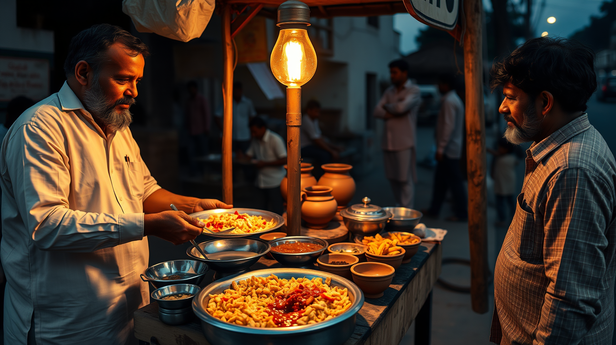
Kolkata's street food doesn't ask for your attention, it already has it. The kati roll, born at Nizam's restaurant on New Market Street sometime in the mid-20th century, is a paratha wrapped around egg and meat with raw onion and green chutney. Eat one standing up at a stall near Park Street at 11 p.m. and you will understand why Kolkata has never needed a fine dining scene to feel like a food city. The jhalmuri here, puffed rice tossed with mustard oil, green chilli, and chopped onion by a vendor who measures nothing, is the kind of snack that makes you distrust recipes. The phuchka, which is what Kolkata calls its version of pani puri, uses a sourer, more assertive tamarind water than you'll find anywhere else. The city's street food has a confidence that matches its literary self-image.

Mumbai: Where Snacks Are a Civic Religion
Mumbai runs on vada pav. The potato fritter inside a soft white bun, smeared with two chutneys, costs less than a bus ticket and feeds the same population that takes it. Dadar's stalls move hundreds of these before 9 a.m. Juhu Beach at dusk offers a different education: bhel puri assembled in seconds, sev puri with pomegranate seeds that nobody asked for but everyone wants, and pav bhaji that leaves a ring of butter on the paper plate. The city's chaat culture is less about individual dishes than about the sequence, you move from stall to stall without a plan, and somehow it adds up to a meal. Haji Ali's juice centre draws its own pilgrimage. Mumbai's street food is not just food; it is the city's most democratic institution.
Varanasi: Chaat as a Spiritual Experience
Varanasi's tamatar chaat is served in a clay bowl near the ghats and contains no tomato you would recognise from a salad. It is cooked down with spices into something thick, sour, and almost meaty, ladled over fried bread and topped with curd and chutney. The lanes near Vishwanath Gali are narrow enough that the smoke from the tawa drifts into the temple courtyards. Malaiyo, a winter-only sweet made from whipped milk foam, saffron, and rose water, disappears by 8 a.m. and cannot be found after December. Baati chokha, technically a meal from the surrounding region, appears in simplified street versions near the railway station. Varanasi's food is inseparable from the city's sense of time: everything is either seasonal, morning-only, or gone by the time you think to ask for it.
Amritsar: The Kulcha That Needs No Introduction
The Amritsari kulcha is a tandoor-baked stuffed bread that arrives at the table with a pool of white butter melting across it and a bowl of chhole that has been cooking since before the restaurant opened. At Kesar Da Dhaba, which has been operating since 1916, the dal makhani is black and slow and nothing like what gets served under that name in hotel buffets. But the street version, the kulcha from a roadside tandoor near the Golden Temple, eaten on a steel plate with raw onion and a green chilli, is the one that stays with you. Amritsar's lassi comes in clay glasses wide enough to require two hands, and the rabri on top is not a garnish. The city feeds people with a generosity that feels constitutional.
Chennai: Filter Coffee and Everything After
Chennai's street food begins before breakfast and the filter coffee is not the beginning, it is the baseline. Idli from a tiffin centre on Usman Road, eaten with sambar and three chutneys, is a different object from the hotel version: lighter, more sour, made from a batter that has fermented properly overnight. The kothu parotta stalls on the city's main roads chop and fold the bread on a flat griddle with egg and masala, the sound carrying half a block. Sundal, boiled chickpeas or black-eyed peas tossed with coconut, curry leaves, and mustard seeds, is sold outside temples and on Marina Beach, and it is the kind of snack that reminds you that restraint can be its own flavour. Chennai's street food is precise, not plain.
Indore: The City That Takes Snacks Seriously
Indore has a claim to being India's most serious street food city that has nothing to do with fame and everything to do with density. Sarafa Bazaar, a jewellery market by day, converts to a food street after 10 p.m. and runs until 2 a.m. The garadu, fried purple yam seasoned with rock salt and lemon, is something you will not find in this form anywhere else in the country. The bhutte ka kees, grated corn cooked with milk and spices, is a Malwa specialty that has no equivalent in other regional cuisines. Poha here is cooked with sev, onion, and a fennel-forward spice mix that makes the Pune or Mumbai version taste underdressed. Indore's relationship with its own food culture is almost competitive: the city knows what it has and is not modest about it.
Hyderabad: Where Biryani Meets the Street
The Hyderabadi biryani gets all the attention, but the street food that surrounds it is the real argument for the city. Irani chai, a slow-brewed, slightly caramelised tea served in a glass at a Irani café, is the correct way to begin any morning in Hyderabad, ideally with an Osmania biscuit that crumbles the right way. The haleem sold during Ramzan from stalls near Charminar is a slow-cooked wheat and meat porridge that has been on the UNESCO intangible cultural heritage list since 2010, the only street food in India with that designation. Lukhmi, a square fried pastry with a minced meat filling, is the Hyderabadi answer to the samosa and is better in every way that matters. The city's street food carries the weight of its composite culture without performing it.
The seven cities on this list share nothing obvious, not geography, not language, not the kind of food they produce. What they share is that their street food is not a supplement to the city's identity but the most direct expression of it. You can read about Varanasi's ghats or Kolkata's literary culture, but the tamatar chaat and the phuchka are the versions of those cities that get under your skin and stay.