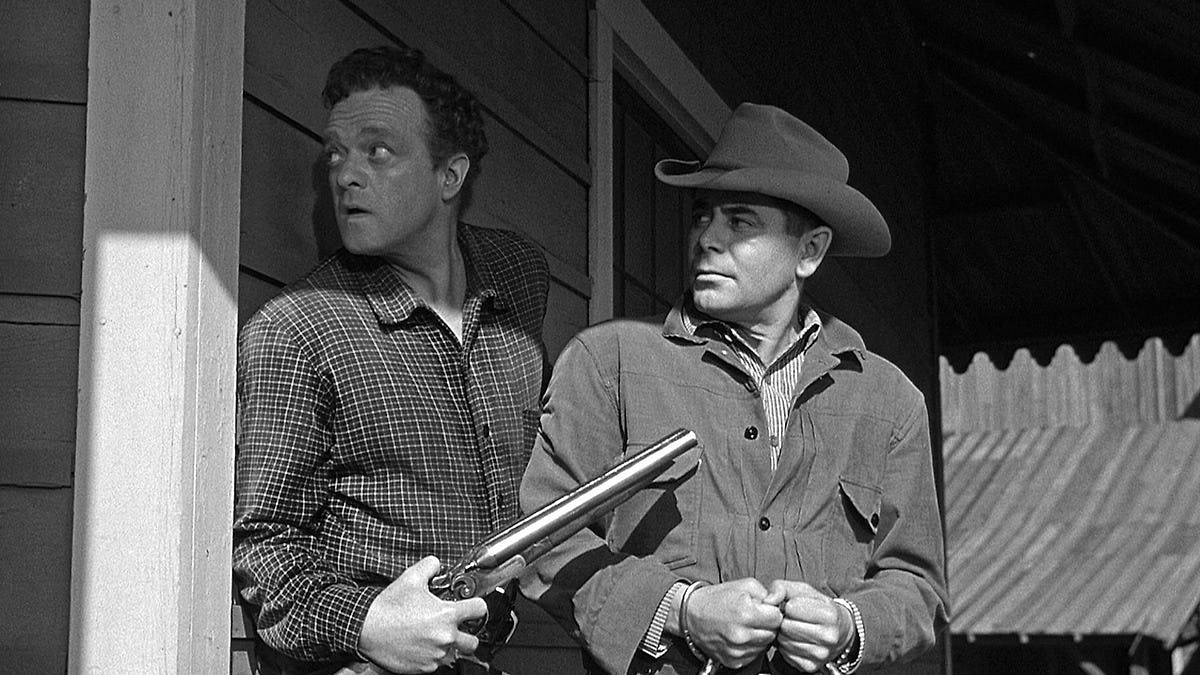
Dan Evans (Van Heflin) was at the wrong place at the wrong time. In 1880s Arizona, he and his two sons witness Ben Wade (Glenn Ford) and his gang rob a stagecoach and murder its occupants. They have no choice but to let it happen; they’re three against 12.
“You can’t just stand by and watch,” his wife Alice (Leora Dana) urges Dan when he and the kids get home without the horses that Wade stole. But she’s not just talking about the robbers; Evans has grown increasingly pessimistic about the world around him. His ranch is in trouble, and the possibility of improvement is slim.

Wade’s gang tricks the townsfolk of Bisbee into thinking they’re witnesses to the crime rather than perpetrators, and they make their escape. But Wade is too busy wooing the barmaid to leave, and the sheriff eventually catches on and arrests him. Justice is served, yet there’s something about Wade’s unshakable confidence and ego that suggests maybe being arrested was all part of his plan.
Evans eventually gets his chance to take action against the men he let rob him. He’s offered $200 (a staggering sum at the time) to help transport Wade from Bisbee to Contention City, where they’ll get on the 3:10 to Yuma that takes Wade to jail. That is, if they can get him there before Wade’s gang comes back to free their leader.
Delmer Daves’ 3:10 to Yuma turns a straightforward mission into a chilling cat-and-mouse game, and with a sparkling new 4K release from Criterion, it’s the perfect time to revisit — or discover anew — this stone-cold classic.
How was 3:10 to Yuma Received Upon Release?
3:10 to Yuma was well received upon its August 7, 1957 release. Bosley Crowther of the New York Times was impressed, highlighting its “unmerciful tension” and calling the movie a “first-rate action picture.” Variety was positive too, although it argued that the “climax fizzles.” Both reviews highlighted the film’s similarities to 1952’s High Noon, and both agreed that 3:10 to Yuma was inferior. Thankfully, more than enough time has passed to see that both films have plenty to offer.
As for its box office performance, Daves’ film earned $1.8 million, making it the 51st highest-grossing film of 1957. Not great, but not bad, either — and it’s better remembered than many of the films that finished ahead of it.

Why Is 3:10 to Yuma Important to See Now?
3:10 to Yuma is worth your time because it’s one hell of a Western. It replaces much of the vast outdoors you’d expect with tense bars and hotel rooms, and beneath the excellent brawls and growing tension is raw humanity. Prolific TV writer Halsted Welles only wrote a handful of screenplays, but his adaptation of Elmore Leonard’s short story is his sharpest, a thrilling western that’s a not-so-covert exploration of masculinity in crisis. The stereotypical Western is full of ultra-masculine men, but Dan possesses no such machismo.
This is a Western-cum-psychological thriller, a study of a troubled man. Evans doesn’t want to be the hero; he’s only doing this for the money, for a chance to help his ailing ranch and struggling family. He sees himself as a failure. His confidence is in tatters, and part of his anger towards Wade stems from how charming Wade is (especially with his own wife) and how charmless Evans perceives himself to be.
Delmer Daves doesn’t get the same respect as his contemporaries, being considered a steady and reliable director rather than a great one. But his work in 3:10 to Yuma is exceptional as he balances tense conversations with rapid, pulse-pounding shootouts. It’s a masterclass in control, and Daves brings every element of the film together in a way that feels effortless.

What New Features Does the 3:10 to Yuma 4K Blu-ray Have?
Oddly, this is one of Criterion’s lighter releases, boasting only a pair of interviews with Elmore Leonard, and another with Peter Ford, Glenn Ford’s son and biographer. They’re both worthy watches with valuable information, although the package feels a little thin. Still, the 4K restoration looks and sounds great, and 3:10 to Yuma is a worthy addition to the Criterion Collection and your shelves. Here’s how Criterion describes its features:
- New 4K digital restoration, with uncompressed monaural soundtrack
- Alternate 5.1 surround soundtrack, presented in DTS-HD Master Audio
- One 4K UHD disc of the film presented in Dolby Vision HDR and one Blu-ray with the film and special features
- Interviews with author Elmore Leonard and actor Glenn Ford’s son and biographer, Peter Ford
- English subtitles for the deaf and hard of hearing