
Get all your news in one place.
100's of premium titles.
One app.
Start reading
Times Life
Times Life
Aishwarya Kapoor

6 Indian National Parks Beyond Ranthambore That Every Tiger and Wildlife Safari Fan Must Visit

Jim Corbett National Park, Uttarakhand

Jim Corbett has been hosting tigers since 1936, which makes it the oldest national park in India and the site where Project Tiger was formally launched in 1973. The Dhikala zone, set inside a broad riverine grassland called the chaur, gives you the kind of unobstructed sightlines that most Indian forests never offer. Tigers here hunt in the open. The park sits across roughly 520 square kilometres of sal forest, riverbed, and grassland in the Himalayan foothills, and the Ramganga reservoir running through it draws wildlife in the dry months between February and June. Elephant-back safaris are no longer permitted, but jeep access into Dhikala is among the most rewarding in the country. Corbett also carries leopards, elephants, and gharial, so a blank morning on tigers is rarely a blank morning.

Bandhavgarh National Park, Madhya Pradesh

Bandhavgarh has the highest recorded tiger density of any reserve in India. The Wildlife Institute of India has documented this repeatedly, and the numbers hold: the core zone of roughly 105 square kilometres sustains a population that makes sightings here less a matter of luck than of patience. The terrain is a mix of sal and mixed forest broken by meadows called bohera, and the ancient Bandhavgarh fort sitting above the park gives the landscape an unusually dramatic backdrop. The Tala zone is the most productive for sightings. Bandhavgarh is also where some of India's most photographed individual tigers have been named and tracked over decades, which means guides carry generational knowledge of specific animals' territories.

Kanha National Park, Madhya Pradesh

Rudyard Kipling drew on the forests of this region for The Jungle Book, and the central Indian sal and bamboo landscape still feels like it belongs to something older than tourism. Kanha's more specific claim is conservation history: the barasingha, or swamp deer, was pulled back from near-extinction here through a dedicated breeding programme that began in the 1970s. The park now holds the only surviving population of the hard-ground barasingha subspecies. For tigers, the Kanha and Kisli zones are the most reliable. Sightings tend to come in the late morning when tigers move to waterholes. The park covers around 940 square kilometres, and the buffer zone supports significant wildlife movement that core-zone visitors often miss.

Sundarbans National Park, West Bengal

The Sundarbans is the only place in the world where Bengal tigers live in a mangrove delta. The forest sits across roughly 10,000 square kilometres shared between India and Bangladesh, with the Indian side designated a UNESCO World Heritage Site. Tigers here swim between islands, hunt fish and crab alongside deer, and have developed behaviours documented nowhere else in the species. The salinity of the water, the tidal shifts, and the density of the mangrove make ground-level safari impossible, all movement is by boat. Sightings are genuinely rare, and that rarity is the point. The Sundarbans tiger is a different animal in a different world, and the boat journey through the delta is worth the trip regardless of whether a tiger appears on the bank.

Tadoba-Andhari Tiger Reserve, Maharashtra

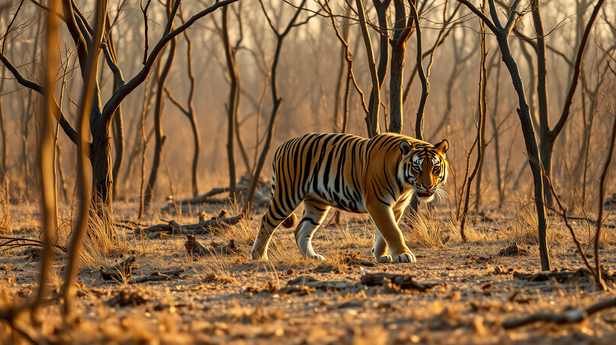
Tadoba is Maharashtra's largest tiger reserve and, among wildlife photographers, one of the most consistently productive parks in central India. The dry teak forests open up significantly between March and May, when deciduous trees shed their leaves and tigers become visible at distances that denser forests never allow. The Tadoba lake at the centre of the park is a reliable draw in summer. Tiger sighting rates here have been reported among the highest in India during peak season, and the local guide community has built a detailed knowledge of individual animal movements over years. The park covers around 625 square kilometres. Chandrapur, the nearest city, is accessible by rail from Nagpur, which makes logistics straightforward compared to more remote reserves.

Pench National Park, Madhya Pradesh and Maharashtra

Pench straddles the border of Madhya Pradesh and Maharashtra and shares the same Kipling country as Kanha, though the two parks have distinct characters. Pench is drier, more open, and generally considered the better introduction for first-time safari visitors, the terrain makes animal movement easier to follow. The Pench river running through the park creates a corridor that draws tigers, wild dogs, and large herds of chital. Tiger sightings here have increased steadily since the early 2000s as the population recovered under Project Tiger protections. The park also has one of the stronger records for wild dog, or dhole, sightings in central India, which is a draw in itself for serious wildlife watchers.

What these six parks share is not just tigers, it's the specific pressure that forests under genuine protection create on the animals living in them. A Sundarbans tiger that swims tidal channels and a Bandhavgarh tiger moving through a meadow at known density are both Bengal tigers, but the reserves shaped them differently. The case for visiting more than one is not about collecting sightings. It's about understanding that conservation in India is not a single story told in the same forest.

Sign up to read this article
Read news from 100's of titles, curated specifically for you.
Already a member? Sign in here
Related Stories
Top stories on inkl right now
One subscription that gives you access to news from hundreds of sites
Already a member? Sign in here
Our Picks
Fourteen days free
Download the app
One app. One membership.
100+ trusted global sources.