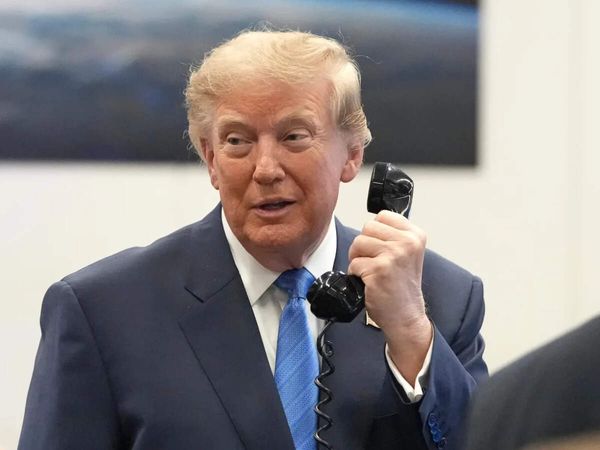
For nearly a decade, MAGA and Donald Trump were synonymous.
- Today, the movement's most consequential fights are unfolding beyond the control of its term-limited president — empowering rival factions to shape MAGA in their own image.
Why it matters: MAGA entered the year with a sheen of invincibility, riding the high of Trump's victory and united in his promise of a new "Golden Age." It's ending 2025 locked in an existential war over the future of conservatism.
How we got here: Five moments over the past year help explain how MAGA arrived at this point.
1. America's "mediocrity" culture: The first clear sign of trouble came last Christmas, when a debate over high-skilled H-1B visas pitted the "America First" base against Elon Musk and Trump's new allies in Silicon Valley.
- DOGE adviser Vivek Ramaswamy was castigated online after arguing American culture had "venerated mediocrity over excellence," and that the U.S. needed to recruit top global talent to stay competitive.
- The tech vs. MAGA clash — which featured a wave of anti-Indian racism — marked the opening salvo in a broader conflict over whether "America First" should be defined more by economic or cultural nationalism.
2. U.S. bombs Iran: MAGA's deepest foreign-policy divide burst into the open in June, when the U.S. joined Israel in bombing Iranian nuclear facilities.
- The strikes split MAGA between pro-Israel factions that cheered Trump's show of strength, and isolationists — led by Tucker Carlson — who warned the U.S. was being dragged into another Middle East war.
- Though the conflict only lasted 12 days, Trump's intervention — paired with the brutality of the war in Gaza — accelerated the rise of explicitly anti-Israel and antisemitic rhetoric inside parts of MAGA.
3. The Epstein files: The Justice Department triggered a months-long backlash by releasing a memo in July that concluded notorious sex trafficker Jeffrey Epstein died by suicide in prison and had no "client list."
- Trump's repeated attempts to move on from Epstein shattered expectations — stoked for years by MAGA influencers — that he would expose a hidden network of elite corruption and pedophilia.
- Congress eventually mandated the release of the Epstein files — defying an intense Trump pressure campaign that culminated in the shock resignation of Rep. Marjorie Taylor Greene (R-Ga.).
4. Charlie Kirk's assassination: The killing of Turning Point USA's founder in September shook the nation and removed MAGA's most effective coalition manager at a critical moment.
- For years, Kirk had served as a rare bridge between factions — giving institutional conservatives, hardline populists and fringe figures a shared stage while keeping disputes largely contained.
- Conspiracy theories from Candace Owens — including claims that Israel played a role in Kirk's assassination and that Turning Point staff participated in a cover-up — have ignited personal and poisonous new feuds.
5. Tucker Carlson interviews Nick Fuentes: The year's most explosive rupture came in November, when Carlson gave a friendly, uncritical platform to Fuentes — a white nationalist and Holocaust denier.
- The 27-year-old Fuentes was already skyrocketing in popularity, particularly among young men, but Carlson's interview vaulted him to the center of MAGA's debate over Israel, antisemitism and extremism.
- The fallout continues a month later: More than a dozen senior officials departed the Heritage Foundation for former Vice President Mike Pence's think tank after Heritage President Kevin Roberts defended Carlson.
Zoom in: The consequences of this yearlong unraveling came into sharp focus at Turning Point's annual "AmericaFest" this past weekend, where the most powerful players in MAGA media traded vicious attacks before a crowd of 30,000.
- Vice President Vance used his keynote address to urge restraint and unity — arguing that "we have far more important work to do than canceling each other."
- "President Trump did not build the greatest coalition in politics by running his supporters through endless, self-defeating purity tests," Vance said, stopping short of addressing the feuds or warring parties directly.
Between the lines: Vance dominated the AmFest straw poll for the 2028 GOP nomination, winning 84% of the vote and the full backing of the Turning Point machine. Still, his power as a unifying force remains untested.
- Pro-Israel conservatives see Vance's refusal to draw lines as tacitly enabling the Carlson wing. Sen. Ted Cruz (R-Texas), a critic of Vance's foreign policy views, is considering a rival 2028 campaign.
- Fuentes sympathizers, meanwhile, see Vance as illegitimate because of his interracial marriage and ties to Big Tech. The far-right faction is loud online, but lacks the institutional backing or electoral machinery to shape MAGA's post-Trump future.
The bottom line: Instead of bridging MAGA's divides, AmericaFest underscored how fractured the movement has become — and how little appetite there is, on either flank, for compromise.