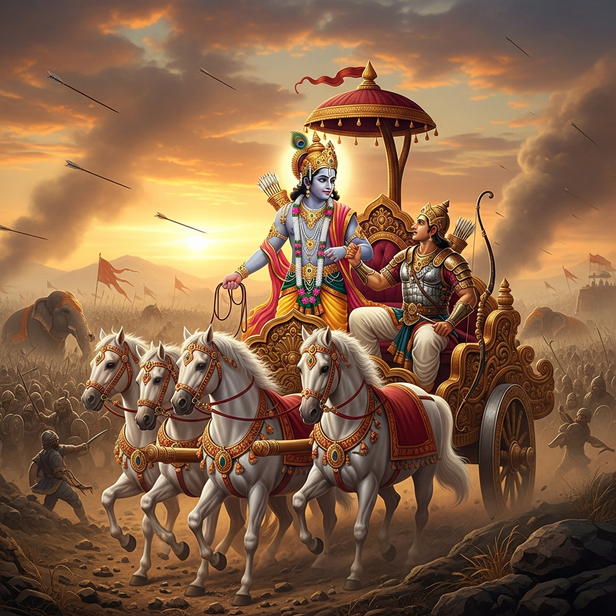
As the divine speaker of the Bhagavad Gita, Lord Krishna is frequently remembered as the one who imparted timeless knowledge on duty, karma, and truth. But what about the times He didn't say anything? When injustice occurred, when sorrow rose, when doubts persisted and yet Krishna said nothing. Was that apathy in silence? Or was there a deeper lesson concealed in the words? Silence is not always a sign of weakness. It is the highest point of knowledge at times.

Draupadi’s Question in the Court
She asked the pointed inquiry, "Had Yudhishthira lost himself before staking her?" after being humiliated in the Kuru court. The elders said nothing. Krishna too did not come out right away to debate morality or the law. Rather, He let the injustice expose the real selves of those in attendance. Her reputation was ultimately preserved by his miraculous intervention, but his previous silence revealed the assembly's moral breakdown. Silence sometimes lets the truth be exposed to the world.
Gandhari’s Curse
Broken by the loss of her boys, Gandhari cursed Krishna that his tribe would die after the dispute. Krishna didn't dispute with fate or defend himself. Silently, he acknowledged the unavoidable passage of time and karma. His quiet was an acceptance of cosmic rule rather than a sign of capitulation. He demonstrated that even divine beings respect fate by not resisting. Here, remaining silent became an expression of humility in the face of the universe's greater plan.
The Fall of the Yadavas
The Yadava clan destroyed itself in drunken fighting years after the war. Even though Krishna knew that the end was near, he did nothing to halt the course of events. Knowing that Gandhari's curse had grown, he watched fate play out. He purposefully kept quiet since interfering would have postponed rather than avoided the inevitable. By taking a step back, He showed that even heavenly power cannot protect one from the effects of destruction brought on by ego and excess. Karma was able to finish its cycle in silence.
Arjuna’s Doubt After the War
Following the conflict, Arjuna experienced confusion and sadness once more. Krishna did not fully recite the Gita this time. Rather, he gave Arjuna a quick reminder and let him think on his own. The ensuing quiet represented development. It is impossible to provide spiritual advice indefinitely; eventually, the disciple must absorb the lessons. Krishna's self control demonstrated that genuine wisdom develops by reflection rather than continual teaching.
The Hunter’s Arrow
The Lord did not scream or strike back when the hunter Jara accidentally shot Krishna. He calmly accepted the situation and reassured the terrified hunter. The Dwapara Yuga came to an end with this last quiet, and the Kali Yuga began. Krishna showed the utmost detachment by refusing to resist. Transcendent silence served as a reminder that life and death are only stops along the eternal path.
Although Krishna's life is renowned for its heavenly discourse, some of His most important lessons were conveyed in silence. He preferred silence to argue in situations involving injustice, grief, karmic cycles, and even near death.
In His case, silence was not absence. It was consciousness.
It was approval.
It was amazing knowledge.
Maybe that's why His silent times still have the greatest impact on us.
Explore the latest trends and tips in Health & Fitness, Spiritual, Travel, Life Hacks, Trending, Fashion & Beauty, and Relationships at Times Life!