
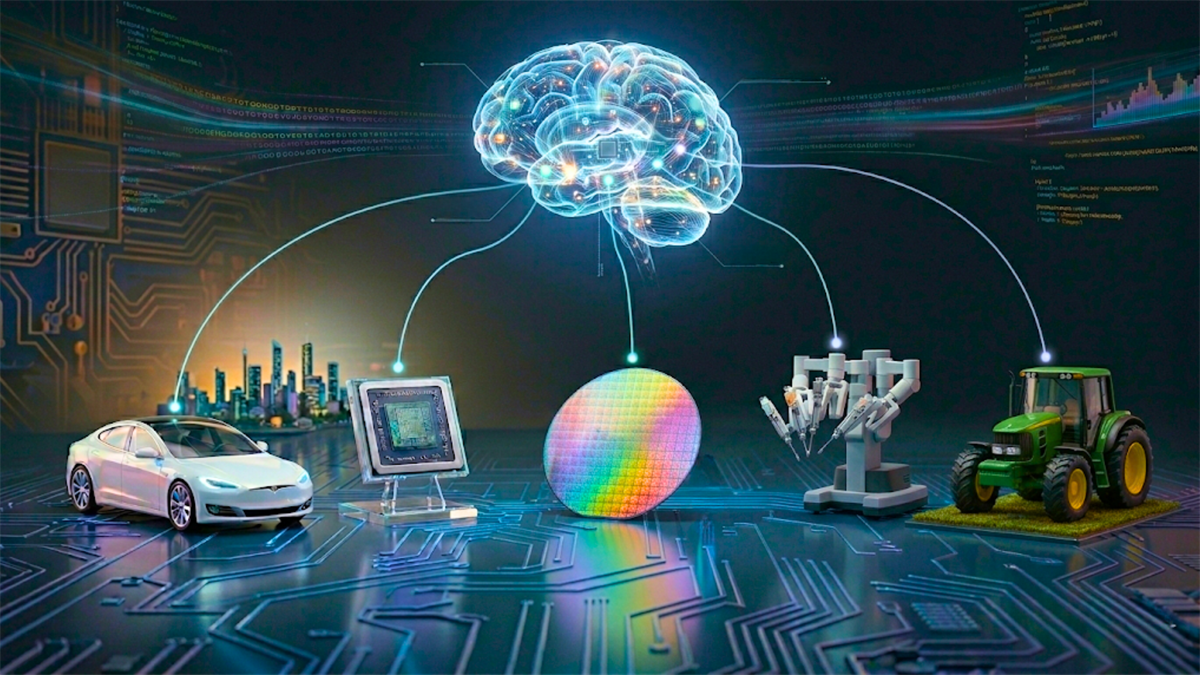
Robotics has steadily gained traction over the past decade, but the last five years have marked a clear inflection point. Adoption across industrial, defense, healthcare, logistics, and even consumer applications has accelerated meaningfully. And the primary catalyst behind this shift is artificial intelligence.
AI is not just enhancing robotics; it is fundamentally redefining it.

Machine learning, computer vision, and generative AI are transforming robots from rigid, pre-programmed machines into adaptive systems capable of learning, reasoning, and operating autonomously. Breakthroughs that once took years of incremental improvement are now happening in compressed timeframes.
Generative AI allows robots to train in simulated environments at high speed rather than relying solely on physical trial and error. Instead of programming every movement manually, developers can expose robots to millions of virtual scenarios in a fraction of the time. And natural language interfaces now allow workers to instruct machines conversationally, dramatically reducing deployment friction.
In short, AI is acting as an accelerant across the robotics landscape, pushing both capability and commercialization forward at a faster pace. These five stocks are advancing more rapidly as a direct result of AI integration.
Tesla: From Autonomous Vehicles to Humanoid Robots
Tesla (NASDAQ: TSLA) may be best known as an electric vehicle manufacturer, but at its core, it is arguably one of the world’s most visible consumer-facing robotics companies.
Its autonomous vehicles are effectively mobile robots operating in uncontrolled real-world environments. Tesla’s Full Self-Driving system relies on neural networks trained on billions of miles of driving data. That same AI backbone powers Optimus, its humanoid robot initiative.
Optimus is designed to perform repetitive, dangerous, or labor-intensive tasks across factories, warehouses, and eventually households. It uses computer vision, reinforcement learning, and Tesla’s custom AI chips to interpret surroundings and navigate complex environments. The real breakthrough is not just in mechanical engineering, but also in the software stack that allows Optimus to learn and improve over time.
CEO Elon Musk has described Optimus as potentially more transformative than Tesla’s vehicle business in the long run. The company is targeting eventual mass production in the millions of units annually, with a projected consumer price point between $20,000 and $30,000.
Tesla recently announced plans to wind down production of its high-end Model S and Model X lines to free up factory capacity for a dedicated Optimus assembly line. That strategic pivot signals confidence that AI-powered robotics could become a central pillar of the company’s future growth.
NVIDIA: The Computing Backbone of Robotics
NVIDIA (NASDAQ: NVDA) is the most obvious AI beneficiary, but its impact on robotics runs deeper than headline GPU demand suggests.
Advanced robotics requires massive computing resources for perception, localization, mapping, and decision-making. Without high-performance processors capable of running complex neural networks in real time, modern robotics would stall.
NVIDIA’s Jetson platform is purpose-built for edge AI and is widely deployed in robots, drones, and autonomous systems. These modules process visual, spatial, and sensor data locally, enabling low-latency decision-making. That is critical in environments where split-second reactions matter.
Beyond hardware, NVIDIA’s Isaac robotics development platform allows engineers to simulate robotic systems in photorealistic virtual environments. Developers can train robots in simulation before deploying them in the physical world, dramatically accelerating innovation cycles while lowering risk and cost.
As robotics systems grow more intelligent and autonomous, NVIDIA remains a foundational infrastructure provider. It is not simply participating in the growth of robotics; it is enabling it.
Deere & Company: Smart Farming at Scale
Deere & Company (NYSE: DE) might surprise some investors on a robotics list, but the agricultural leader has quietly transformed into a technology-driven automation company.
Labor shortages, rising input costs, and the need for greater efficiency have pushed agriculture toward autonomy. Deere’s fully autonomous 8R tractor can operate without a driver, using AI-powered computer vision and advanced GPS guidance to navigate fields with precision.
Following its acquisition of Blue River Technology, Deere launched its See & Spray system, which uses machine learning to distinguish crops from weeds in real time. Instead of blanket herbicide spraying, the system applies chemicals only where needed, reducing usage and improving environmental efficiency.
AI also powers Deere’s broader ecosystem through the John Deere Operations Center, which aggregates farm data and delivers predictive analytics to optimize planting, harvesting, and maintenance decisions.
The company has effectively shifted from being a heavy equipment manufacturer to a data-driven automation platform for agriculture. As AI models improve, the productivity gains across farming operations could accelerate, reinforcing Deere’s long-term positioning.
Teradyne: Testing the AI Revolution
Teradyne (NASDAQ: TER) operates at a critical junction of semiconductor complexity and industrial automation. As AI chips become more powerful, dense, and performance-sensitive, testing requirements intensify.
Teradyne’s automated test equipment validates advanced semiconductors for data centers, autonomous systems, and robotics applications.
AI-driven demand has become a primary driver of growth. In Q4 2025, the company reported EPS of $1.80, well above consensus, while revenue rose nearly 44% year over year to $1.08 billion. AI-related demand, including data center expansion, accounted for a majority of quarterly revenue.
Beyond semiconductor testing, Teradyne owns collaborative robotics businesses that manufacture industrial robotic arms and mobile robots. These systems increasingly incorporate AI to improve flexibility in factories and logistics centers.
With AI adoption scaling across industries, both chip testing and AI-enabled robotics solutions position Teradyne as a beneficiary of the broader automation wave, a picks-and-shovels play.
Intuitive Surgical: AI in the Operating Room
Intuitive Surgical (NASDAQ: ISRG) is a pioneer in robotic-assisted surgery and remains the global leader in minimally invasive procedures.
Its da Vinci Surgical System has already transformed surgical precision by giving physicians enhanced visualization, dexterity, and control. Now, AI is deepening that advantage.
Rather than operating solely as a hardware manufacturer, Intuitive is building an intelligent surgical ecosystem. AI algorithms analyze intraoperative data in real time, enhance imaging clarity, and provide insights that help surgeons make more precise decisions.
The company’s Ion endoluminal system, for example, uses AI-powered computer vision to navigate to difficult-to-reach lung nodules, compensating for discrepancies between pre-operative imaging and live anatomy. This improves diagnostic accuracy and patient outcomes.
As the installed base of robotic systems grows globally, the accumulation of surgical data further strengthens Intuitive’s AI models. That flywheel effect could expand its competitive moat over time.
The Acceleration Effect
Robotics is not new. What is new is the velocity of innovation.
AI is compressing development timelines, improving adaptability, and broadening commercial use cases across nearly every sector. Whether in autonomous vehicles, agriculture, semiconductor testing, industrial automation, or operating rooms, AI is acting as a multiplier.
For investors, the theme is not simply robotics adoption, but robotics acceleration driven by AI integration.
And these five companies sit at the forefront of that shift, advancing faster because intelligence is now embedded directly into the machines themselves.
Where Should You Invest $1,000 Right Now?
Before you make your next trade, you'll want to hear this.
MarketBeat keeps track of Wall Street's top-rated and best performing research analysts and the stocks they recommend to their clients on a daily basis.
Our team has identified the five stocks that top analysts are quietly whispering to their clients to buy now before the broader market catches on... and none of the big name stocks were on the list.
They believe these five stocks are the five best companies for investors to buy now...
The article "5 Stocks Racing Ahead as AI Supercharges Robotics" first appeared on MarketBeat.