Get all your news in one place.
100's of premium titles.
One app.
Start reading
Tom’s Guide
Tom’s Guide
Technology
Nicola Appleton

5 signs you need a new mattress: Red flags you shouldn’t ignore

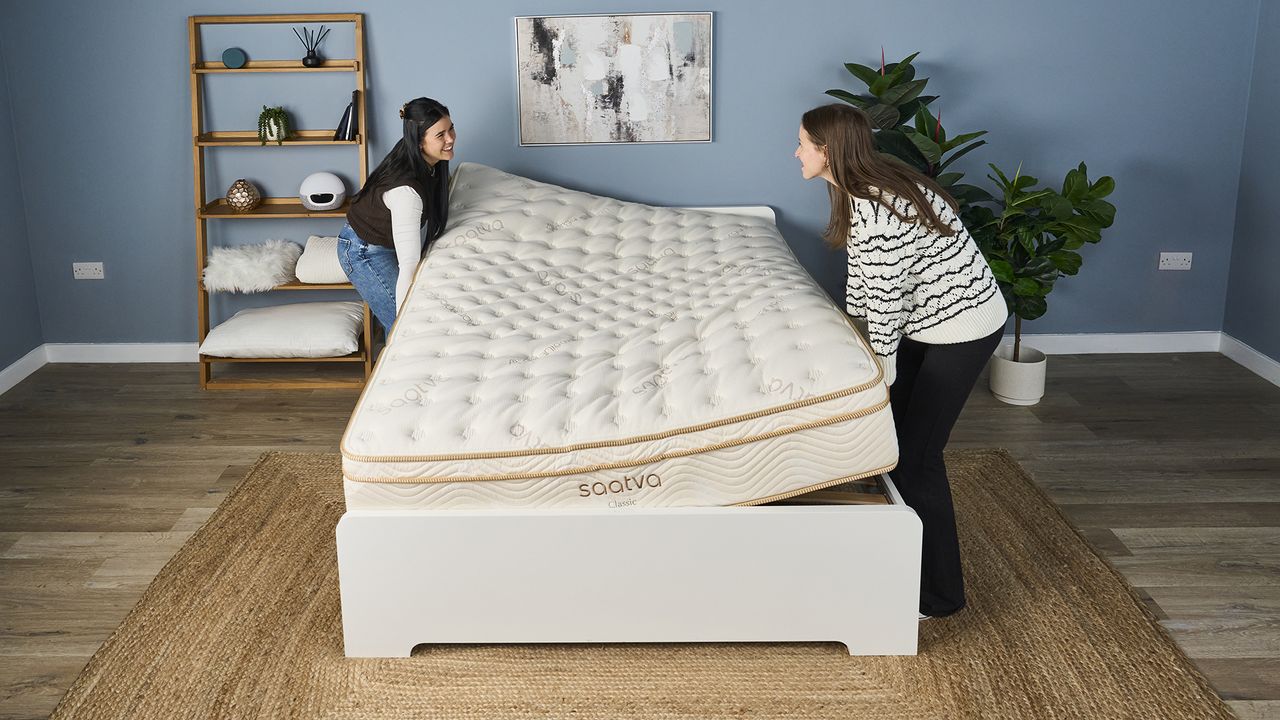
Two women stand at either end of a Saatva Classic Mattress helping to install it on a white bed frame in our sleep studio. With white glove delivery, you can avoid this task.

Clocking up enough time in bed but struggling to get comfortable, only to wake in the morning with neck and back pain, is frustrating. And it’s a sure sign that your mattress is to blame.

Mattresses last between six and eight years on average, with that lifespan dropping off further for cheaper models. On the flip side, quality mattresses crafted from durable materials – such as luxury organic latex mattresses – can last for more than 15 years. Plus, how well you look after your mattress can make a big difference to how long it lasts.

But the bottom line is that even the best mattresses on the market have an expiry date (yes, even those with ‘lifetime warranties'). Your mattress won’t suddenly stop being comfortable overnight. Instead, it’s more of a gradual tapering-off of comfort and support.

The good news is that the Memorial Day mattress sales are just kicking off, which means that if your old mattress has had its day, now's a great time to buy a new one at a low price.

How long does a mattress last?

  • Innerspring mattresses: 5-7 years (coils lose tension which weakens support and pressure relief, they burst through the cover and make a lot of noise.)
  • Memory foam mattresses: 7-10 years (foams no longer snap back into shape, resulting in visible signs of sagging and inadequate comfort and support.)
  • Latex mattresses: 15-25 years (the structure of the latex breaks down, giving it a cracked or brittle appearance. This compromises support and results in permanent body indentations.)
  • Hybrid mattresses: 7-10 years (foam comfort layers break down and the coils lose their tension, leading to permanent dips where you usually sleep and a loss of support.)

5 red flags that mean your mattress needs replacing

Here are the unmistakable signs your mattress needs replacing, depending on your mattress type:

Red flag 1: The hammock effect

(Image credit: Getty Images)

You can visibly see sagging or a permanent indentation deeper than one inch. Over time, the structure of your mattress will break down and no longer snap back into shape when you get out of it. This results in permanent body indentations.

We call this the hammock effect, and it’s one of the clearest indications that your mattress no longer offers adequate support. When you can see a permanent body indentation down the center of the mattress, it means that — depending on the mattress type you have — the coils have lost their tension, or any foams or latex layers have started to degrade.

When this happens, your mattress is no longer offering adequate support. And this loss of support results in compromised pressure relief and a lack of healthy spinal alignment, which is a one-way road to waking up with aches and pains (more on that below). If not addressed pronto, it could even lead to some long-term issues, such as ongoing back pain.

Mattress tester tip: To check if your mattress has started to hammock, lay a yardstick or a long taut piece of string across the mattress. If you can fit your fingers under the string in the center, your mattress has failed the sagging and indentation test.

What to replace it with:

If your mattress has started to dip or sag and you’re looking to replace it with a more durable model, there are two beds that stand out for their long-term support after rigorous testing: The Saatva Classic and Plank Firm. The Plank, a quality memory foam mattress, boasts a high density support core that, combined with its flippable design for even wear, will help it outlive cheaper memory foam models.

However, with its dual-coil steel support system (designed to prevent sagging), quality construction and high density foam edges for ongoing support right around the perimeter, the Saatva Classic is the more durable out of the two, and is the best hybrid mattress we’ve ever tested.

Red flag 2: Morning neck and back pain

(Image credit: Getty Images)

Are you waking up with neck or back pain and wondering what could have caused it? If your pain eases off within 30-60 minutes after getting out of bed, it’s a strong indication that your mattress is to blame.

Once a mattress begins to lose its support, waking with neck and/or back pain becomes increasingly common. That’s because an insufficiently supportive mattress is unable to hold your spine in healthy alignment with the rest of your body. This leads to your back dipping slightly, which causes buildup of pressure in the lumbar region. After holding that position for upwards of eight hours, your muscles will became stiff and sore.

However, when your back is thrown out of alignment, so is your neck — which means your muscles stay in a strained position all night long. Unsurprisingly, this ongoing tension leads to neck pain and even headaches.

While an unsupportive pillow could also be to blame, if your mattress is older than its expected lifespan and showing any other signs it needs replacing, then it is likely the mattress at fault.

What to replace it with

The best way to ensure that you get the support you need is to invest in a mattress that's tailored to your sleep style. If you sleep mainly on your side, one of the best mattresses for side sleepers will have a softer feel, providing cushioning for your shoulders, hips and knees while keeping your spine straight.

The best mattresses for back pain will deliver firmer support that suits back sleepers better, while if you're one of the minority of people who sleep on their stomach, the best mattress for stomach sleepers will get you maximum support and prevent your spine from arching in the night.

But what if you share a bed with someone who sleeps in a different way to you? Fortunately there are some great options on the market, and one of our favorites is below...

Red flag 3: The heat trap

(Image credit: Getty Images)

Whether it’s due to hot weather, illness or hormonal fluctuations, trying to sleep when you’re overheating at night feels miserable. While there are ways to try to stay cooler at night (opting for breathable bedding, sleeping with the window open etc.), these are all futile if your mattress is to blame for waking up hot.

Memory foam has gained a bad reputation for being prone to sleeping hot, thanks to its dense structure. Worse, as the foams break down with age, they become denser, which turns up the dial on their heat trapping tendencies.

What to replace it with

If you’re looking to replace your mattress, don’t discount a memory foam mattress entirely. During our in-house testing, we found that some newer all-foam mattresses performed pretty well in our temperature regulation tests. For example, the Siena Signature scored a decent 3.3 out of 5 for cooling, while the Nectar Premier scored 3.5 out of 5.

If your sleep is often disturbed by waking up hot, it’s probably worth investing in one of the best cooling mattresses of the year. Cooling mattresses use a variety of different methods to keep temperatures down, from breathable designs (like hybrid mattresses) and naturally moisture-wicking materials (such as latex, wool or cotton), through to employing actively cooling technology, such as PCM, copper and GlacioTex.

Some specialist cooling mattresses, like the Bear Elite Hybrid, effectively combine breathable construction, cooling copper infused foams and a Celliant cover, which actively draws heat from the body and converts it into energy across the surface of the mattress. For context, the Bear scored an impressive 5 out of 5 for temperature regulation in our tests and is our top cooling recommendation.

Red flag 4: You wake up sneezing, coughing and with headaches

(Image credit: Getty Images)

A mattress gains an estimated 10-20% of its original weight during a ten year period, purely by accumulating shed skin cells, dust mites, pollen and other allergens. Grim. And as those allergens build, your sleep quality declines.

Waking up with a blocked nose, sneezing, a tickly cough or a headache that you can’t shake are all signs that you’re fighting a losing battle against a long-term build-up of dust mites and other allergens.

While regular mattress vacuuming can help in the fight against dust mites, it won’t be enough to lift the dust mites and debris that have already sunk to the inner layers of your mattress.

What to replace it with

If dust mite allergies are a concern, it’s worth considering one of the best organic mattresses, thanks to their naturally hypoallergenic properties. That’s because they’re naturally breathable, moisture wicking and antimicrobial. This makes them actively resistant to dust mites.

Red flag 5: You feel every move your partner makes

(Image credit: Getty Images)

Do you always wake up every time your partner shifts position? Probably not. But as the materials in your mattress that used to effectively absorb motion – whether that’s coils or dense comfort layers – begin to break down, you’ll find you start to notice every movement they make.

Once memory foam degrades with age, it becomes permanently compressed (that’s why it doesn’t quite spring back into shape when you get out of it). That permanent compression means that it’s no longer able to absorb motion like it might have once.

However, innerspring mattresses with interconnecting coils arguably succumb to the trampoline effect the fastest, as they lose their tension and are unable to support and absorb weight and motion as effectively as they used to.

What to replace it with

Motion isolation is one of our key parameters in our mattress testing methodology, during which we test for how well a mattress prevents movement from travelling across its surface in two specific ways.

We found that hybrid mattresses tend to be a bit more responsive than memory foam mattresses, which absorbs motion more effectively thanks to its slow-moving foams. Case in point, the all-foam Siena Signature scored an impressive 4.5 out of 5 for motion isolation, making it the best out of our top 5 mattresses at absorbing motion.

The hotel test

If you sleep better in a hotel or on a friend or family member’s mattress, and wake up more rested and with fewer aches and pains than you do on your own mattress, then it’s time to change your bed.

Actually, is it you and not your mattress?

Significant lifestyle changes could be why the mattress you bought and loved three years ago no longer feels comfortable. For example, you might have gained or lost a significant amount of weight, which can alter how firm a mattress feels.

Firmness is subjective and weight plays a big role in this: someone who weighs under 150lbs will find a medium-firm mattress feels much harder than someone who weighs 250lbs, who will likely find the same mattress feels much softer.

Sign up to read this article
Read news from 100's of titles, curated specifically for you.
Already a member? Sign in here
Related Stories
Top stories on inkl right now
One subscription that gives you access to news from hundreds of sites
Already a member? Sign in here
Our Picks
Fourteen days free
Download the app
One app. One membership.
100+ trusted global sources.