Get all your news in one place.
100’s of premium titles.
One app.
Start reading
Times Life
Times Life
Nidhi

5 Rivers from the Mahabharata That Teach Us About Life and Karma

“गङ्गे च यमुने चैव गोदावरी सरस्वति ।

नर्मदे सिन्धु कावेरी जलेऽस्मिन् सन्निधिं कुरु ॥”

This ancient shloka is still recited in homes and temples across India. In a single prayer, it invokes the presence of sacred rivers in a handful of water. That simple act reveals something profound. In Indian thought, rivers are not just bodies of water. They are living symbols of memory, morality, and movement.

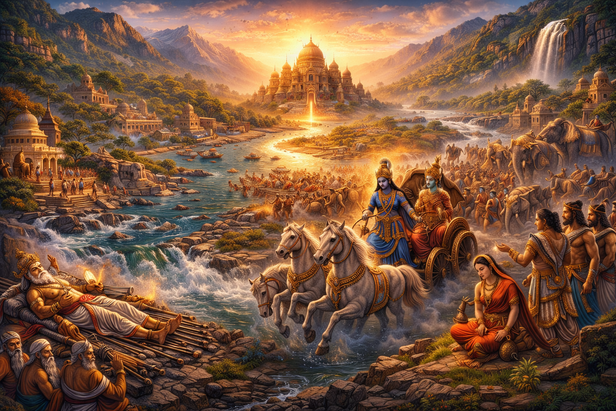
In the Mahabharata, rivers are never just scenery. They shape births, vows, wars, and pilgrimages. They witness grief and redemption. They silently carry the weight of human action. Each river becomes a teacher of karma, reminding us that life, like water, is always flowing, always responding to what we put into it.

The Mahabharata, attributed to Maharishi Ved Vyasa, is not only an epic of war. It is a deep exploration of human choices and their consequences. The rivers flowing through its narrative mirror the laws of karma and dharma that guide human life.

1. The Ganga – The Flow of Higher Duty

Haridwar, Feb 15 (ANI): Devotees arrive in large numbers to take a dip in the Ga...
Haridwar, Feb 15 (ANI): Devotees arrive in large numbers to take a dip in the Ganga River on the occasion of Mahashivratri, at Har Ki Pauri, in Haridwar on Sunday. (ANI Photo)

The Ganga is inseparable from the Mahabharata. King Shantanu falls in love with Goddess Ganga, and their son Devavrata grows up to become Bhishma, one of the most respected figures in the epic.

The story of Ganga drowning her first seven sons can seem disturbing at first. But within the epic’s framework, her actions are part of a larger divine plan. They reflect a truth the Mahabharata repeats often. Human understanding is limited. Cosmic justice works on a scale we cannot always see.

The Ganga represents surrender to higher duty. She flows from the heavens to the earth without losing her purity. Bhishma, her son, lives a life defined by his vow and commitment to dharma, even at great personal cost.

The lesson here is clear. Karma is not always about comfort. Sometimes it demands sacrifice. Like the river, we must keep moving in alignment with truth, even when the path is difficult. Stagnation leads to decay. Purposeful movement brings clarity.

2. The Yamuna – The Wisdom of Balance

The Yamuna flows through regions that become central to the political and spiritual landscape of the epic. Its presence marks important territories and sacred spaces.

Unlike the powerful and often dramatic Ganga, the Yamuna is gentler and calmer. It reflects the importance of balance in life. The Mahabharata shows us what happens when balance is lost. The unchecked ambition of the Kauravas leads to destruction. The Pandavas survive because they act with restraint and guidance.

The Yamuna teaches that karma is not only about taking action. It is about thoughtful action. Acting without reflection creates chaos. Avoiding action out of fear creates weakness. The right path lies somewhere in between.

Life constantly places us at crossroads. The Yamuna reminds us to pause, reflect, and then move forward with steadiness.

3. The Saraswati – The Power of Inner Knowledge

Mahabharata
He reflects every individuals dilemma between duty and emotion.

The Saraswati river is described in the Vedic texts and referenced in the Mahabharata as a sacred and mighty river. Over time, it is believed to have disappeared from the visible landscape, flowing underground.

In the epic, the Saraswati is associated with sages, rituals, and spiritual gatherings. It represents knowledge, learning, and subtle influence.

Its disappearance offers a powerful metaphor. Not everything that shapes our life is visible. Just as the Saraswati continues beneath the surface, karma operates quietly. Some consequences are immediate. Others unfold slowly, beneath the surface of time.

The Mahabharata repeatedly emphasizes the importance of wisdom. Characters who ignore wise counsel suffer. Those who seek knowledge find clarity.

The Saraswati teaches that inner understanding is the foundation of right action. Without knowledge, karma becomes blind. With awareness, it becomes purposeful.

4. The Sindhu – The Weight of Collective Action

The Sindhu, known today as the Indus, is one of the grandest rivers of the subcontinent. The very name India is derived from it. In the Mahabharata, regions around the Sindhu are linked with powerful kingdoms and warriors.

A river of such magnitude does not sustain one person. It sustains civilizations. It nourishes fields, cities, and generations.

The Mahabharata reminds us that actions are rarely isolated. The conflict between the Pandavas and Kauravas affects not just a family but an entire society. When leaders make choices rooted in ego, the consequences ripple outward.

The Sindhu teaches responsibility. Our actions contribute to a larger current. Karma is not only personal. It is collective. Every decision we make influences the social and moral environment around us.

Living with awareness of this interconnectedness is an essential part of dharma.

5. The Narmada – The Strength of Transformation

Jabalpur, Jan 25 (ANI): Devotees gather in large numbers to participate in the M...
Jabalpur, Jan 25 (ANI): Devotees gather in large numbers to participate in the Maha Aarti on the bank of the Narmada River on the occasion of Narmada Jayanti, in Jabalpur on Sunday. (ANI Photo)

The Narmada is revered in ancient texts and considered one of India’s holiest rivers. It flows across rocky terrain, carving deep gorges and shaping landscapes with patience and persistence.

Though not central to the Kurukshetra war, the Narmada is part of the sacred river tradition acknowledged in the epic era.

Its journey across stones and cliffs mirrors life’s struggles. The Mahabharata is filled with exile, humiliation, loss, and endurance. The Pandavas spend years in hardship before reclaiming their rightful place.

The Narmada teaches resilience. Transformation does not happen overnight. Water shapes rock slowly, but inevitably.

Karma does not guarantee an easy life. It promises growth through experience. The obstacles we face are not punishments alone. They are shaping forces.

Sign up to read this article
Read news from 100’s of titles, curated specifically for you.
Already a member? Sign in here
Related Stories
Top stories on inkl right now
One subscription that gives you access to news from hundreds of sites
Already a member? Sign in here
Our Picks
Fourteen days free
Download the app
One app. One membership.
100+ trusted global sources.