Get all your news in one place.
100’s of premium titles.
One app.
Start reading
Dot Esports
Dot Esports
Michael Carter

5 Card Draw Rules: Mastering Poker’s Classic Foundation

Five card draw represents poker’s most straightforward variant, stripping away community cards and complex board textures to focus on pure hand evaluation and strategic deception. This classic format dominated home games and casinos for decades before Texas Hold’em’s rise, and understanding its mechanics provides an essential foundation for all poker variants.

The game’s elegance lies in its simplicity. Players receive five private cards, evaluate their strength, exchange unwanted cards for new ones, and bet accordingly. Yet within this basic framework exists substantial strategic depth involving mathematical probability, opponent reading, and tactical deception. This guide examines five card draw rules, hand rankings, betting structure, and fundamental strategy principles.

How to Play 5 Card Draw: Game Setup and Structure

Five card draw accommodates two to eight players, though optimal play occurs with four to seven participants. The game requires a standard 52-card deck, poker chips for betting, and a designated dealer position that rotates clockwise after each hand.

Each hand begins with two mandatory bets called blinds. The first player to the dealer’s left posts the small blind, typically half the minimum bet, while the next player posts the big blind at the full minimum bet amount. These forced bets create initial pot value and ensure action on every hand.

Following blind posting, the dealer distributes five cards face down to each player, one at a time in clockwise rotation. Players examine their private holdings without revealing cards to opponents. Unlike community card variants, five card poker hands consist entirely of each player’s individual cards with no shared board.

Five card draw tables run consistently at the best poker sites, attracting both nostalgic veterans and players exploring classic poker formats.

Five Card Draw Rules: Betting Rounds and Game Progression

The game progresses through two distinct betting rounds separated by the drawing phase. Understanding poker rules 5 card draw requires mastering both betting rounds and recognizing how each affects hand development strategy.

First Betting Round (Pre-Draw)

Action begins with the player left of the big blind, who may fold, call the big blind amount, or raise. Betting continues clockwise, with each player facing the same options based on the preceding action.

This initial round establishes pot size and provides preliminary information about opponent hand strength through betting patterns. Conservative players fold weak holdings immediately, while aggressive players may raise with strong hands or as bluffs to build pots or pressure opponents.

Drawing Phase

Following the first betting round’s completion, remaining players enter the draw. Beginning with the player to the left of the dealer, each participant may discard between zero and five cards, receiving an equal number of replacement cards from the deck. Players typically announce their discard number, providing opponents with strategic information about potential hand strength.

Drawing zero cards signals either an extremely strong made hand or an advanced bluff. One-card draws usually indicate straight or flush pursuit, two cards suggest three of a kind, and three cards imply a pair. Drawing four or five cards reveals very weak holdings.

Second Betting Round (Post-Draw)

After all draws are complete, the final betting round begins. Action starts with the first remaining player in the early position, who may check (decline to bet but remain active) or bet. Subsequent players may check if no prior bets occurred, call existing bets, raise, or fold.

This concluding round determines the final pot size and often features aggressive betting from players who improved their hands or perceive weakness in opponents. Action continues until all remaining players either match the current bet or exit the hand.

5 Card Draw Hand Rankings: Poker Hand Hierarchy

Hand rankings in five card draw follow standard poker hierarchy, with higher-ranking combinations defeating lower ones. Understanding 5 card draw hand rankings proves essential for evaluating whether to continue in hands and determining appropriate bet sizing.

Hand Example Approximate Odds Description
Royal Flush A♠ K♠ Q♠ J♠ 10♠ 1 in 650,000 Ace through Ten of the same suit
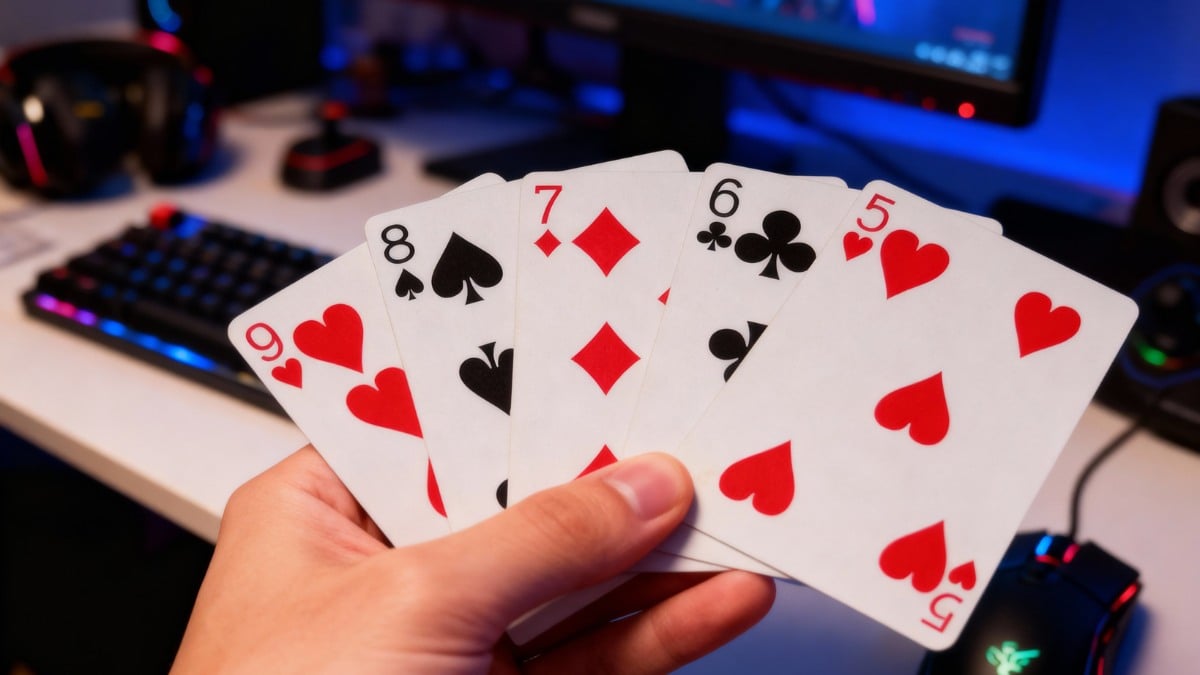
Straight Flush 9♥ 8♥ 7♥ 6♥ 5♥ 1 in 72,000 Five consecutive cards of the same suit
Four of a Kind Q♦ Q♣ Q♥ Q♠ 7♣ 1 in 4,000 Four cards of identical rank
Full House J♠ J♦ J♥ 5♣ 5♠ 1 in 700 Three of one rank, two of another
Flush K♠ 9♠ 7♠ 4♠ 2♠ 1 in 500 Five cards of matching suit, non-consecutive
Straight 10♥ 9♦ 8♣ 7♠ 6♥ 1 in 250 Five consecutive cards of mixed suits
Three of a Kind 7♦ 7♣ 7♥ K♠ 4♦ 1 in 47 Three cards of identical rank
Two Pair A♠ A♦ 6♣ 6♥ 9♠ 1 in 21 Two cards of one rank, two of another
One Pair K♥ K♣ 10♦ 7♠ 3♣ 1 in 2.4 Two cards of matching rank
High Card A♦ J♣ 9♥ 6♠ 3♦ 1 in 2 Five unrelated cards

The chart above shows five card poker hands ranked from strongest to weakest. Royal flush and straight flush hands win virtually every showdown, while high card holdings rarely survive to showdown without improvement. Understanding these probabilities helps players make informed decisions about whether to continue betting or fold marginal holdings.

Most reputable online casinos feature five card draw alongside their poker variant libraries, providing hand ranking references and tutorial modes.

Betting Limits and Structure Variations

Five card draw operates under three primary betting structures, affecting strategic approach and variance levels.

Limit: Fixed bet sizes at predetermined amounts. Small bets apply during the first betting round, while big bets (typically double the small bet) apply after the draw. This structure reduces variance and emphasizes technical skill over bankroll pressure.

Pot Limit: Players may bet up to the current pot size. This structure allows for larger bets than fixed limit while preventing the extreme swings of no limit play.

No Limit: Players may bet any amount up to their entire chip stack at any time. This format creates maximum variance and places a premium value on psychological reads and aggression.

Most casual games use a limit structure for their accessibility and reduced variance.

Strategic Fundamentals for 5 Card Draw

A successful five card draw requires balancing mathematical probability with opponent observation and tactical deception.

Starting Hand Selection

Play primarily strong starting hands: pairs of Jacks or better, high cards with straight or flush potential, or three-card combinations to straights and flushes. Fold weak pairs and disconnected low cards immediately. Tight starting requirements prevent consistently losing small amounts across many hands.

Drawing Strategy

Draw the minimum number of cards necessary to improve your hand. With three of a kind, draw two cards rather than holding a side card kicker. With two pairs, draw one card to pursue a full house. With one pair, pull three cards unless the pair exceeds Queens, where holding a high kicker provides minimal advantage.

Position Awareness

Later positions enjoy informational advantages, observing opponent actions before making decisions. Play tighter from early positions and expand ranges from late positions when multiple players have folded.

Opponent Observation

Track opponent drawing patterns to estimate hand ranges. Players consistently drawing three cards likely hold pairs, while those frequently standing pat or drawing one card pursue straights, flushes, or full houses.

The rise of Bitcoin poker has introduced five card draw to privacy-focused players seeking rapid deposits and withdrawals.

Common Mistakes and Misconceptions

Several frequent errors plague beginning five card draw players, creating exploitable tendencies for observant opponents.

Overvaluing Small Pairs:

Low pairs (sixes through nines) win infrequently at showdown and rarely improve during the draw. Folding these hands from the early position prevents small, consistent losses.

Excessive Bluffing:

The limited betting rounds and information make five card draw less amenable to frequent bluffing than community card variants. Bluffs work best against tight opponents in late position when the pot offers favorable odds.

Passive Play with Strong Hands:

Players holding three of a kind or better before the draw should bet or raise aggressively to build pots. These hands win most showdowns and deserve maximum value extraction.

Drawing to Inside Straights:

Four-card straight draws missing an inside card (example: 9-8-6-5) complete approximately 8.5% of the time, making them poor draws unless pot odds justify the attempt. Outside straight draws (example: 9-8-7-6) complete roughly 17% of the time and justify drawing under proper odds.

Smartphone-optimized mobile casinos transform commute time into productive five card draw practice sessions.

The Deal is Done

Five card draw’s straightforward mechanics and pure hand evaluation focus make it the ideal starting point for new players in poker, while offering sufficient depth to challenge experienced participants. The game emphasizes fundamental concepts like hand strength evaluation, position value, and opponent observation without the complexity of community cards and multiple betting streets.

Modern poker may have evolved toward community card formats, but five card draw’s classic structure preserves poker’s essential elements. Players who master these foundational rules develop skills transferable to all poker variants while enjoying a game whose elegant simplicity has entertained players for over a century.

The path to five card draw proficiency requires patience, mathematical understanding, and careful opponent observation. These same qualities define poker excellence across all variants, confirming five card draw’s enduring value as both an entertaining game and an educational foundation for poker mastery. 


Sign up to read this article
Read news from 100’s of titles, curated specifically for you.
Already a member? Sign in here
Related Stories
Top stories on inkl right now
One subscription that gives you access to news from hundreds of sites
Already a member? Sign in here
Our Picks
Fourteen days free
Download the app
One app. One membership.
100+ trusted global sources.