%20Services%20for%20Businesses.jpg)
Most breaches don't succeed because an alert never fired. They succeed because nobody was there to act on it in time.
Managed detection and response services close that gap by putting expert analysts on your alerts around the clock.
This guide compares five leading MDR providers, what each one actually delivers, and how to pick the right fit.
Key Takeaways
- MDR combines security technology with human analysts who monitor, investigate, and respond to threats 24/7.
- Response speed is one of the clearest ways to compare providers.
- Some services work only on their own platform, while others ingest telemetry from third-party tools.
- Premium tiers typically add dedicated advisors, deeper threat hunting, and incident response support.
- The best provider depends on your existing stack, team size, and how much response authority you want to hand over.
What Is Managed Detection and Response?
MDR is a service where an outside team of security experts monitors your environment, investigates suspicious activity, and takes action against threats.
It pairs detection technology with people, so alerts get triaged and handled rather than left in a queue.
Coverage usually starts with endpoints, and many services now extend to cloud workloads, identities, email, and network telemetry. The broader that coverage, the fewer places an attacker can hide without being noticed.
That matters most for organizations without a full-time security operations center. An MDR provider gives them round-the-clock coverage without hiring and scheduling analysts across every shift.
How We Chose These Providers
We reviewed each provider's MDR service using only information published on its official website, press releases, and product documentation.
We compared coverage, response capabilities, service tiers, and what sets each service apart.
Every provider on this list offers 24/7 monitoring backed by in-house analysts. The table below gives a quick overview before the detailed breakdown.
|
Provider |
MDR offering |
Standout feature |
Best for |
|
ESET |
MDR and MDR Ultimate tiers |
6-minute detection and response |
SMBs through enterprises |
|
Rapid7 |
Rapid7 MDR |
Unlimited incident response support |
Teams wanting SIEM-based MDR |
|
Arctic Wolf |
Managed Detection and Response |
Concierge Security Team |
Teams wanting a named partner |
|
SentinelOne |
Wayfinder MDR Essentials and Elite |
Google Threat Intelligence built in |
Singularity Platform users |
|
Sophos |
Sophos MDR |
Choice of three response modes |
Mixed-vendor environments |
The 5 Best MDR Services
1. ESET
ESET delivers 24/7 MDR that combines AI with human expertise, and the company says it can cut detection and response time from months to just 6 minutes.
It draws on its own threat intelligence network of more than 100 million sensors, 11 R&D centers, and over 35 years of experience.
The service comes in two subscription tiers, one built for small and mid-sized businesses and an MDR Ultimate tier for enterprise-scale organizations.
Ultimate adds retrospective threat hunting, digital forensic incident response assistance, and a dedicated incident response lead.
The company is part of the CISA-led Joint Cyber Defense Collaborative and was named a Market Leader in MDR in the KuppingerCole Leadership Compass 2026. A Cyber Warranty is also included with eligible MDR subscriptions.
2. Rapid7
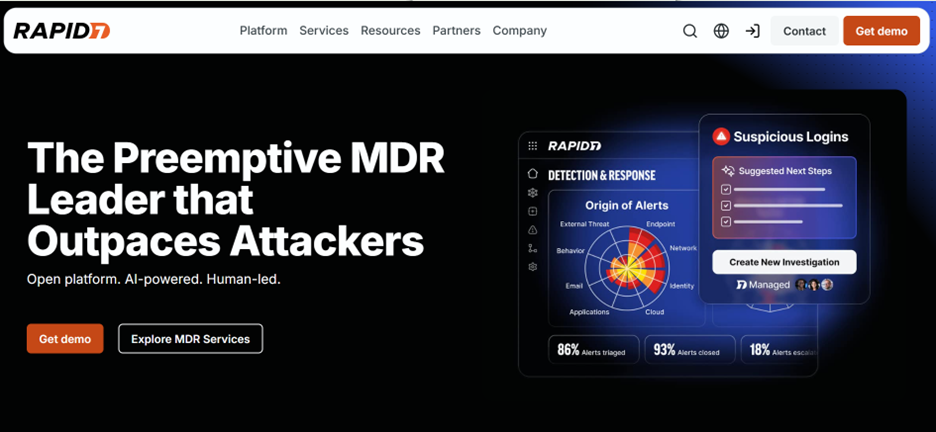
Rapid7 MDR is a 24x7 service delivered on Rapid7's SIEM platform, combining exposure intelligence, AI-assisted investigations and expert-led response. Rapid7 says more than 11,000 organizations worldwide trust the company.
Customers receive unlimited incident response support along with full transparency into investigations.
Rapid7 states its team responds without restriction, which removes surprise costs and third-party retainers during an incident.
On its MDR Elite service, each customer gets a named Customer Advisor who acts as the main point of contact. That advisor works alongside the SOC and incident response teams from deployment through remediation.
3. Arctic Wolf
Arctic Wolf delivers MDR on its Aurora Platform, which is built on open XDR architecture and combines AI with security experts for 24x7 monitoring, detection, and response.
Its Alpha AI technology enriches each event before it reaches the Security Operations Center for analyst triage.
The Aurora Platform offers more than 200 technology integrations and ingests over 8 trillion security events each week. That scale feeds the data lake Arctic Wolf uses for real-time detection and response.
Customers also work with Arctic Wolf's Concierge Security Team, which provides security operations expertise and tailored recommendations. It suits organizations that want an ongoing partner rather than alerts alone.
4. SentinelOne
SentinelOne launched its Wayfinder Threat Detection and Response suite in November 2025 in partnership with Google Cloud.
Wayfinder MDR Essentials provides 24x7x365 coverage across endpoints, cloud workloads, and identities.
The service combines SentinelOne's AI-driven alerting and triage with curated intelligence from SentinelOne and Google Threat Intelligence.
Coverage is unified through the Singularity Platform, so it fits organizations already using that platform.
Wayfinder MDR Elite adds Incident Readiness and Response experts plus a dedicated Threat Advisor for every customer. That advisor delivers hands-on guidance, operational reviews, and tailored risk recommendations.
5. Sophos
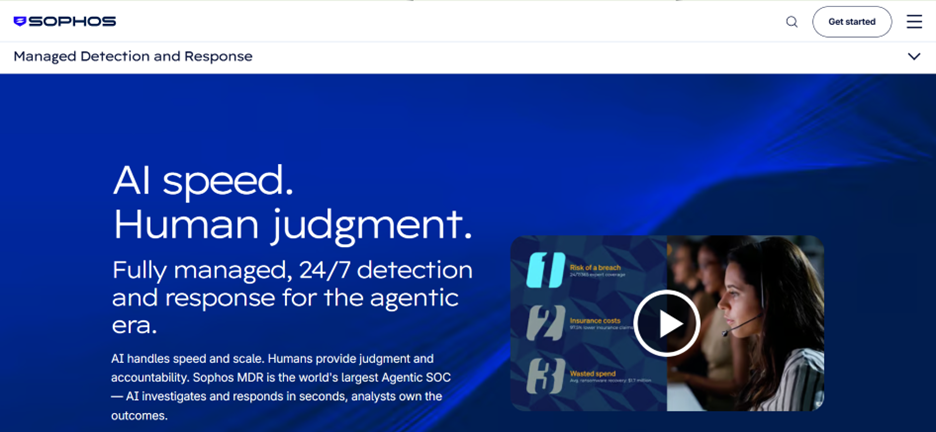
Sophos MDR provides around-the-clock coverage backed by seven global security operations centers. It can integrate telemetry from third-party endpoint, firewall, network, identity, email and backup tools, not just Sophos products.
Customers choose how involved Sophos gets, from full-scale incident response to collaborative support or detailed threat notifications.
With a Sophos MDR Complete license, full-scale incident response is unlimited with no caps and no extra fees.
Weekly and monthly reports are delivered through Sophos Central, the company's single dashboard for alerts and management. It works well for teams that want to keep their existing security tools in place.
How to Choose an MDR Provider
Start with your current security stack and check whether the provider works with it or requires its own platform.
Open integrations protect existing investments, while platform-native services can offer tighter coverage.
Next, look at response authority and incident response terms. Confirm what the provider can do on its own, whether incident response is capped, and whether it costs extra.
Ask to see sample reports before you sign anything. Regular weekly or monthly reporting shows what the team investigated and how your security posture is changing over time.
It also pays to ask how onboarding works and how long it takes to reach full coverage. A clear onboarding plan keeps protection gaps to a minimum while you switch providers.
Finally, decide how much hands-on guidance you need. Premium tiers with named advisors suit lean teams, while larger security teams may only need expert triage and escalation.
FAQ
What does an MDR service include?
Most MDR services include 24/7 monitoring, alert triage, threat hunting, and response actions such as containment. Premium tiers often add dedicated advisors and incident response support.
How is MDR different from EDR?
EDR is technology that detects and records activity on endpoints. MDR adds a team of human experts who use that technology to investigate and respond on your behalf.
Do MDR providers work with existing security tools?
Some do, while others run only on their own platform. Check each provider's integration list before signing, especially if you use tools from several vendors.
Who needs an MDR service?
Organizations without a round-the-clock security team benefit most. Larger enterprises also use MDR to extend internal teams and add specialist threat hunting.
What is mean time to respond?
Mean time to respond is the average time between detecting a security incident and taking the first action to address it. Lower numbers mean threats have less time to cause damage.
Conclusion
The right MDR service turns a flood of alerts into fast, expert action at any hour. Each provider here offers 24/7 coverage, but they differ in speed, platform approach, and how much support comes with premium tiers.
Compare response times, integration needs, and incident response terms before you commit. Matching those factors to your team's capacity will point you to the provider that fits best.