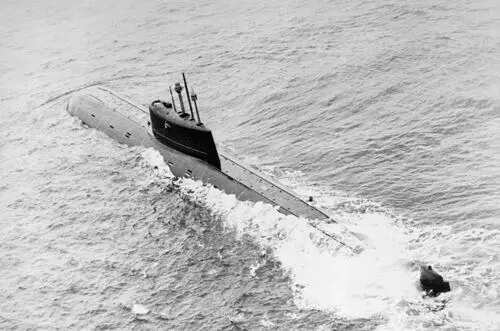
A Cold War-era nuclear submarine located almost 5,500 feet underwater might seem like the start of an environmental catastrophe. The fact that there is radioactive waste seeping from its wreckage only adds to this belief. However, scientists who are currently observing this area are surprisingly calm and composed. This is because of all the years that have been spent observing and measuring this phenomenon. While the numbers might seem alarming at first glance, they are actually nothing compared to what one might believe. Researchers emphasise that continuous monitoring and detailed analysis have shown the radiation levels to be localised and relatively low, posing minimal risk to the broader marine ecosystem.

What happened to the sunken Norwegian Sea nuclear submarine
The submarine in question is the Soviet submarine K-278 Komsomolets, which sank in 1989 following a fire that occurred on board. The submarine currently lies at a depth of 1,700 metres, or 5,500 feet, at the bottom of the Norwegian Sea. The site has been revisited several times to study the state of the submarine using remotely operated vehicles.
Recent research on the current status of the site has confirmed that radioactive substances, such as caesium-137, are indeed leaking from various parts of the submarine, including a ventilation duct. In some samples collected directly from the source, it has been established that radiation levels are significantly higher than they normally are in seawater. However, this is not new information and is in line with previous studies.
Radiation levels are not as dangerous: Explained
The key to understanding this state of affairs is to understand the context. The highest levels of radiation have been found only at the point of leakage. Even a few feet away from this point, the levels of radiation have been found to be much lower.
As researcher Hilde Elise Heldal said during the investigation, “we weren’t surprised to find high levels here,” which shows that this is a normal state of affairs when the point of leakage is taken into account. It has also been found that there has been no increase in the levels of radioactive substances in the surrounding seawater.
Why scientists say the situation is “not alarming”
In spite of the radioactive materials, experts have always assured everyone that there is no cause for alarm. The radiation authorities in Norway have assured everyone that the leak does not pose any danger to either human life or marine life.
There are several reasons for this. First, the volume of the ocean is so vast that any radioactive materials that escape are quickly diluted. Secondly, the leak is not widespread; most of the radioactive materials are concentrated around the wreck. Thirdly, the level of radiation, even when high, is still within manageable limits.
It should be noted that the site has been under surveillance for several decades, and no damage has been seen that can be attributed to the submarine.
Built-In safety and long-term monitoring of nuclear substances
Nuclear submarines are designed to have multiple protective barriers to ensure that no radiation leaks out of the vessel. The nuclear reactors are sealed, contained within strong structures, and then protected by the submarine’s hull.
The scientists are not ignoring the problem, but rather considering it a long-term environmental research project. This ensures that any changes are picked up, and the scientists will react appropriately.
In a nutshell, the situation with the leaking nuclear submarine may seem catastrophic, but the reality of the situation is much more measured and under control than one may think. The radiation is contained, the risks are low, and the situation is firmly under the control of the scientists.