Get all your news in one place.
100's of premium titles.
One app.
Start reading
The Economic Times
The Economic Times
Trending Desk

4,000-year-old noodles found in China: Scientists discover the world's oldest bowl buried beneath the Yellow River region that survived an earthquake and flood

Think about what you had for dinner last night. There is a decent chance noodles were involved in some form — a bowl of maggi, a plate of chowmein, or something fancier. Noodles are everywhere. Billions of people eat them every single day.

But where exactly did they come from? That question has been argued about for decades among food historians, archaeologists, and researchers. And one discovery in the Qinghai province of northwest China has done more to answer it than almost anything else.

A bowl buried under three metres of earth

In 2005, a team of researchers led by Houyuan Lu of the Chinese Academy of Sciences published a study in the journal Nature describing what they called the oldest physical evidence of noodles ever found.

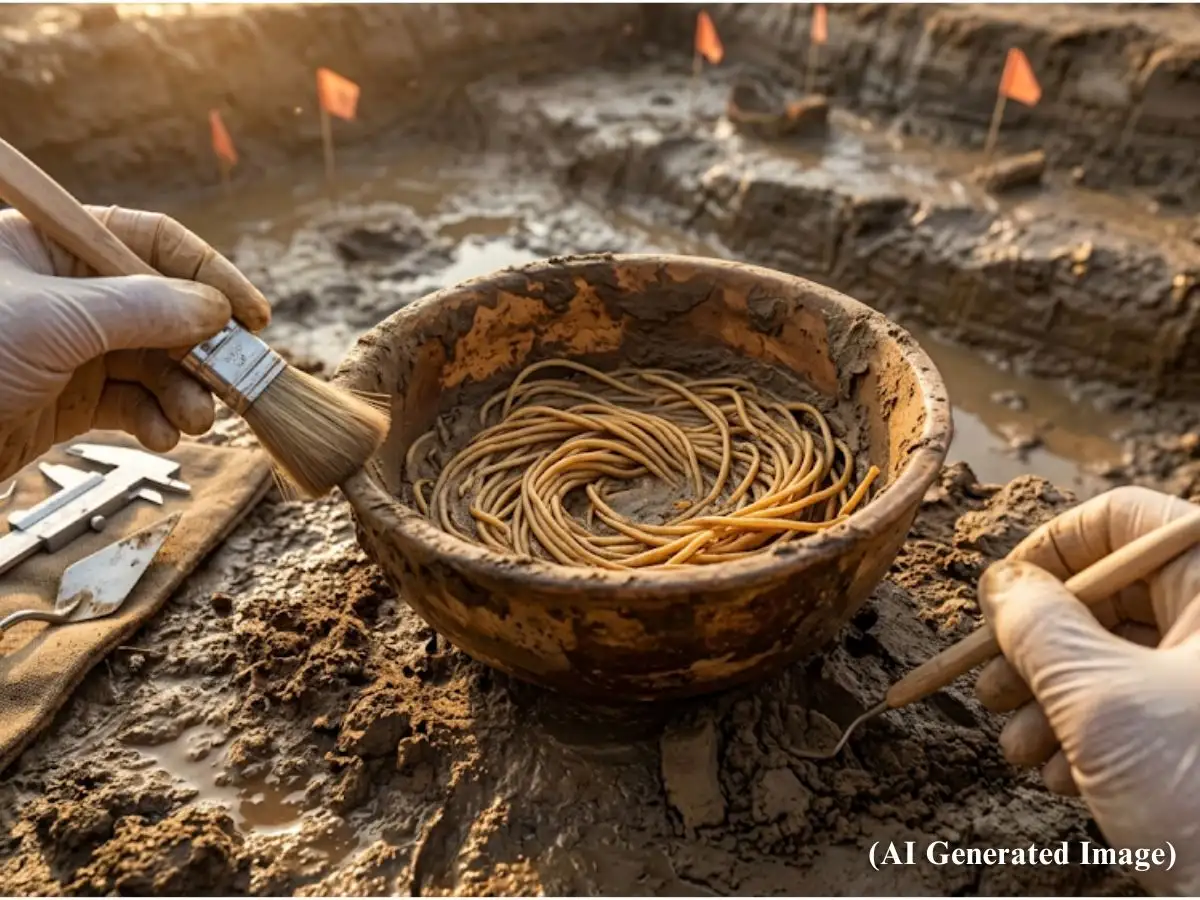
The find came from Lajia, an archaeological site in China's upper Yellow River region. Buried under roughly three metres of sediment was an upside-down earthenware bowl. Inside it were long, thin, yellowish strands that had somehow survived for around 4,000 years.

The site itself is associated with the Qijia culture, a Late Neolithic community with a structured agricultural society. People here were farming, making ceramics, and clearly, cooking.

How did noodles survive 4,000 years?

This is the part that genuinely surprises people. Food does not usually last four millennia. What made it possible here was a sequence of disasters.

Researchers believe an earthquake, followed by flooding, created conditions that sealed the bowl and dramatically reduced oxygen exposure. The result was a kind of accidental time capsule. What should have decomposed thousands of years ago was instead preserved well enough for modern scientists to examine and analyse.

It is why Lajia is sometimes referred to as China's Pompeii.

What were the noodles made of?

According to the original 2005 Nature study , the noodles were made from two varieties of millet, foxtail millet and broomcorn millet. This was significant because it tied the dish to ancient Chinese cereal crops rather than the wheat that forms the basis of most pasta consumed in the world today.

However, not everyone accepted this conclusion without question. A 2011 study published in the journal Archaeometry pushed back on it, arguing that pure millet dough cannot be stretched into strands the way noodles require. Millet lacks gluten, which is what gives dough the elasticity needed to be pulled thin. The researchers suggested that the starch granules identified at the site may not have actually been part of the noodles themselves.

The exact recipe, if it can be called that, remains unresolved.

Did China invent noodles?

The Lajia find shifted the historical record considerably. Before this discovery, the oldest known references to noodles came from documentary sources that were far more recent. Lajia pushed the physical record back by centuries.

But the discovery did not settle the broader debate about who invented noodles. The long-running argument between China, Italy, and the Arab world over the origins of the dish has not been definitively resolved. What Lajia did was give China the earliest known physical specimen, which is a different thing from proving the dish originated there exclusively.

Researchers have also been careful to point out that the existence of noodles at Lajia does not prove a direct line of descent from those ancient millet strands to the wheat-based pasta of medieval Europe or the ramen of Japan. These may well have developed independently, in different places, at different times.

A dish that refuses to belong to one place

That is perhaps the most interesting thing about noodles. They have a way of appearing across cultures, adapting to local grains, local tastes, and local techniques. Wheat noodles in China, rice noodles in Southeast Asia, semolina pasta in Italy, glass noodles in Korea — each one is its own tradition.

The bowl at Lajia does not end the conversation about where noodles came from. If anything, it opens it further. It is evidence that people were making and eating this kind of food thousands of years before it appeared in any written record.

And the debate, much like noodles themselves, continues to stretch.

Sign up to read this article
Read news from 100's of titles, curated specifically for you.
Already a member? Sign in here
Related Stories
Top stories on inkl right now
One subscription that gives you access to news from hundreds of sites
Already a member? Sign in here
Our Picks
Fourteen days free
Download the app
One app. One membership.
100+ trusted global sources.