David Tobin, the Executive Director of the Community Manufacturing Initiative, and producer for the 3D Printing Nerd YouTube channel, stood on the floor of the Rocky Mountain RepRap Festival. He waved his arms emphatically while encouraging a group of event sponsors to take a stand against legislation threatening 3D printing. “All this will be gone! The RepRap community? Gone! Gone, if this is allowed to pass.”
As one of the country’s largest gatherings of consumer 3D printing enthusiasts, RMRRF drew nearly 6,000 people to showcase creative projects and home-brewed hardware in Loveland, Colorado. Only two major 3D printer manufacturers joined the festival, Prusa Research with a large display of hardware, and Snapmaker, whose team walked the floor to chat with makers. Both companies are vocal supporters of open source ideals, a belief that innovation should be shared freely.

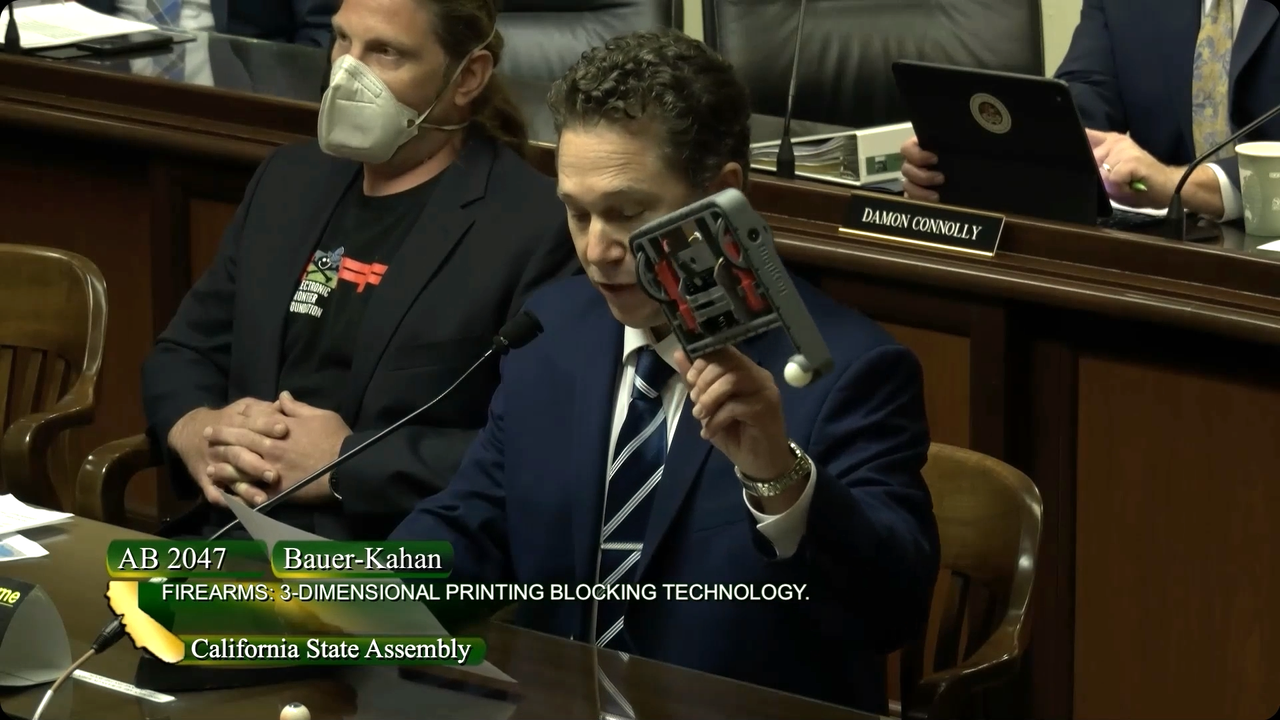
That spirit of innovation is currently under threat from well-intended, but arguably ill-informed lawmakers who are working to ban 3D printed “ghost guns.” Tobin spoke at RMRRF that afternoon about the potential harm of government overreach from his home state of California, which is rapidly pushing a bill to install blocking technology on every 3D printer. California’s AB 2047 would allow the state’s Department of Justice to monitor every 3D printer in the state in an attempt to prevent guns from being printed. It would also ban open-source firmware like Marlin and Klipper that sit at the heart of most consumer 3D printers. Any machine not approved by California would become illegal, which includes every 3D printer currently used by consumers, businesses, and schools.
Current 3D printers are doomed to become e-waste, as they lack the computing power, cameras, and even wi-fi components that would allow them to be upgraded to work with the as-yet-to-be-invented monitoring systems. Most machines currently in use would be illegal to sell within the state of California.
Tobin wants to educate both lawmakers and everyday citizens on the positive benefits of 3D printing. He also wants to give 3D printing enthusiasts the tools to pick up the fight to support 3D printing without engaging in political rage bait on social media.
“It's very easy to get caught up in the emotional arguments with this. There's passionate people on both sides of it. And there's some very volatile things you can say to get people fired up. But that's bait. Don't play that game,” he told his audience. He said this is an issue about education, technology, and science.

One of the surprising things Tobin learned when he visited California’s capital to speak with lawmakers was what he characterized as misinformation being spread by a lobbying group called Everytown for Gun Safety.
“They've done some phenomenal work over the years for education in firearms and gun control and other things like that, like making sure there's locks on things, making sure you understand how to properly use stuff, all sorts of different areas.” He said Everytown has painted a target on 3D printing in their quest to banish ghost guns.
“This is not like a mom and pop,” he said of Everytown and its $57 million lobbying fund. Tobin said the real concern is that organizations like this need to keep on the campaign trail to keep money pouring into their coffers.
“I spoke with state senators that actually think there is an epidemic of weapons on airplanes right now.” He claims that lobbyists in New York are falsely telling people that it only takes a single button push to make a gun, like it’s Star Trek. “That's a conversation that's being manufactured to drive attention,” Tobin contends.
His biggest fear is that 3D printing will be removed from schools in order to prevent children from learning how to use the technology and creating harmful things. “If kids don't have access to additive manufacturing, they will not be competitive on the global stage. We will not be able to innovate and allow ourselves to grow. We will not be able to think of the most amazing things that we haven't even thought of yet.”
Tobin did an impact analysis of the California bill, which is available to download from the 3D Printing Nerd’s YouTube channel. Over 1.5 million California children and 30,000 businesses use 3D printing and additive manufacturing. He revealed a staggering $10.5 billion in sunk costs, money already invested by the state of California and its aerospace, medical, and technology giants into additive hardware and specialized software that could be rendered obsolete in a heartbeat. These businesses may be forced to leave the state to avoid having equipment banned or products flagged by government software looking for “bad shapes.”
“Can you imagine that on your network?” he questioned. “Can you imagine that in your business when you're doing your R&D, and you're trying to develop a new prosthetic or something like that, and it flags it?”
The turmoilAB 2047 could unleash on 3D printing is not restricted to California. Washington, New York, and Colorado are also exploring bills to prevent 3D-printed firearms. Historically, when California takes a stand on technology, safety, or the environment, the rest of the country follows. Manufacturers may feel it's easier to comply with California law for every printer sold in North America, effectively ending the era of Open Source as we know it.