
There’s one director’s name that ensures that the movie you’re about to watch is going to be a real mess. From 1968 until the early 2000s, “Alan Smithee” was the official pseudonym used by Hollywood directors who did not want to take credit for their work. There are a few reasons why this might happen: studio interference, for example, or a production that was compromised in some way. And although horror has gained prestige in the past few decades, the genre’s once-disreputable nature made the Smithee name tempting for filmmakers who were embarrassed to be associated with it. But there’s one title where all of these factors came together in a most spectacular fashion: the infamous Hellraiser: Bloodline.
The fourth film in the Hellraiser series was actually directed by Kevin Yagher, a longtime special-effects artist who designed both the makeup for Freddy Krueger and the original Cryptkeeper puppet for Tales from the Crypt. Yagher got the job after Re-Animator’s Stuart Gorden exited the project over “creative differences,” a bad omen that got worse when the movie began shooting in the summer of 1994. Whole departments were fired and replaced, the script was scaled back for budgetary reasons, and executives at Miramax hated Yagher’s original cut, rewriting pivotal scenes and hiring a new director to shoot them. By the time it reached theaters, Hellraiser: Bloodline had been cut down from 110 to 85 minutes, prompting Yagher to take his name off of the film.

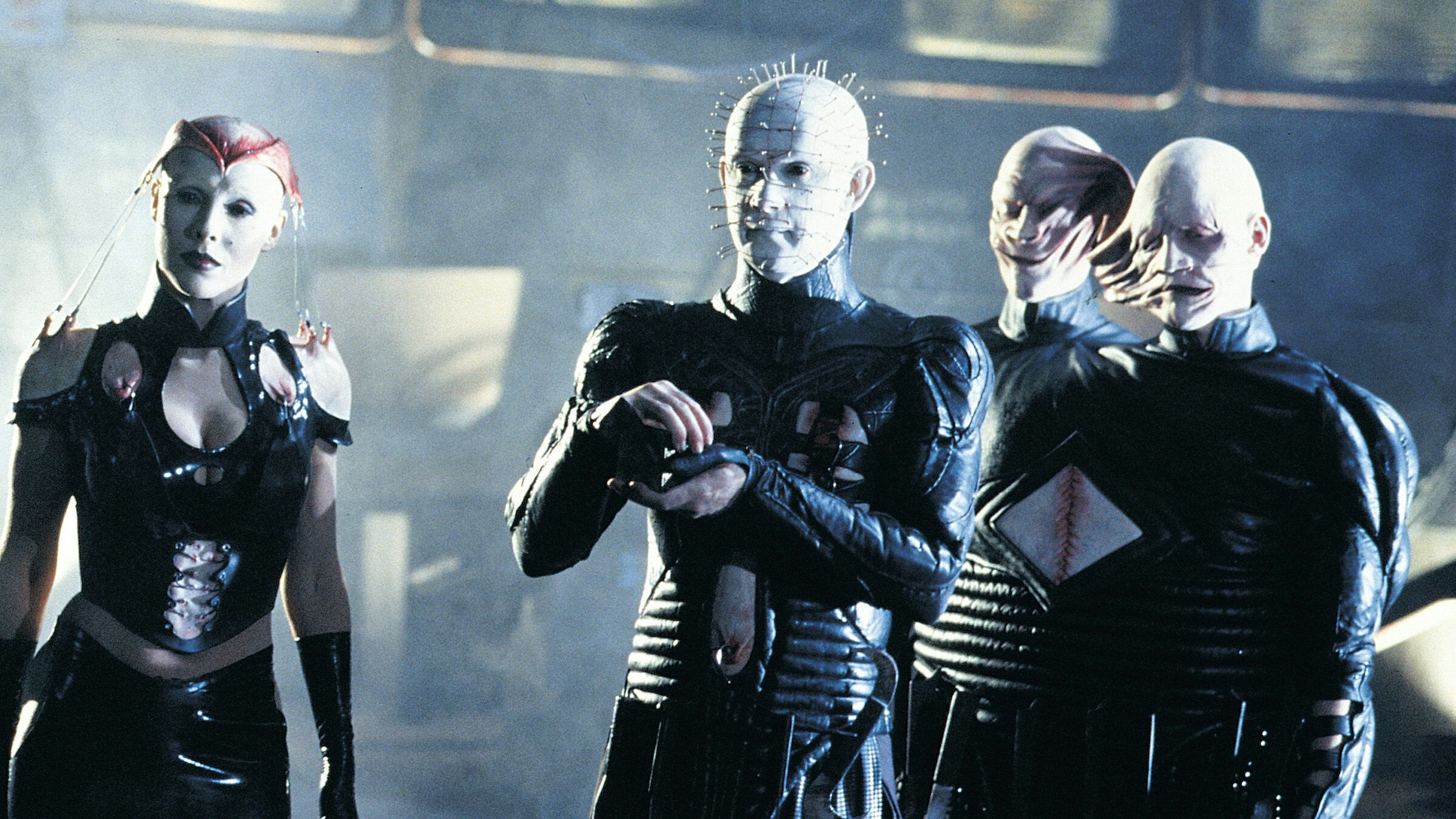
The movie got bad reviews and did poorly at the box office, effectively banishing the rest of the series to direct-to-video hell as a punishment for Bloodline’s sins. And it is true that the theatrical cut of Hellraiser: Bloodline doesn’t make a whole lot of sense. The film takes place in three distinct eras: The 18th century, where Phillip LeMarchand, a.k.a. “Toymaker,” creates the original demon-summoning puzzle box as a commission for a decadent aristocrat; ‘90s Manhattan, where LeMarchand’s descendant John Merchant is building a skyscraper based on his ancestor’s creation; and the year 2127, where Pinhead and his minions roam free on a spaceship that doubles as a portal to Hell.
In the film’s final version, these storylines are chopped up and reordered in a nonlinear fashion, made even more confusing by the fact that the same actor, Bruce Ramsay, plays LeMarchand and his descendants in all three eras. But even within this messy structure, there are glimpses of some interesting themes and fascinating world-building: Take the rivalry between Biblical demon Angelique (Valentina Vargas), who likes to play with her prey, and the severe, efficient Pinhead (Doug Bradley), who approaches the torture of damned souls more like a bureaucrat than an artist. Their mutual dislike suggests a power struggle in Hell that replaced the ancient Angelique with the more modern Pinhead, mirroring the evolution from feudal monarchies to capitalist democracies on Earth.
This concept is explored in greater detail in Peter Atkins’ original screenplay for Hellraiser: Bloodline, which has since been published as a standalone book. Atkins’ screenplay also provides a more detailed history both of “the box” (a.k.a. The Lament Configuration) and the LeMarchand family, as well as — brace yourself, because this would have been awesome — a group of clown Cenobites commanded by the seductive Angelique. But the biggest difference between the screenplay and the final film is that originally, the saga was told in chronological order, which would have cleared up a lot of confusion. It wouldn’t have cleared up all of the movie’s issues, but shooting from the script would undoubtedly have helped.
The thing is, Yagher did shoot the script. That’s just not what ended up in theaters. Multiple workprints were assembled in between Yagher’s original cut and the theatrical version; one of them was released in 2023, as a special feature on the Hellraiser: Bloodline disc in Arrow Video’s “Quartet of Torment” boxed set. That particular cut contains more gore and more character development, and all of them contain multiple small differences that are like candy for Easter-egg obsessed Hellraiser fans. But all this speculation on what might have been ignores one fact: In its own, sometimes campy way, even the theatrical cut of Hellraiser: Bloodline is awesome.
For all of its flaws, the film leans into the franchise’s erotic potential, adding a layer of romantic decadence to its 18th-century storyline that’s perfectly of its ‘90s crushed-velvet goth era. (Hellraiser: Bloodline was also Adam Scott’s first movie role, and it’s hard not to be amused by the future sitcom star doing a French accent in a cheap wig.) The large-scale ambition of the film is admirable as well, creating great new villains like the twin Cenobites in the 2127 storyline and reimagining the series’ iconic puzzle box on a massive scale.
Hellraiser: Bloodline is grand, gothic, silly, bloody, and deathly serious, all at the same time. It takes everything that fans love about the series, and blows it up to outrageous proportions. Plus, Pinhead goes to space! What horror fan doesn't want to see that?