Get all your news in one place.
100’s of premium titles.
One app.
Start reading
InsideEVs
InsideEVs
Technology

30,000 Robots By 2028: Hyundai's Big CES Announcement, Explained

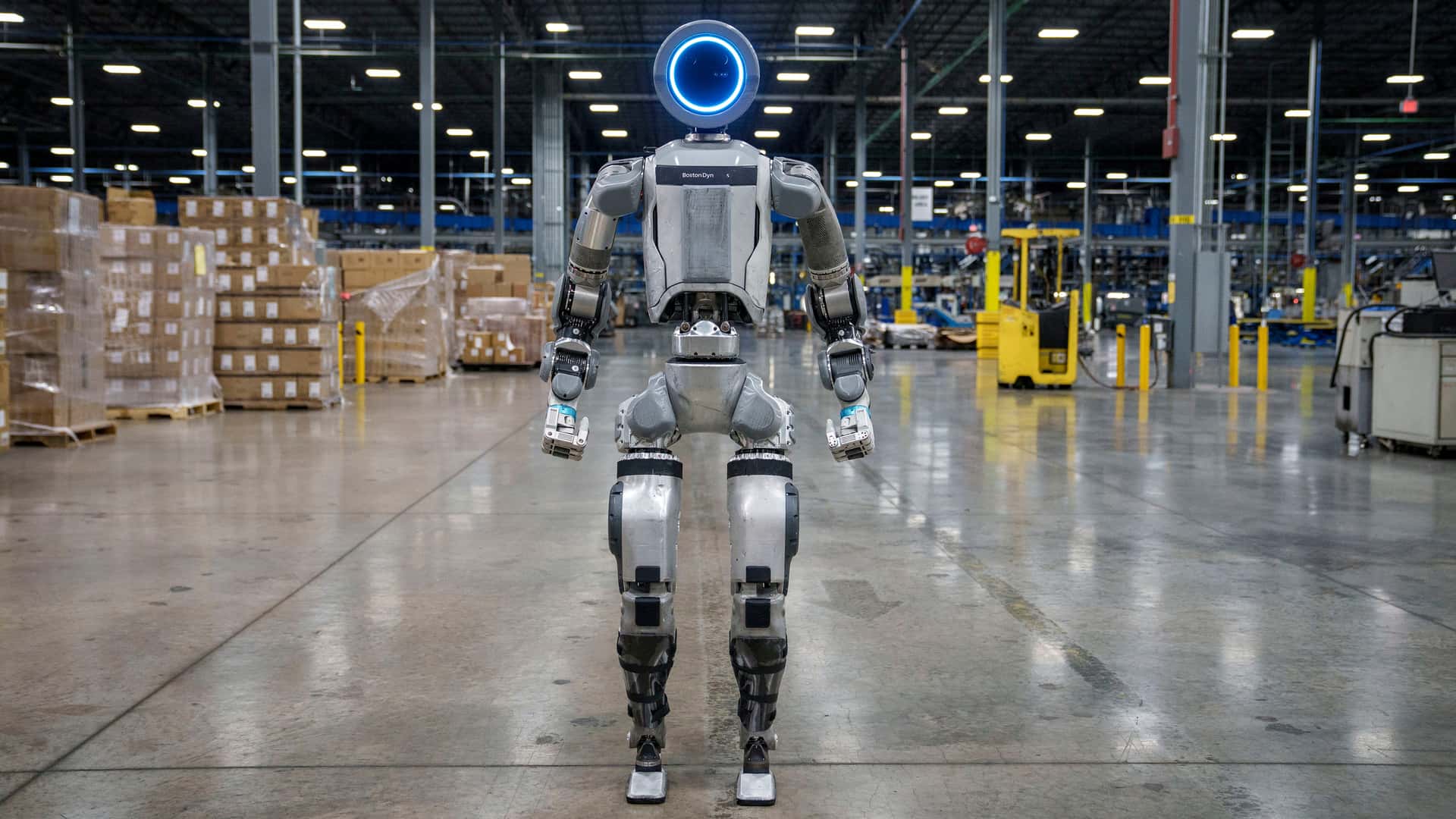
  • Hyundai's subsidiary Boston Dynamics introduced its humanoid robot, "Atlas," at CES 2026. 
  • The company says Atlas will be trained to work in its auto plants, adopting the same strategy that Tesla is using to validate its "Optimus" humanoid.
  • Hyundai says it will build 30,000 robots globally by 2028, with a big robotics plant coming to America around then.

Hyundai doesn’t just want to build your car. It wants to build the robot that builds your car, and the ones that deliver your packages, too. Almost five years after acquiring U.S. robotics giant Boston Dynamics, the Korean automaker announced plans to build 30,000 robots annually starting in 2028. And some of them will even look like humans.

That puts it in a direct race with Tesla, which has been developing its “Optimus” humanoid for years, and other automotive players like Xpeng. Just like Tesla, the company also says its humanoid robots’ first job will be at its own car factories, where engineers can keep the clankers under a watchful eye.

So what exactly is Hyundai planning, and why does the company think it can pull this off?

Hyundai Atlas

What Hyundai Is Doing

Hyundai is in the process of scaling Boston Dynamics from an experimental startup to a mass-market robot brand. The company's best-known robot, Spot, has been the tip of the spear. The four-legged quasi-dog is already working on construction sites around the world, as a data collection and monitoring tool. (Spot robots are already used at Hyundai factories, including the Metaplant in Georgia.)

Its brother, Stretch, is a box-unloading wheeled robot that is already operating in a number of markets.  

Spot is already considered a world-beating robot. But the company’s humanoid project, Atlas, is a much tougher nut to crack. While specialty robots may offer advantages in many cases, the promise of a general-purpose human robot is much bigger, allowing you to replace humans in a one-to-one way. To do that, Atlas will be able to operate fully autonomously, lift up to 110 pounds and automatically replace its own battery, the company claims.

It’ll be able to do this in temperatures ranging from -4 degrees Fahrenheit (-20 degrees Celsius) and 104 degrees Fahrenheit (40° C), and you’ll be able to spray it off with a hose and use it in the rain. 

Tesla CEO Elon Musk says production Optimus robots will start working in its factory sometime next year, but you know how he is about timing. 

The point is, it should work just about anywhere you’d ask a human to work in normal conditions. But first, it’ll have the same first job as Tesla’s Optimus: go to work in its parent company’s auto factories.

How Are They Going To Get There?

At CES today, Hyundai said it plans to deploy Atlas humanoids at its auto plants, including the Metaplant. They’ll start with simple tasks, the company says, like arranging parts in order. The target for that is 2028, while the company claims they’ll be doing complex component assembly by 2030.

The idea is to use the dangerous, complex environment of an automotive factory as a training ground for tomorrow’s robot workers. Eventually, though, Hyundai and Boston Dynamics want to be doing large-scale production of robots.

It’ll build 30,000 units per year by 2028, the press release claims, and construct a factory in the U.S. with the capacity to build 30,000 units on its own. That’s part of Hyundai’s new effort to invest $26 billion into the U.S. over the next four years. 

Hyundai will also make robots under its own name, like this MoBed concept delivery robot.

But the foundation of this plan is a company-wide push to develop “real-world AI” (a term I first heard from Tesla’s Optimus plans). That’s already in progress. Hyundai announced a partnership with Nvidia at last year's CES, and is now adding another heavy hitter to its bench.

While Hyundai and Boston Dynamics develop the robot hardware, they’ll work together with Google’s DeepMind AI division on developing the software. This goes with the division’s recent “Gemini Robotics” model, which is designed to allow robots to perceive, reason from and interact with the physical world.

That’s a huge get for Hyundai, as DeepMind is broadly considered one of the most sophisticated AI labs in the world.

Hyundai Atlas

And the company plans to apply its robotics lessons throughout its empire. From its logistics arm to its auto supplier arm to its ship-building division to its Hyundai-branded consumer-facing robots, like this one, Hyundai wants to push robotics across its global properties. The humanoid robot may be the Holy Grail of the market, but there are plenty of other opportunities to make money and cut costs here.

The Coming Robot Battle

Make no mistake: The humanoid robot market is coming, and the contest to dominate it has already started. Yet it is a gargantuan challenge to solve. Replicating the range of motion of the human body requires cutting-edge microelectronics for control, sophisticated joints for flexibility, a near-perfect AI for balance and perception and the flexibility to survive a limitless number of motions over a long service life.

No company has proven it can do this. But among those trying, the Hyundai Motor Group is among the only ones with a demonstrated lead in robotics, decades of experience in high-precision manufacturing and, now, a real AI strategy. Let’s see if the company can pull it off. 

Contact the author: Mack.Hogan@insideevs.com.

Got a tip for us? Email: tips@insideevs.com
Sign up to read this article
Read news from 100’s of titles, curated specifically for you.
Already a member? Sign in here
Related Stories
Top stories on inkl right now
One subscription that gives you access to news from hundreds of sites
Already a member? Sign in here
Our Picks
Fourteen days free
Download the app
One app. One membership.
100+ trusted global sources.