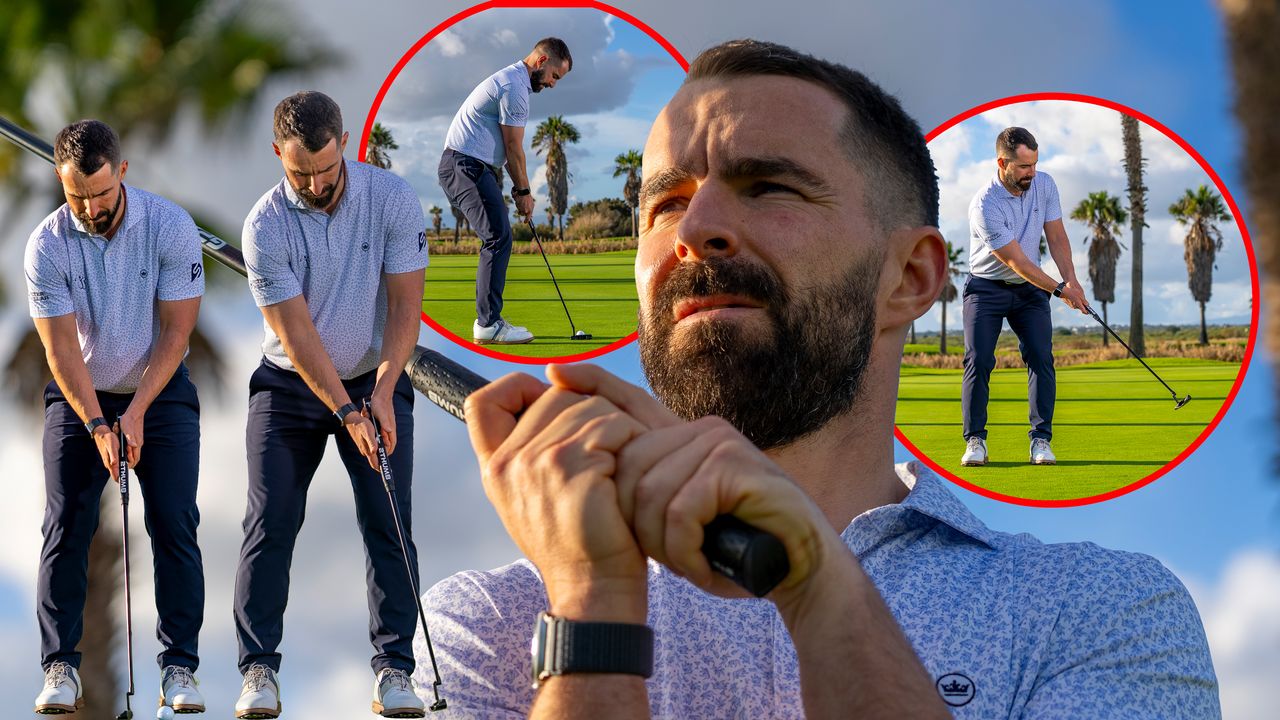
As amateur golfers, we often fall foul of common mistakes on the golf course that cost us precious shots... and putting is no exception, according to PGA Pro and putting guru, James Jankowski.
James Jankowski has coached more than 3000 golfers in his career, helping amateurs and top professionals to improve their putting and shoot lower scores.

James also contributed to our expertly-curated putting improvement guide, which is a great resource if you are looking to fire up the flat stick and cut your handicap in 2026.
In this article, James shares three common putting mistakes that he sees time and time again from amateur golfers and offers an actionable strategy to banish them from your game for good...
3 Putting Mistakes Costing You Shots On The Golf Course
Mistake 1: Set-up

There are plenty of things we can control before hitting a putt, like selecting the best method for how to grip a putter or mastering a solid and dependable set-up.
A good set-up allows the upper body to move independently from the lower body and core.
When golfers sit too much into their address position, with too upright a posture and too much tension, that separation becomes difficult and you can overuse your hands and arms through the putting stroke.
How to fix it:
Instead, try tilting forward more from the hips – more than with any other club in the bag – and allow your arms to hang naturally underneath your shoulders with plenty of space.
This should be relatively free from tension, with a relaxed posture, almost like you're falling/rounding forward. From this position it becomes much easier to disassociate the torso from the lower body, core and head.
A sound putting stroke relies on synchronisation and co-ordination, not on locking everything together through muscular tension.
Mistake 2: Synchronisation

Synchronisation is encouraged through proper acceleration and timing. When the handle and clubhead move together, the wrists remain relatively quiet, which stabilises the stroke.
Again, it is not about locking the wrists through tension, but about quieting flexion/extension through co-ordination. If the acceleration is too harsh or late/early, separation between the handle and clubhead increases.
How to fix it:
Try this synchronisation drill to co-ordinate your stroke. Take your normal grip but lift both thumbs off the club so the handle rests in the fingers at the back of the grip.
Now swing the putter back and forth, keeping the thumbs off. Now learn to co-ordinate the motion; keep the handle and putter head moving together without too much separation.
Mistake 3: The Backstroke

Many golfers fail to create enough speed in the backstroke.
As a result, the stroke becomes too short and they try to compensate with late acceleration and an exaggerated followthrough. Impact in golf is not a hit, it’s a collision.
How to fix it:
To produce consistent strikes, build speed through the putting stroke and use the club's momentum through impact.
Speed begins in the backstroke. If the backstroke is too slow or too short, creating speed during the transition and using momentum in the strike becomes difficult.
Focus on making the backstroke quick enough so that it becomes long enough and simply transfer that speed smoothly in the transition and cruise through impact.