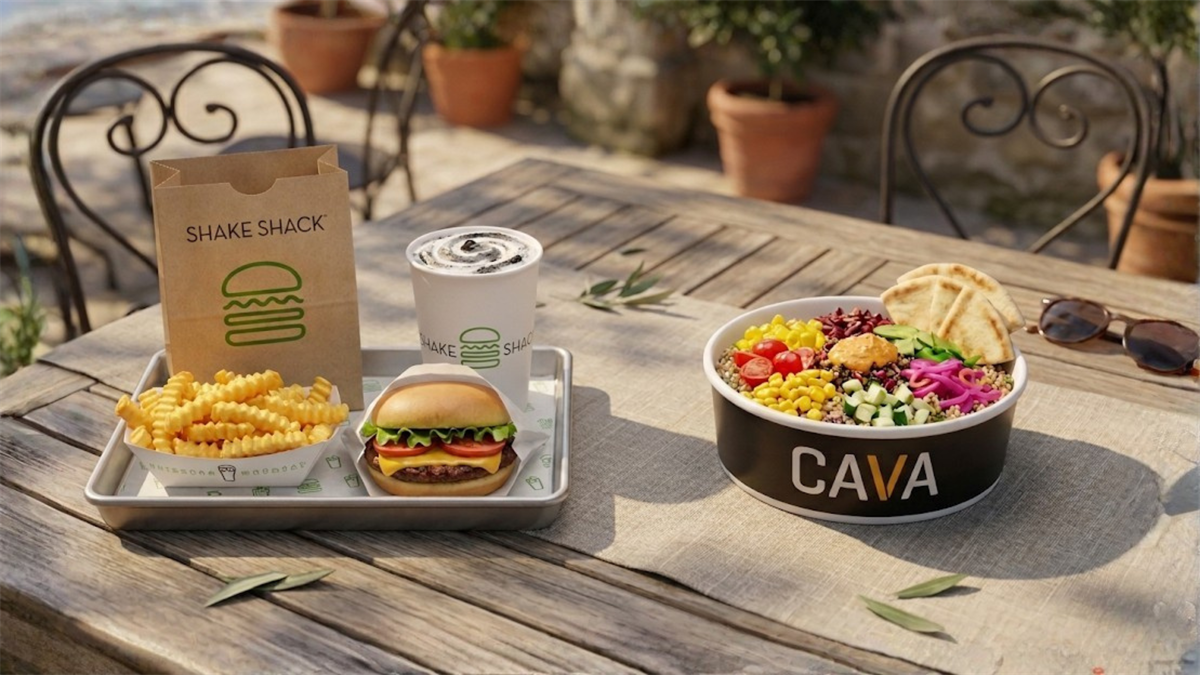
Shake Shack (NYSE: SHAK) and CAVA Group (NYSE: CAVA) are two of the leading names in the fast casual space. These companies recently reported earnings that reinforced the idea that consumers continue to spend.
Fast casual dining has become a key signal for the broader economy when it comes to restaurant and retail stocks. This sector balances affordability with nutrition, attracting Gen-Z consumers who increasingly choose these chains as their lunch and/or dinner options.

The Numbers Behind the Headlines
The underlying fundamentals tell a compelling story. Shake Shack posted Q4 2025 total revenue of $400.5 million, up nearly 22% year-over-year (YOY), with full-year revenue crossing $1.45 billion. That’s growth of more than 15%.
System-wide “shack count” (i.e., new restaurants) grew to 659 locations, up nearly 14% from a year ago, and the company reduced average net build costs to under $2 million per location, roughly 20% lower than the prior year. Those are meaningful improvements to unit economics that tend to get overlooked when investors focus solely on comps. Adjusted earnings before interest, taxes, depreciation, and amortization (EBITDA) for the full year reached approximately $210 million, up 20% YOY.
CAVA Group's story is similarly impressive in scale. Full-year revenue hit $1.2 billion, growing 22.5% versus 2024, while the company expanded its restaurant count from 367 to 439 over the course of 2025. Full-year adjusted EBITDA came in at $152.8 million, up 21% year-over-year. CAVA also generated $26.1 million in free cash flow, with net cash from operations of $184.8 million. That's an important signal of financial self-sufficiency for a company still in aggressive expansion mode.
Cautious Guidance or as Good as It Gets?
Same-store sales (or comparable-store sales) are one of the key metrics for retail stocks in general, and particularly for restaurant stocks. Both CAVA Group and Shake Shack reported low single-digit growth in same-store sales in their respective reports. Specifically, CAVA’s number came in at 0.5%, and Shake Shack’s came in at 2.1%.
At a time when many restaurants have reported negative same-store sales growth, any positive number is good. That’s particularly important, since both companies are still in the expansion stage.
The question is about forward guidance. Both companies guided for same-store sales growth between 3% and 5% for the full year 2026. That may become a headwind for each stock after each stock has been part of a rotation-led pullback the week after earnings.
Worth noting is that Shake Shack's Q4 result marked its 20th consecutive quarter of positive same-store sales growth. That streak offers reassurance about the brand's durability even amid macro headwinds and rising beef costs. For its part, CAVA's two-year stacked same-restaurant sales figure accelerated to 21.7%, suggesting the single-quarter headline number understates the underlying momentum.
Margin Trends Diverge Slightly
One area worth watching is restaurant-level profit margin. Shake Shack held its margin flat YOY at 22.7% in Q4 and expanded it by 120 basis points over the full year to 22.6%. This expansion was largely driven by labor productivity improvements while absorbing beef cost inflation in the low-teens percentage range. Management guided for a full-year 2026 restaurant-level margin of 23% to 23.5%, implying continued expansion.
CAVA's Q4 margin came in at 21.4%, down from 22.4% a year ago, as the company absorbed costs associated with rapid unit growth and investment in new markets. However, the full-year margin of 24.4% still leads Shake Shack, and management guided for 2026 margins of 23.7% to 24.2%. That's healthy territory for a chain still opening 74 to 76 net new restaurants this year, including first-time entries into Cincinnati, St. Louis, Columbus, and Minneapolis.
CAVA Group: Potential Golden Cross Confirmation
CAVA Group has fallen back as active traders took profits for the post-earnings rally and rotated into energy and defense stocks.
However, the stock is holding comfortably above the stock’s 50-day and 200-day simple moving averages (SMAs). Analysts remain constructive, with the consensus rating at Moderate Buy.
However, the bigger story reveals itself when the 200-day SMA line is added. That’s when a potential golden cross signal is forming. A golden cross occurs when the 50-day simple moving average crosses above the 200-day SMA.
Such a move is likely to confirm the bullish reversal in CAVA stock. It may also confirm not only the consensus price target of $83.82, but also the bullish price target increase from KeyCorp, which now gives CAVA stock a price target of $95, up from $65.

Shake Shack: Waiting for Conviction
The outlook for SHAK stock is less clear. The stock does appear to have broken out of its bearish downturn at the beginning of 2026. However, SHAK stock has been trading in a range with support at its 50-day SMA.
What SHAK stock seems to lack, however, is momentum. The moving average convergence/divergence has been close to neutral for some time. That coincides with volume that has generally been light.
The stock's consensus rating sits at Hold, reflecting a wait-and-see stance from analysts. A positive move above the 200-day SMA (not shown) around $103 may be bullish confirmation that a broader uptrend is in place.
With Shake Shack planning 55 to 60 new company-operated Shack openings in 2026 and a three-year target of low-teens revenue growth annually, the fundamental case for the stock may be building—but waiting for the chart to catch up.

Where Should You Invest $1,000 Right Now?
Before you make your next trade, you'll want to hear this.
MarketBeat keeps track of Wall Street's top-rated and best performing research analysts and the stocks they recommend to their clients on a daily basis.
Our team has identified the five stocks that top analysts are quietly whispering to their clients to buy now before the broader market catches on... and none of the big name stocks were on the list.
They believe these five stocks are the five best companies for investors to buy now...
The article "2 Restaurant Stocks, 2 Earnings Beats, 2 Very Different Setups" first appeared on MarketBeat.