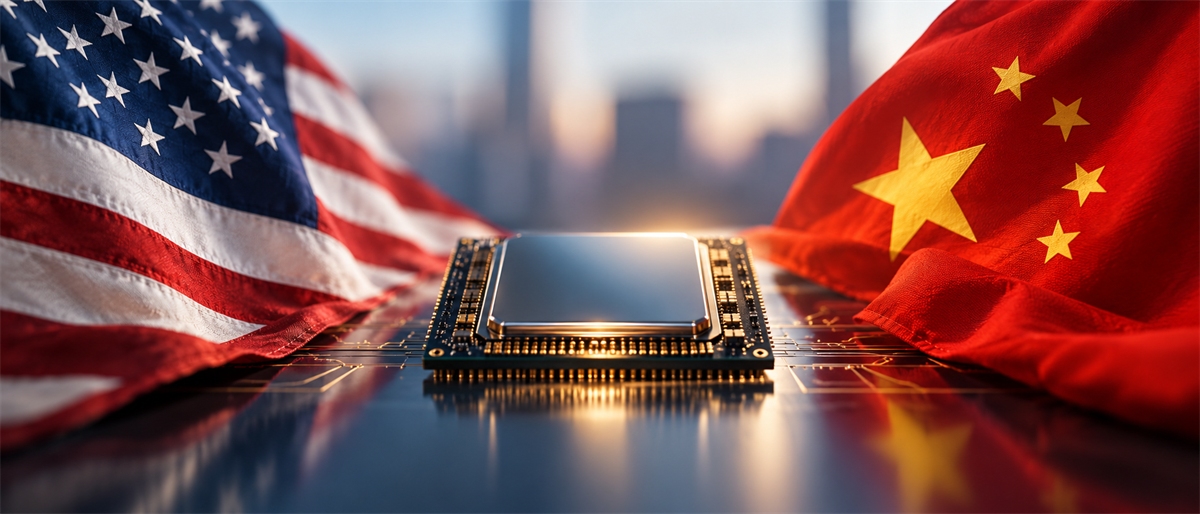
As the U.S.-China AI race heats up despite tech leaders' growing calls for caution, the meeting between Presidents Trump and Xi in late September 2026 may have been more of an opportunity to reduce risks incrementally rather than a chance to fully reset the rivalry between the two nations.
Investors may want to watch for modest moves that benefit both countries without resolving their deepest disagreements, such as reduced or paused tariffs, agreements on the Chinese purchase of U.S. products, and measures to ease AI chip export restrictions.
With this in mind, companies across industries ranging from semiconductors to consumer brands with significant cross-border exposure to industrials and more could all benefit, as could Chinese stocks that are more tapped into U.S. markets. This might sway the risk-reward balance of a China-focused exchange-traded fund such as the KraneShares CSI China Internet ETF (NYSEARCA: KWEB) or the iShares China Large-Cap ETF (NYSEARCA: FXI).
China's Internet and Software Firms May Look More Compelling, But Not Because of the Summit
KWEB targets China's technology and internet industries, with many of its 45 holdings being major firms recognized worldwide, such as Chinese-listed Tencent Holdings Ltd. (OTCMKTS: TCEHY).
These companies are highly exposed to U.S.-China technology policies, including AI and semiconductor restrictions. They're also heavily dependent upon Chinese consumer spending, which can be sensitive to changes in the diplomatic relationship between the two countries.
To be sure, investors may wait for a long time after the summit for changes to trade policy. A small drop in KWEB's share price in the final trading days of September suggests that investors looking for a big, immediate boost from the Trump/Xi summit did not find what they hoped for.
For this reason, KWEB is likely to continue to appeal to those who already found it a worthwhile investment: the fund is unique as a pure-play access point for Chinese software and tech companies, and it has dropped by 28% year to date (YTD), providing an attractive entry point.
Still, KWEB's biggest gains, and any case for its pricey 0.69% expense ratio among cost-conscious ETF investors, are more likely to come from strong Chinese consumer spending, advertising growth, or AI commercialization than from the latest summit.
A Broader Approach to Chinese Large-Cap Names May Be Less Susceptible to Geopolitical Volatility
FXI's strategy is much broader than KWEB's, including a variety of different industries and sectors in its basket of 52 large-cap names. Although it tends to lean away from tech and consumer names, it still holds large positions in some of the biggest names in KWEB's portfolio (Tencent is its largest holding, for instance). This may prevent investors from considering holding both of these funds simultaneously.
FXI's portfolio is heavily tied to financial companies in China; however, this makes it a play on the country's overall economy rather than one on a specific industry above others.
Some aspects of the broader Chinese economy are tied to its geopolitical relationship with the United States, but there are a host of other major factors that are less closely linked—the domestic property market, for instance, or the government's fiscal stimulus policies.
This fund may appeal to investors expecting state-owned enterprises in China to thrive for one reason or another, and it may be less volatile than KWEB due to its diversification and the types of companies it primarily focuses on. It may also be less susceptible to shifts due to the recent summit for some of the same reasons.
FXI is also trending downward this year, down by about 11% YTD, presenting a case for value-focused investors. However, it may be even less likely than KWEB to see a near-term catalyst that reverses this trajectory, given the Trump/Xi summit. Instead, investors might consider this fund a longer-term bullish play on China's broader economy. With a strong average trading volume, there is substantial investor interest in this fund and ample liquidity.
On the other hand, it trades at an annual fee that is even higher still than KWEB's, so investors will pay a premium for this flexibility and the exposure.
Investors should decide for themselves whether the market's sentiment surrounding the political summit in September was already reflected in stock prices—and if future disappointments on tariffs, AI policy, exports, or other hot-button issues might continue to send ETF prices downward.
The article "2 China-Focused ETFs For After the Trump-Xi Summit" first appeared on MarketBeat.