Get all your news in one place.
100's of premium titles.
One app.
Start reading
The Economic Times
The Economic Times
Trending Desk

1938 shock discovery in South Africa: A fish scientists thought was extinct suddenly reappeared after 65 million years and changed science forever

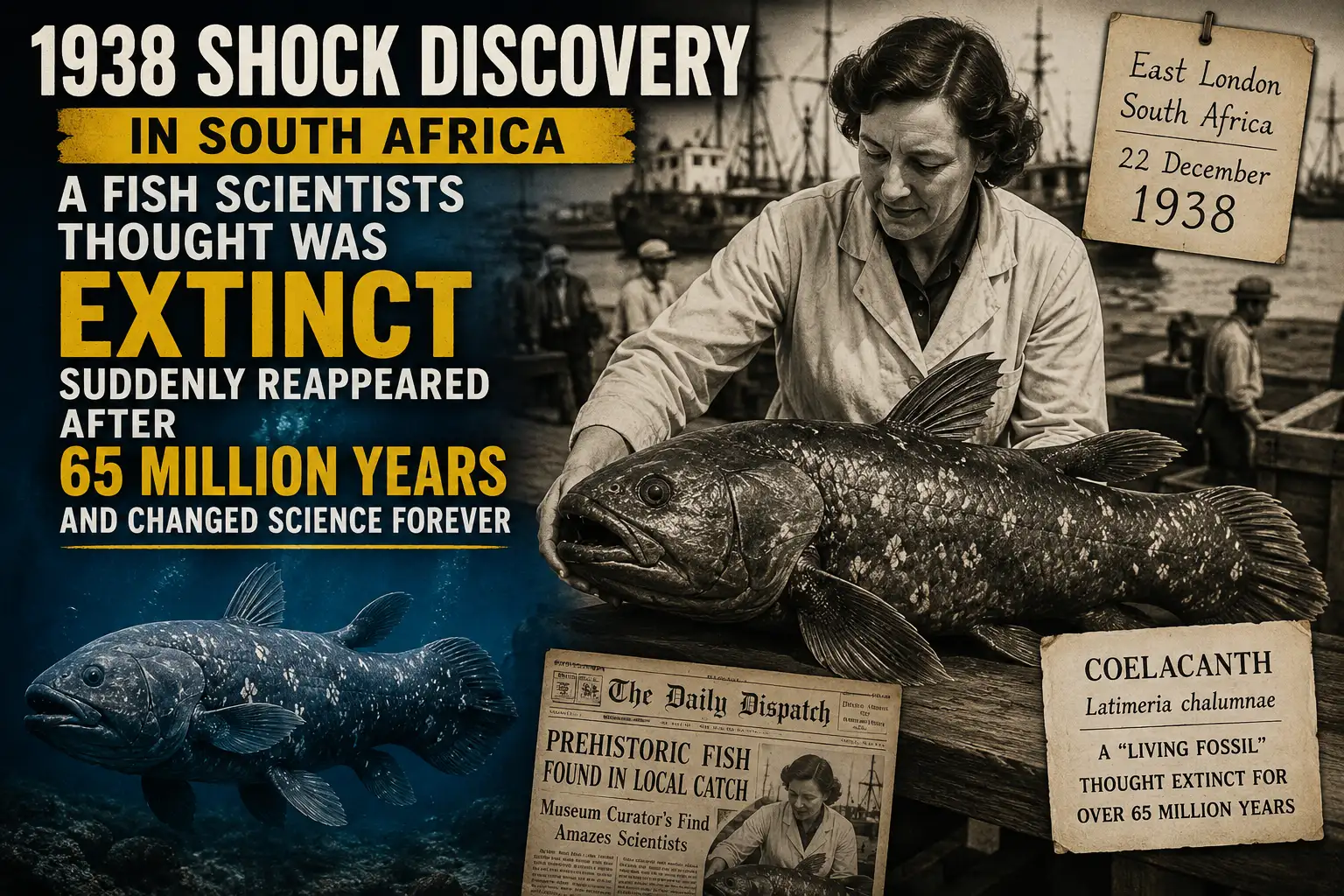
Sometimes science doesn’t move forward in a straight line but takes a sudden turn, triggered by chance. That is exactly what happened in December 1938, when an ordinary fishing catch in South Africa led to one of the most astonishing biological discoveries of the 20th century.

A museum curator, going through a fisherman’s haul at a coastal port, picked up a strange, heavy blue fish. At first glance, it looked unusual but what came next would leave the scientific world stunned.

ALSO READ: Best Proverb of the Day: “People visit the rich with gifts, but they visit the poor with...”

A routine visit turns into a historic moment

The curator was not expecting anything extraordinary that day. She was simply examining fish brought in by local fishermen, a routine part of museum work.

But among the catch was a fish that didn’t quite match anything known in modern marine biology. Its body structure looked ancient, almost prehistoric. Realizing that it might be important, she carefully preserved it and sent it for expert analysis.

A living fossil reappears after millions of years

What scientists discovered next was unbelievable. The fish belonged to a group believed to have gone extinct around 65 million years ago, long before humans existed. Until that moment, it had only been known through fossil records.

The creature is now famously known as the coelacanth, often called a “living fossil” because it appears almost unchanged from its ancient ancestors. Its rediscovery immediately forced scientists to rethink long-held beliefs about evolution and extinction.

Why the discovery shocked the scientific world

The idea that a species thought to be extinct could still be alive in deep ocean waters challenged everything researchers believed at the time. It suggested that the deep sea might still hold species that had survived major extinction events unnoticed for millions of years.

The coelacanth didn’t just reappear as a biological curiosity. It became a key species in understanding how vertebrates evolved, especially the transition from fish to early land animals.

Its fin structure and skeletal features offered clues about evolutionary links that had long been debated in science.

Still a mystery today

Even after decades of research, the coelacanth remains one of the ocean’s great mysteries. Scientists have since found a few more populations in deep waters near Africa and Indonesia, but it is still extremely rare.

Its survival story is a reminder that the planet still holds secrets waiting to be uncovered—sometimes in the most unexpected places.

Sign up to read this article
Read news from 100's of titles, curated specifically for you.
Already a member? Sign in here
Related Stories
Top stories on inkl right now
One subscription that gives you access to news from hundreds of sites
Already a member? Sign in here
Our Picks
Fourteen days free
Download the app
One app. One membership.
100+ trusted global sources.