
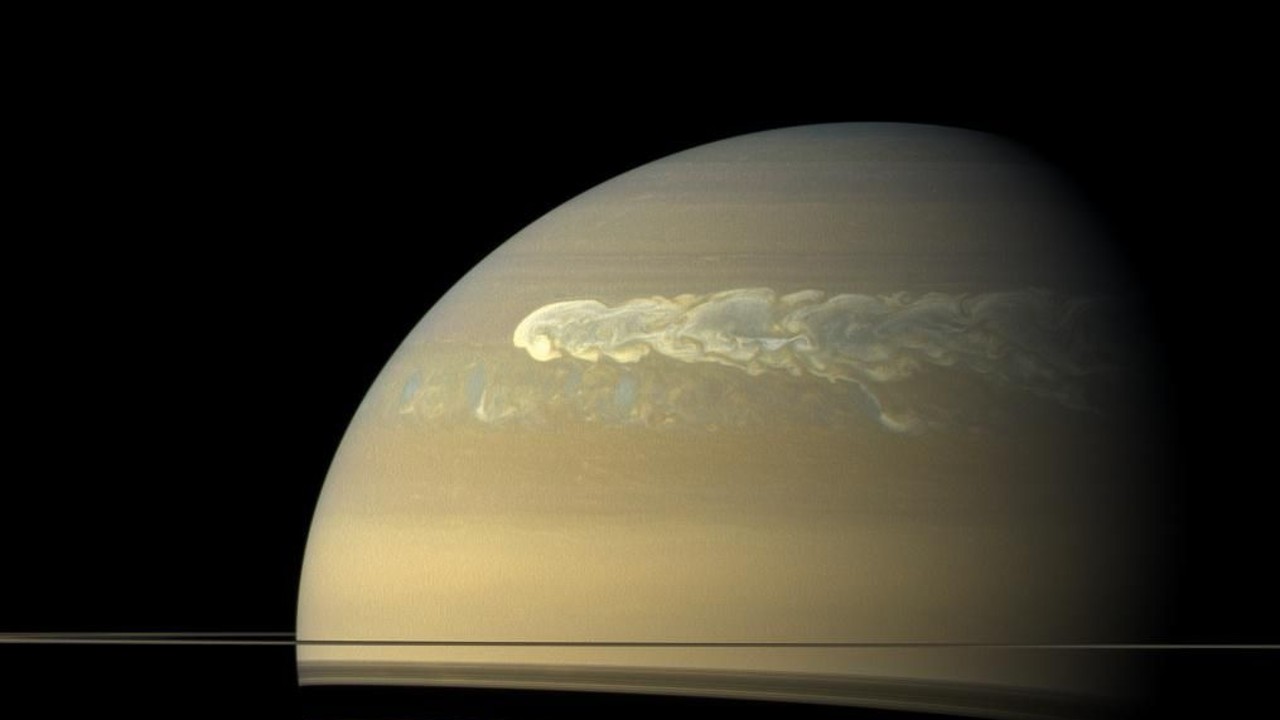
Scientists have discovered that Saturn experiences long-lasting megastorms that persist for centuries and churn up its deep atmosphere.
Saturn had previously been considered somewhat calmer than its fellow solar system gas giant Jupiter, which has been home to a 10,000-mile-wide storm called the Great Red Spot for hundreds of years. Though the Great Red Spot remains the largest storm in the solar system, the newly uncovered storms of Saturn are still powerful enough to put Earth's hurricanes to shame.
The megastorms of Saturn, thought to occur between every 20 and 30 years, are similar to hurricanes on Earth but are much larger. Whereas Earth's hurricanes get energy from our planet's oceans, the mechanism driving megastorms in the hydrogen and helium-rich atmosphere of Saturn is somewhat mysterious.
But astronomers from the University of California, Berkeley and the University of Michigan, Ann Arbor have learned more about these storms on Saturn by studying disruptions in the distribution of ammonia gas in the planet's deep atmosphere. "Understanding the mechanisms of the largest storms in the solar system puts the theory of hurricanes into a broader cosmic context, challenging our current knowledge and pushing the boundaries of terrestrial meteorology," University of Michigan assistant professor Cheng Li said in a statement.