
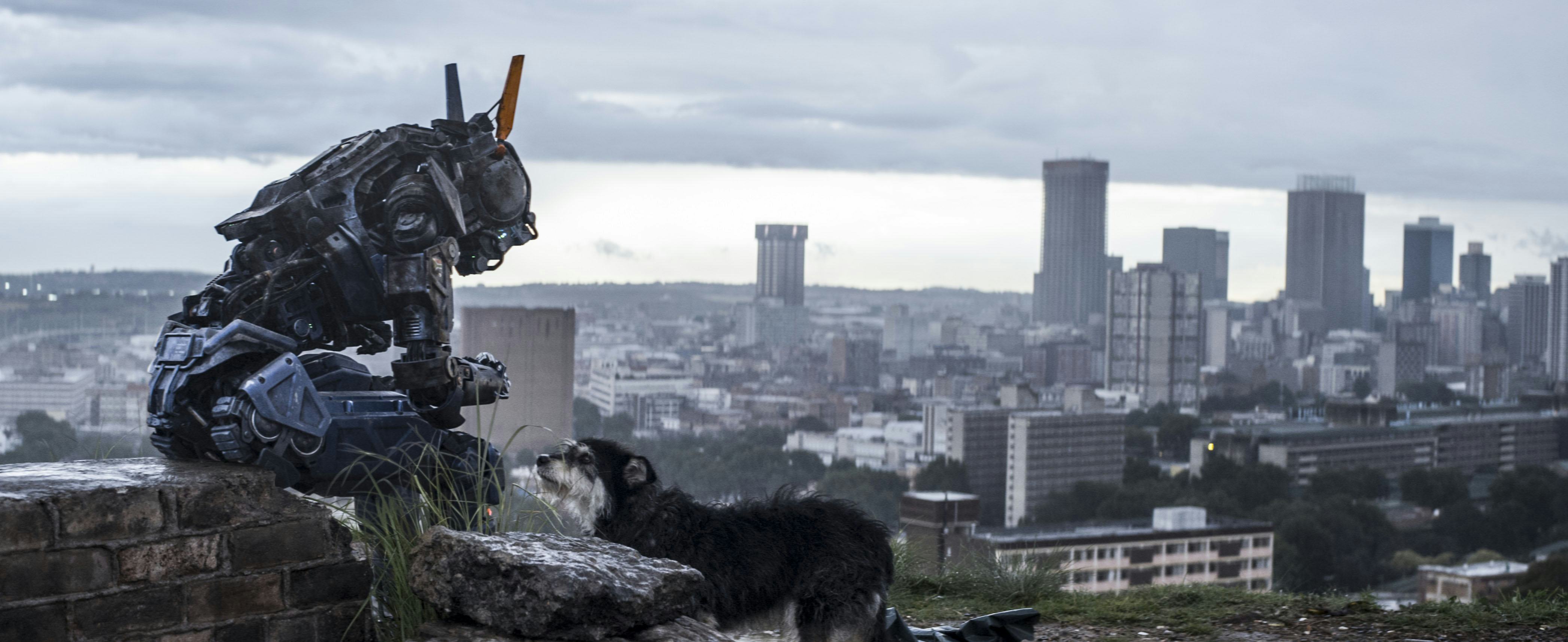
We live in the world that sci-fi pioneers like Isaac Asimov warned us about. Inequality heightens while political authoritarianism is on the rise, while companies pursue the development of AI-powered military robots and job-ending AI. Most science fiction, at least what makes it to screen, appropriately highlights these dangers, but other than “don’t do it!”, film history doesn’t always offer advice on what we should do about these future technologies. Chappie, Neill Blomkamp’s exploration of near-future AI, suggests a novel solution: make AI-powered bots more human, not less.
Chappie takes place in a world where Johannesburg gets the world’s first robotic police force, the “Scouts,” thanks to inventor Deon Wilson (Dev Patel) and the company Tetravaal. A set of local criminals, led by Yolandi (Yolandi Visser) and Ninja (Ninja), inherit the world’s first truly autonomous, sentient robot when they kidnap Deon and his latest project. The catch: its consciousness starts as a child, and it must be raised like one. Between Ninja’s desire to use Chappie for crime, Yolandi’s sensitivity to it as a sort of child, and Deon’s desire to test the limits of his experimental consciousness, Chappie goes through a complex array of developmental stages. Meanwhile, at Tetravaal, Deon’s work rival, Vincent (Hugh Jackman), pursues the development of his walking tank of a robot, the Moose. And as he “grows,” the atypical Chappie becomes part of the resistance movement against the growing horde of military robots.