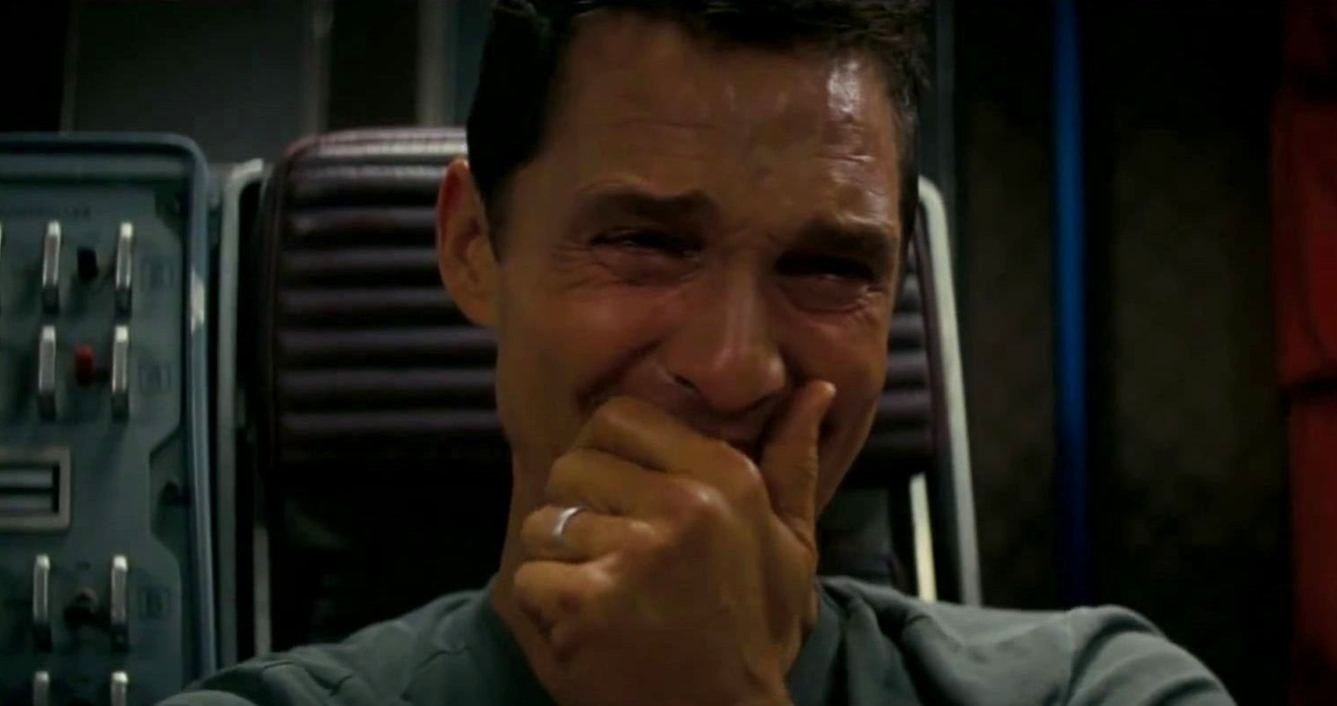
No movie has been ruined by a meme quite the way Interstellar was ruined by the Matthew McConaughey crying meme. Just one year after the release of Interstellar, the visage of McConaughey staring at a screen while utterly losing his sh*t was suddenly standing in for all kinds of trivial things that had nothing to do with the context of the scene within the film. Memes are fun, but memes are also contextless monsters, destroying nuance, writing, and actual meaning relentlessly. And if there’s one kind of movie that simultaneously is utterly memeable and also should not be memed, it’s a big Christopher Nolan movie like Interstellar.
To put it a slightly different way, on the 10th anniversary of Interstellar, the problem with discussing why this film is good requires the usual summaries of what exists in the movie that is remarkable, which, strangely, with this film, becomes reductive quickly. With relative ease, we can rattle several “firsts” about Interstellar that make it sound culturally relevant — it was one of Timothée Chalamet’s first films (in a minor role), it was the first movie Nolan made after the conclusion of The Dark Knight Trilogy, and it was the first major sci-fi film to depict black holes with very-close scientific accuracy. But none of these firsts are why Interstellar remains a brilliant and strangely underrated science fiction masterpiece. Because this film is one of the rare cases where it’s not only greater than the sum of its parts, but those individual parts are occasionally, paradoxically, greater than the whole.