
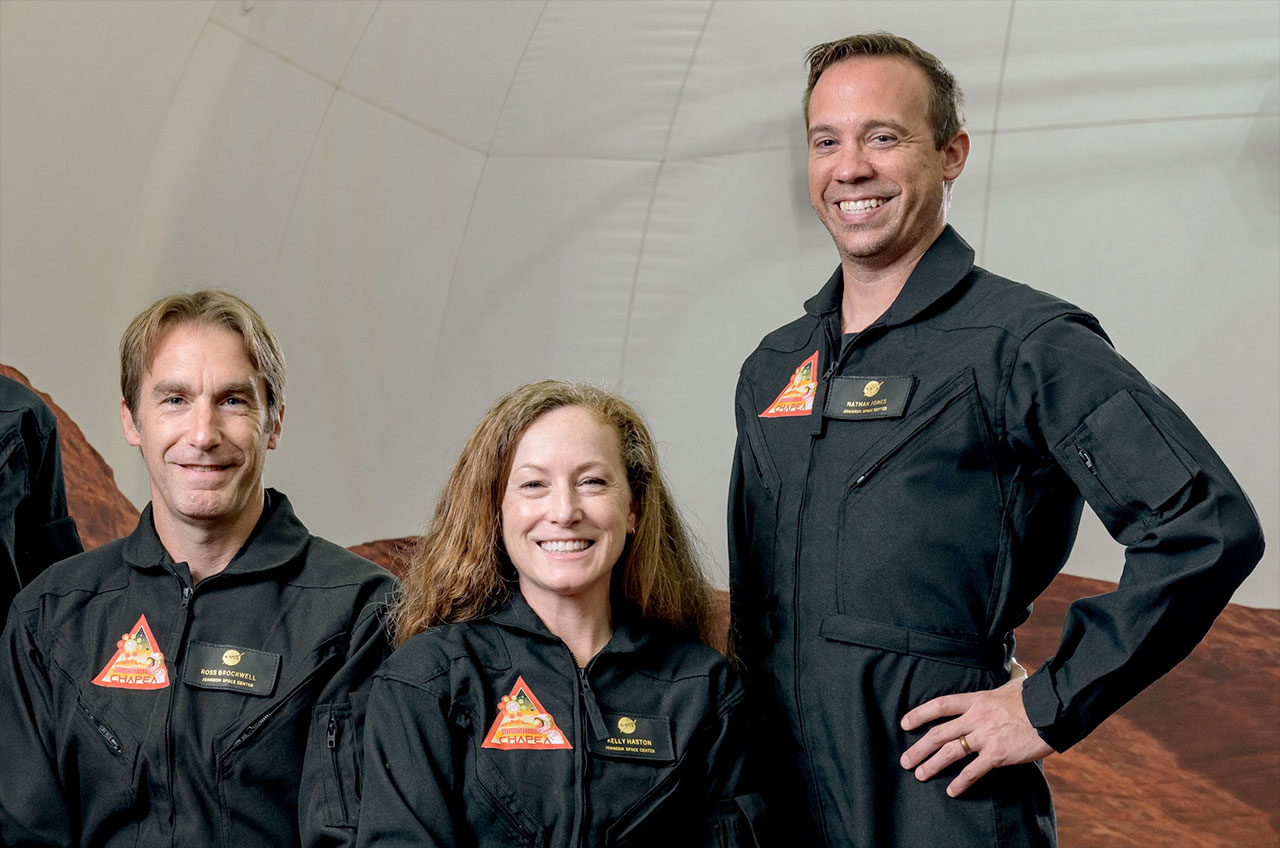
The next time that Kelly Haston, Ross Brockwell, Nathan Jones and Anca Selariu will see blue sky, a year will have gone by on Earth.
Not that the four "analog astronauts" are leaving the planet, but for the next 12 months they will live inside a mock Mars base located at NASA's Johnson Space Center in Houston, Texas, where they will be remotely observed and studied by scientists. As the first of three planned Crew Health and Performance Exploration Analog, or CHAPEA, crews, Haston, Brockwell, Jones and Selariu will help inform the space agency how to better design and plan for future human missions on the real Martian surface.
Mission 1 gets underway tonight (June 25) as the four volunteers enter the 1,700-square-foot (158 square meters) habitat, known as "Mars Dune Alpha," at 7:30 p.m. EDT (2330 GMT). They will not leave the 3D-printed structure — other than to conduct the occasional Mars-walk within an adjoining 1,200-square-foot (111 square m), enclosed Mars "sandbox" — until July 7, 2024.
"To me, this is really exciting, because one of the things that's different than some of our previous analogs at NASA is, people will be in isolation as a crew for 378 days," Suzanne Bell, lead for NASA's Behavioral Health and Performance Laboratory at Johnson Space Center, said in an interview with collectSPACE.com. "We also do analogs in something called HERA, the Human Exploration Research Analog, and our missions there have been 45 days. And then we collect data at other analogs, too, with varying lengths, but this will be three, over one yearlong missions, which is a really great extended isolation."
Related: A month on 'Mars': Preparing to visit the Red Planet ... on Earth













