The bombs and missiles started falling on Tehran in full daylight, at about 9.15am, after the working day had started and the streets and offices were full.
Bombing campaigns in the modern era usually start at night, to heighten the target’s sense of disorientation and minimise the effectiveness of air defence.
This time was different, however. The plumes of smoke that rose from the streets of the Iranian capital came from the buildings in the government zone and villas in the well-to-do districts. As Israeli officials were to confirm later, this initial salvo from Israel and the US was a decapitation strike, aimed at killing Iran’s leadership and eliminating as much as possible of the government apparatus at the same time. For such a consequential goal, it made sense to wait until officials had arrived at their desks.
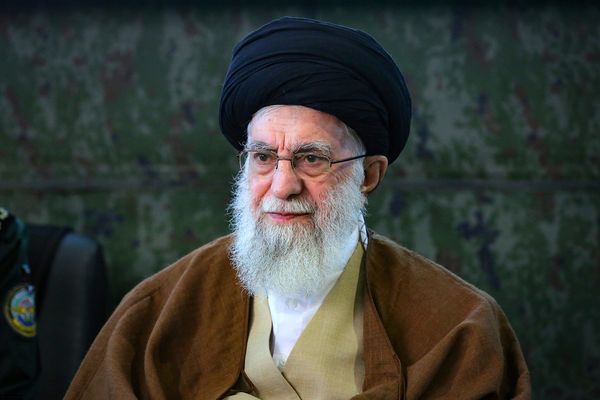
By 10.30am, Tehranis had reported two rounds of explosions along Pasteur Street, where many government buildings are clustered, including the offices of the supreme leader, Ayatollah Ali Khamenei, President Masoud Pezeshkian, the national security headquarters and the assembly of experts, which chooses the new supreme leader when the incumbent dies or retires.
Satellite photos showed the supreme leader’s compound as a dark grey mess of dust and ash but Iranian news agencies insisted Khamenei was safe in an undisclosed location and Pezeshkian was also unhurt.
An Israeli military official briefing reporters a little later confirmed both leaders had been targeted but added the outcome was unclear.
It was not just the current leadership that was targeted. The Tehran residence of the former Iranian president, Mahmoud Ahmadinejad, was also destroyed, and his fate was not immediately known.
Ambulances were reported leaving the Pasteur district carrying the injured as news came from across the country of attacks in other cities, including Qom, Tabriz, Kermanshah, Lorestan Khorramabad and Karaj.
At the same time, the first reports of civilian casualties arrived. The state-run news agency IRNA reported that at least 40 people were killed after an Israeli strike hit a girls’ elementary school in Minab in the southern Iranian province, Hormozgan. The Islamic Revolutionary Guard Corps has a base in the city, which may have been the target, but waiting for people to come to work to begin bombing also raises the chances of killing children arriving at school and other civilians being crowded together.
If the targeting of the leadership was not sufficient evidence that the US-Israeli strike was aimed at regime change, the Israeli spy agency, the Mossad, posted a tweet in Farsi, calling for an uprising.
“Our Iranian brothers and sisters, you are not alone! We have launched a special, super secure Telegram channel for you,” the message read. “Together we will return Iran to its glorious days. Share with us photos and videos of your just struggle against the regime. And most importantly – take care of yourself! We are with you.”
The Mossad’s wording urging Iranians to topple their government was soon echoed by Donald Trump, not in person, but in a recording made before Washington went to sleep on Friday night, and broadcast on his own Truth Social channel at about 2.30am Washington time, roughly 11am in Tehran.
In the recording, the president stood at a lectern in a white USA baseball cap and announced the start of “major combat operations in Iran”. The eight-minute address started with the claim that the attack was to defend the American people from “imminent threats” from the Iranian regime, “a vicious group of very hard, terrible people”.
It ended with a rallying cry for the Iranian people to rise up when the dust had settled, telling them it was now or never.
“I say tonight that the hour of your freedom is at hand,” he said. “Stay sheltered. Don’t leave your home. It’s very dangerous outside. Bombs will be dropping everywhere. When we are finished, take over your government. It will be yours to take. This will be, probably, your only chance for generations.”
“Now you have a president who is giving you what you want, so let’s see how you respond,” Trump went on. “Now is the time to seize control of your destiny and to unleash the prosperous and glorious future that is close within your reach. This is the moment for action. Do not let it pass.”
Not long after, the Pentagon let it be known the attack on Iran was given the codename Epic Fury. Israel announced its own name for the new war, Operation Roaring Lion, and even produced a logo to go with it, the blue and white Star of David flag with the eponymous lion standing before it, mouth gaping.
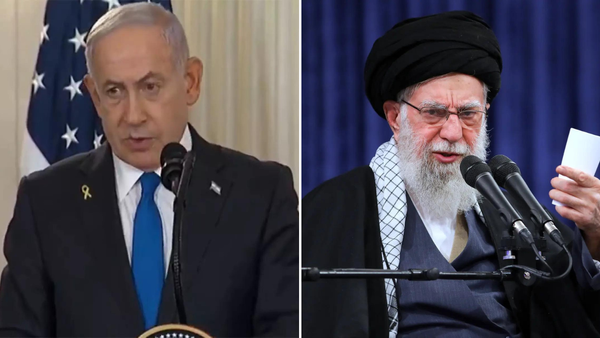
In keeping with the close coordination between the two countries, Benjamin Netanyahu released a statement at about the same time as Trump, thanking him for his leadership, and underlining the war aim “to remove the existential threat posed by the terrorist regime in Iran”.
In briefings over the course of the morning, Israeli military officials stressed the two countries’ militaries had worked hand in glove for months to prepare the joint attack.
The exact timing of the attack seems to have been determined by a number of moving parts falling into place. Talks between Trump’s son-in-law, Jared Kushner, his special envoy, Steve Witkoff, and an Iranian delegation led by the foreign minister, Abbas Araghchi, adjourned in Geneva on Thursday without a definitive conclusion.
Araghchi said that “good progress” had been made, and Omani officials who had acted as brokers said the negotiations would resume on a technical level next week in Vienna.
The Americans said nothing. It is now clear Witkoff and Kushner were sent to Geneva on the chance they could procure a complete Iranian capitulation, surrendering not only the country’s nuclear programme but its missile production too. It is possible that no Iranian offer would have been good enough to stop a war, once Trump’s armada had gathered.
Back in Washington, Trump declared himself “not thrilled”. The next day, Adm Brad Cooper, the head of US Central Command, and the chair of the joint chiefs of staff, Gen Dan Kaine, presented a final briefing to Trump on the military options, and at more or less the same time, the world’s biggest aircraft carrier, the USS Gerald Ford, arrived in Haifa after its two-week voyage from the western Atlantic where it had participated last month in the toppling of another of Washington’s enemies, the Venezuelan leader, Nicolás Maduro.
The presence of the Ford and its escort of destroyers brought Trump’s vaunted “armada” to its full complement, the biggest force to be amassed in the Middle East since the Iraq invasion 23 years ago. It was critical for sustaining a major aerial war as well as in helping defend Israel against the inevitable Iranian backlash.
As the Ford docked on Friday, the US ambassador in Israel sent a memo to his staff telling them that if they wanted to leave the country they should depart that day, to whichever outside destination they could buy a ticket for.
Realising that time was running out, the Omani foreign minister, Badr Albusaidi, who had brokered the US-Iranian talks, made an urgent trip to Washington where he met vice-president JD Vance and pleaded with him to give diplomacy some more time.
Waking on Saturday to the news his mission had failed and the bombing had started, Albusaidi expressed his dismay.
“Active and serious negotiations have yet again been undermined,” the minister tweeted. “Neither the interests of the United States nor the cause of global peace are well served by this. And I pray for the innocents who will suffer. I urge the United States not to get sucked in further. This is not your war.”
Albusaidi’s words came too late. The US had already been sucked in by its volatile president to a major war that quickly became regional.
Ebrahim Azizi, the chair of the Iranian parliament’s national security commission, declared on Saturday morning: “We warned you, but now you have started down a path that is beyond your control.”
Within a few hours, Iran’s substantial arsenal of missiles had been unleashed in all directions around the region, towards Israel and the Gulf states housing US military bases. Explosions were reported in the United Arab Emirates, Bahrain, Qatar and Kuwait.
Billowing clouds of grey smoke rose from the US base just south of the Bahraini capital, Manama, and the government evacuated the population from the area. In the wealthy Palm Jumeirah area of Dubai, the five-star Fairmont hotel erupted in flames after being hit. There was no immediate estimate of casualties.
The United Arab Emirates announced that it had intercepted incoming Iranian missiles, and one person was reported to have been killed in Abu Dhabi from falling debris from an intercepted projectile.
By the time members of Congress awoke in Washington, the Gulf was ablaze as a result of war they had not been consulted on, apart from a briefing from secretary of state, Marco Rubio, on Tuesday to the “gang of eight” congressional leaders.
“Against the clear wishes of the American people, President Trump has thrust our nation into a major war with Iran – one he never made a case for, never sought congressional authority for, and for which he has no endgame,” Jack Reed, the ranking Democrat on the Senate armed services committee, said.
As night fell on Tehran, and rumours circulated on which of the country’s leaders were dead, and which had survived, it was impossible to determine which course events would take, now that Trump and Netanyahu had rolled the dice on the future of the region.