When Vladimir Putin launched his cynically euphemistic “special military operation” against Ukraine four years ago, it was supposed to last about a week. In that time, according to the Kremlin’s plan, Volodymyr Zelensky – a supposed “Nazi” who just happens to be Jewish – was expected to flee Kyiv to some comfortable bolthole in the West.
Safe to say, things have not gone to plan. Ukrainian territory has been occupied, too often after being razed to the ground, and force has been used to the most obscene degree against the civilian population.
Yet, after some successful Ukrainian counterattacks, Russia today occupies less of Ukraine’s sovereign territory than in the early stages of the war, and its military has proved to be poorly trained, badly led, ill equipped, undisciplined, and not entirely loyal – as was demonstrated by the rebellion staged by the Wagner mercenary leader Yevgeny Prigozhin in 2023, which came surprisingly close to toppling the Russian president himself.
Russia has threatened the West with nuclear weapons, to no avail, and its economy has been crippled by disinvestment and sanctions. To no small degree does this nominal superpower, with a GDP roughly the size of Italy’s, rely on aid from China, North Korea and Iran. That, in itself, is a national humiliation.
Such small, incremental gains that have been achieved by Putin’s forces on the battlefield have been secured at a huge cost – reports estimate 1.3 million dead and injured. With losses of 30,000 plus a month, even Russia will find it difficult to sustain the “meat grinder” – especially if conscription is avoided in politically sensitive big cities such as Moscow and St Petersburg.
Yet, compared with the battle lines in 2024, Russia now occupies only 1 per cent more Ukrainian land than it did then. No wonder Putin wants the remainder of the Donbas to be handed over without a fight. His aim was to “Russify” the whole of Ukraine, but he has only succeeded in making the country yearn to be freer and more European.
So far from forcing Nato to retreat, it has expanded, with Sweden and Finland adding substantial heft on Russia’s western flank and in the Arctic region. In many respects, European Nato has become more united and clearer about the reality of Putin’s intentions. No one can bank on these for sure, maybe not even the Russian president himself, who prefers to take his opportunities as they present themselves. But there can be no doubt that, as he said on day one, the restoration of Russia’s post-1945 dominance in Eastern Europe is the clear, overriding ambition.
That, however, also brings any assessment of this war to the question of Western solidarity, and the response to Putin’s undisguised aggression. The answer is that the West has been tragically weak, and if it had demonstrated a fraction of the sustained strength of purpose and bravery of the Ukrainians, then by now, the Russians might have been so weakened that they’d sue for peace, rather than play-acting at the talks with Donald Trump’s endlessly gullible envoy, Steve Witkoff.
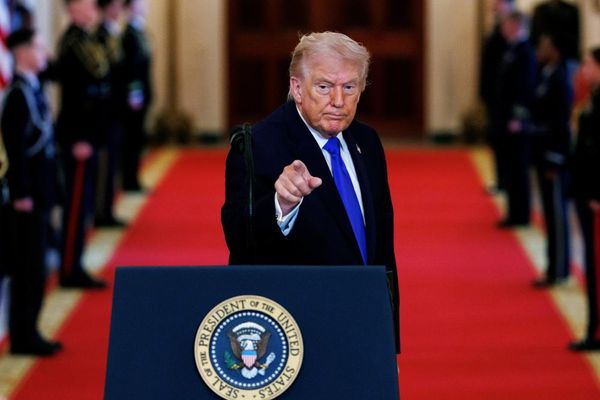
The second coming of Mr Trump was indeed an unwelcome resurrection for most of the European powers, and his “peace plan” – in reality, a demand for Kyiv to surrender on Russian terms – is obviously a fatal threat to Ukrainian independence. At best, it would dismember the country, and leave it open to a future return of Putin’s armies and missiles just as soon as he has regrouped and repaired his war machine.
In President Trump, the Russian leader has found a friend, and something far too close to an ideological ally, one who derides the European democracies for their “civilisational erasure” almost as much as the Kremlin does. Into this moral vacuum should have come a unified European response. But all concerned, not least the Kremlin, can see the dreadful feebleness on show.
The European Union is not a defence union. Even so, its failure to overcome the vetoes of Russia-friendly states, such as Hungary and Slovakia, in order to send more money to Ukraine, is lamentable.
Poland, one of the few nations to spend what is needed on defence, cannot spare troops to safeguard any ceasefire in Ukraine, because it fears Russian incursions itself. In short, the Macron-Starmer “coalition of the willing” looks more like a pact of the reluctant.
If President Zelensky is right in his judgement that Putin has already started the third world war, then the verdict at this juncture must be that Ukraine has survived it, and that Russia has not won this first phase. But, given US detachment and European disarray, the next phase, which could easily last for another year or two, will prove even more decisive. It would be reassuring if there were much evidence that Europe’s leaders really understood the catastrophe their peoples face.
We’re in deep trouble – everything about our armed forces is yesterday’s war
President Trump is wrong. Ukraine can win this war
Navalny’s poisoning will taint Vladimir Putin until his dying breath
A critical point for Ukraine – and for Europe
SEND reform cannot wait – and neither can fiscal reality
Now Donald Trump and the royal family know ‘the rule of law’ is no empty phrase