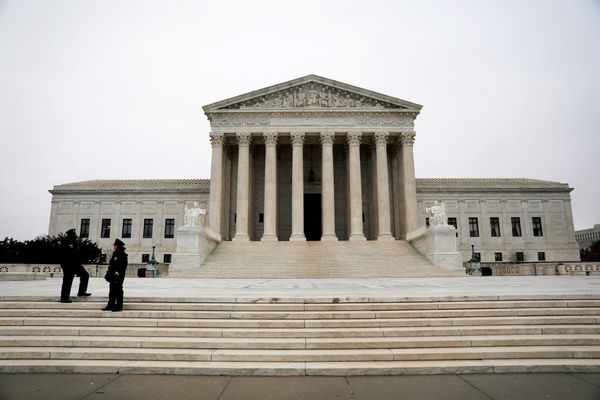
The US supreme court has upheld the constitutional guarantee of birthright citizenship, affirming that nearly all people born on US soil are American citizens and rejecting a central pillar of Donald Trump’s anti-immigrant agenda.
The president had issued an executive order on the first day of his second term that sought to deny automatic citizenship to the children born to undocumented immigrants and temporary foreign residents. Writing for the majority, Chief Justice John Roberts said this order violated the 14th amendment of the US constitution.
“Citizenship, then and now, was the right to have rights – to freely participate in our political community,” wrote Roberts. “The Framers of the Fourteenth Amendment extended that promise to ‘every free-born person in this land.’ We keep that promise today.”
Roberts was joined by the liberal justices Sonia Sotomayor, Elena Kagan and Ketanji Brown Jackson, and the conservative justice Amy Coney Barrett. The conservative justice Brett Kavanaugh concurred with the judgment but dissented in part, arguing that the executive order violated federal law but not the constitution. The conservative justices Clarence Thomas, Samuel Alito and Neil Gorsuch filed dissenting opinions. The court’s writings in the ruling span 194 pages, nearly 90 of which were written by Thomas in dissent, his longest in his tenure on the court.
Trump called the ruling “too bad for our Country”, but said US Congress should now take up the matter legislatively, suggesting another avenue to keep the issue alive.
“No long and unwieldy Constitutional Amendment is necessary! Congress should start TODAY to work on ending expensive and unfair to our Country, Birthright Citizenship,” Trump wrote on his Truth Social platform. “They will have my Complete and Total Support!”
Civil rights groups and Democrats celebrated the ruling from the conservative court, calling it one of the most important decisions in the modern era and noting how it affirmed the promise of America.
The American Civil Liberties Union, whose national legal director, Cecillia Wang, argued the case before the supreme court as part of a class-action challenge brought by parents of children who would be affected by the president’s order, celebrated the ruling as a “major victory”.
“The court’s decision reaffirms a fundamental American promise – if you are born here, you are a citizen,” Wang said. “A president cannot change the constitution by executive fiat. Our brave clients and our legal team stand with millions of people around our country who spoke up for one of our most cherished rights. The constitution’s guarantee of birthright citizenship stands strong.”
Trump has long sought to dismantle the principle of birthright citizenship, pushing the racist lie that Barack Obama was born in Kenya and ineligible for the presidency . He also baselessly questioned Kamala Harris’s eligibility for the vice-presidency and later, the White House, based on the immigration status of her parents at the time of her birth.
The totality of Trump’s second-term immigration agenda has sought to radically re-define who gets to claim American citizenship. In an extraordinary move, Trump attended the oral arguments in person when the court heard the case, the first time a sitting president had attended oral arguments.
The Trump administration argued the phrase “subject to the jurisdiction thereof” in the 14th amendment meant babies born in the US to people who are not lawfully present in the country are not citizens. The executive order says this includes when neither of a person’s parents were US citizens or lawful permanent residents, or if a parent has legal, but temporary, status. It sought to apply this meaning starting on 19 February 2025, which would affect hundreds of thousands of babies annually.
As courts deliberated for more than a year over the cases brought against the president’s order, the fate of many thousands of children born in the US to parents without permanent legal status hung in the balance.
Reactions on Capitol Hill split largely along partisan lines. Hakeem Jeffries, the Democratic leader in the US House, noted that the 14th amendment “withstood the unconstitutional attack launched by Donald Trump and his most sycophantic and xenophobic enablers”.
“On the eve of America’s 250th birthday, the far-right Maga conservatives have failed in their quest to remake the United States, and American values have prevailed,” Jeffries said.
Several Republicans expressed disappointment with the ruling.
“I do think that this has been grossly abused in recent years,” Mike Johnson, the Republican speaker of the US House, said at a press conference. “You just come on to the soil and have your child, and then they’re able to avail themselves of the welfare state and everything else.”
In Tuesday’s ruling, the majority opinion walks through the plain meanings of citizenship, from English common law into slavery and then emancipation, and then into efforts to undermine citizenship, including the Chinese Exclusion Act.
Roberts writes that the “odious” decision in Dred Scott denied citizenship to Black people, arguing then that it was “blood, not soil” that decided citizenship. The 1857 decision was reversed by the 14th amendment, to codify the rights of Black Americans – and confer citizenship to “all persons born or naturalized in the United States, and subject to the jurisdiction thereof”.
“Children born in the United States to parents unlawfully or temporarily present are ‘subject to the jurisdiction’ of the United States and are citizens at birth under the Fourteenth Amendment’s Citizenship Clause,” the majority writes.
In her concurring opinion, the liberal justice Jackson writes that the 14th amendment’s “universalist aims should forever be the death knell for this kind of claim – one that seeks to make bloodline the marker of birthright”.
“The America that was reborn from the rubble of the Civil War simply does not countenance that inequitable result,” she wrote. “Thankfully, a majority of the Court remembered this today, and has dutifully preserved the most basic animating principle of our Nation’s founding – that all human beings are created equal – once more.”
Thomas, however, writes in his sprawling dissent that Black people were entitled to citizenship because they were Americans with “no other homeland” or allegiance to other nations. The same is not true, he writes, “for the children of foreign temporary visitors”.
In a partial concurrence, Kavanaugh writes that he does not believe Trump’s executive order violates the 14th amendment, but that it does violate a federal statute. Congress could, he writes, amend the federal statute or create new legislation to establish exceptions to birthright citizenship for children born to parents who do not have permanent legal status in the country.
“But Congress has not yet done so,” he writes.
Alito, in his dissent, called the decision “one of the most important” in the court’s history, but, in his estimation, “the Court has made a serious mistake”.
He, like Kavanaugh, floats the idea of Congress addressing the issue.
Overturning a constitutional amendment requires a two-thirds majority vote of both chambers of Congress, or the legislatures of two-thirds of the states to call for a convention, a much higher bar than passing a new statute. Trump shared an article on Truth Social on Tuesday morning alluding to a statutory process to upend birthright citizenship.
The quest to overturn birthright citizenship has gained traction among some conservatives in recent years, though most legal scholars still believe the amendment has been interpreted correctly. The administration is relying in part on the legal arguments of a white supremacists from the late 1800s, the Washington Post reported. John Eastman, a lawyer who worked with Trump to try to overturn the 2020 election results who has since been disbarred in California, is also a key proponent of the effort to overturn birthright citizenship, Politico reported.
Domicile weighed heavily into the Trump administration’s claims, though the word is not included in the 14th amendment. The landmark decision on birthright citizenship, United States v Wong Kim Ark, said that a child born to parents of Chinese descent who had permanent “domicile” in the US would be a US citizen at the time of birth under the 14th amendment. The Trump administration argued “domicile”, meaning a permanent residence, is a critical part of the interpretation.
The justices were skeptical of the government’s claims during oral arguments. Roberts, the conservative chief justice, at one point referred to part of the government’s argument as “very quirky”. Liberal justice Kagan said the government was using “pretty obscure sources” to arrive at part of its case.
In the decision, Roberts wrote that “the Court exhaustively canvassed the text and history of the Citizenship Clause and at no point identified any evidence that the ratifiers thought themselves to be imposing a domicile limitation”.
Roberts repeatedly bats down the idea that “domicile” was much more expansive an idea, and that primary allegiance to the US was commonly seen as part of that definition, both arguments the government tried to make in its case. He writes that “there is scant evidence for this dramatically revisionist view”.
Read more coverage of today’s supreme court rulings: