The US House has reportedly rejected legislation, passed by the Senate, that would finance most of the Department of Homeland Security (DHS) but withhold funds from Immigration and Customs Enforcement (ICE) and part of Customs and Border Protection (CBP).
Mike Johnson, the Republican House speaker, said that GOP leadership will instead put forward a short-term funding bill to fund the entire DHS for 60 days, according to multiple reports.
The announcement comes as Johnson struggles to keep his fractured party together, after conservative hardliners in the lower chamber said the Senate bill – which lawmakers advanced in a rare overnight session ahead of Congress’s two-week recess – was dead on arrival.
Republican representative Chip Roy, a member on the influential House rules committee, called the predawn breakthrough on Capitol Hill “laughably bad” and insisted that his colleagues would be “rejecting it out of hand”.
“It is absolutely offensive to the people that we represent that the Senate would send over a bill that doesn’t fund border patrol and the core components of ICE,” Roy told reporters. He also said that members will push to attach several concessions to advance Donald Trump’s agenda – including voter identification.
The Senate-passed measure would have funded the DHS subagencies affected by the lapse in funding which has lasted almost six weeks, such as the Transportation Security Administration (TSA), the US Coast Guard, the Federal Emergency Management Agency (Fema) and the the Cybersecurity and Infrastructure Security Agency (Cisa).
The decision by House GOP leadership to reject the agreement sets up a clash with the Senate, and will require lawmakers in the upper chamber to return from their break to vote on the House’s continuing resolution. That proposal is unlikely to receive any support from Democrats in the Senate.
Lawmakers have been deadlocked for two months over broader DHS funding. Democrats, for their part, have demanded stronger guardrails on federal immigration enforcement, in the wake of the fatal shootings of two US citizens during the Trump administration’s immigration crackdown in Minneapolis.
Senate Republicans ultimately conceded to an 11th-hour deal that Democrats have been pushing for weeks – reopening only the affected agencies and omitting funding for ICE and border patrol.
The bill passed earlier lacks many of the key reforms that Democrats had been pushing for - like the need to obtain judicial warrants when entering private property and for officers to no longer wear masks. Nevertheless, Senate minority leader Chuck Schumer, heralded the deal as a victory for his party.
“Democrats held firm in our opposition that Donald Trump’s rogue and deadly militia should not get more funding without serious reforms, and we will continue to fight for those reforms,” he said.
Since ICE received $75bn through the president’s sweeping policy bill last year, it has been largely insulated from the funding lapse hitting the rest of DHS and has continued operating.
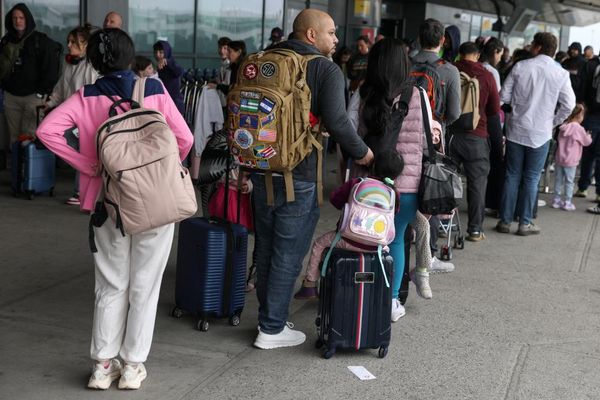
That contrast has grown starker amid historic airport wait times, weeks of missed paychecks for TSA workers, snaking security lines and furious travelers missing flights.
Acting TSA chief Ha Nguyen McNeill said this week that some officers are sleeping in cars or selling plasma, and that 40% have stopped reporting to work. The White House said nearly 500 officers have quit since last month.
In response, Trump said Thursday he would sign an executive order to immediately pay 50,000 airport security workers, claiming on Truth Social it would “quickly stop the Democrat Chaos at the Airports”.
The push for ICE funding hasn’t slowed, with Senate Republicans vowing to move federal immigration enforcement money — along with funding for the administration’s Iran campaign and parts of the Save America Act — through reconciliation, which requires only a simple Senate majority.
Late Thursday, Republican Lindsey Graham, who chairs the Senate budget committee, said that he will “proceed quickly and efficiently” to ensure “ICE and other vital functions of homeland security, as well as the US military and efforts to increase voter integrity, are Democrat-resistance proof”.