The day so far
-
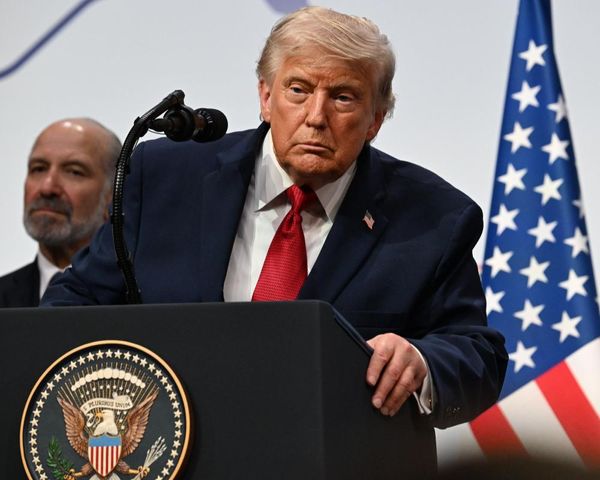
Donald Trump abruptly derailed the confirmation process for his own nominee as the US’s top intelligence chief, Jay Clayton, early this morning, in a move that will allow the US president’s controversial selection for acting director of national security, Bill Pulte, to assume the role and remain in place for at least several weeks until Clayton is confirmed. Tom Cotton, a Republican senator and chair of the intelligence committee, initially said on X that the hearing would go ahead as planned “unless the president directs [Clayton] not to appear or withdraws his nomination”. Trump later directed Clayton not to appear and the hearing was cancelled, which Cotton called “regrettable”. My colleague Cate Brown has the story.
-
Trump also responded to criticism of his ceasefire deal with Iran, warning at the G7 summit that he was prepared to go back to dropping bombs and insisting the deal did not require the US to pay even 10 cents to Iran. Here’s Patrick Wintour’s report.
-
Senior US officials dictated the memorandum of understanding with Iran to journalists after days of secrecy. According to the officials, the draft agreement includes a new “minimum” standard for down-blending of highly enriched Iranian uranium and has provisions to ensure the “territorial integrity” of Lebanon after Israel’s continued attacks against Hezbollah in Lebanese territory. In return, the US will move to waive, but not eliminate, some wide-ranging sanctions against Iran once the deal is signed. The US draft of the agreement also secures toll-free passage of the strait of Hormuz for only 60 days, and it does not preclude fees in the future, the officials said. The accord, which Trump said today is “not final”, is due to be signed on Friday in Bürgenstock, Switzerland.
-
The Federal Reserve left interest rates unchanged for the fourth time this year after its first meeting under new chair, Kevin Warsh, a Trump appointee who has taken over the central bank during a tumultuous time for the US economy. Here’s Gaya Gupta’s report.
Updated
Fed begins Warsh era by keeping rates on hold, but sees hike later this year
And we have that now. The Federal Reserve has left interest rates unchanged for the fourth time this year after its first meeting under new chair, Kevin Warsh, a Donald Trump appointee who has taken over the central bank during a tumultuous time for the US economy.
“Economic activity is expanding at a solid pace despite elevated uncertainty that owes, in part, to the conflict in the Middle East,” the Fed’s open market committee said in a short statement. “Productivity growth and capital investment are strong. Job gains have kept pace with the workforce, and the unemployment rate has changed little.”
The Fed was widely expected to keep rates at a range of 3.5% to 3.75%, where it has remained since December.
The Fed also removed in its monthly policy statement the easing bias, which previously a signal that indicated that the central bank was looking for further opportunities to make a rate cut as their next rate change. Last month, three Fed governors dissented over the inclusion of this easing bias.
Warsh begins his four-year term as chair at a time when the US economy has been rattled by heightened inflation and geopolitical uncertainty.
A sharp spike in energy prices caused by Trump’s war on Iran has pushed inflation to 4.2% – the highest level the US has seen since 2023 and far from the Fed’s 2% target. Though the announcement of a ceasefire deal between the US and Iran sent oil prices tumbling to a three-month low, it will likely take months for energy prices to return to prewar levels.
Meanwhile, hourly earnings dropped to a seasonally adjusted 0.7%, indicating that price increases have stripped out wage gains over the past year.
But it’s unclear whether higher inflation will ever convince a majority of the Fed’s 12 voting members to call for a rate increase. Core inflation, which strips out volatile food and energy prices, has increased only mildly, to 2.9% from the year prior. The country’s labor market has also remained relatively strong, with the unemployment rate holding steady at 4.3%.
Even as Americans continue to balk at higher prices, Trump has continued to advocate for lower rates but said last week that he doesn’t “want to have a big influence” on Warsh.
“Kevin is fantastic, and I want him to do whatever he wants,” Trump said in an interview with Meet the Press on NBC News, while also reiterating his desire for a rate cut.
Updated
Kevin Warsh is due to hold his first news conference as chair of the Federal Reserve shortly, following his first federal open markets committee meeting in the role, where he is expected to announce where the Fed sees interest rates going.
Before that, we expect the Fed to release a policy statement alongside its rate decision, and economic projections for where policymakers see interest rates going over the coming years.
Updated
Senior US officials dictate US-Iran memorandum to journalists
Senior US officials have dictated the memorandum of understanding with Iran to journalists after days of secrecy.
The officials spoke on condition of anonymity to read the draft, which Iran has not released, ahead of a formal signing ceremony set for Friday in Switzerland.
According to the officials, the draft agreement includes a new “minimum” standard for down-blending of highly enriched Iranian uranium and has provisions to ensure the “territorial integrity” of Lebanon after Israel’s continued attacks against Hezbollah in Lebanese territory.
In return, the US will move to waive, but not eliminate, some wide-ranging sanctions against Iran once the deal is signed.
The US draft of the agreement also secures toll-free passage of the strait of Hormuz for only 60 days, and it does not preclude fees in the future, the officials said.
The accord is due to be signed on Friday in Bürgenstock, Switzerland. The Associated Press reports that it also envisions Iran receiving at least $300bn to rebuild after the war, citing leaked copies of an interim agreement that officials say broadly matches the document.
Updated
Trump’s Department of Labor claims without data that states defrauded government
Keith Sonderling sent letters to 53 states and US territories demanding action to “combat waste, fraud and abuse” within the unemployment insurance program, threatening to withhold administrative funds from states for the first time history.
“We are officially putting governors on notice,” said the acting US secretary of labor. “The American people will no longer tolerate the blatant waste, fraud and abuse of their hard-earned tax dollars – no state should allow it either. If states allow it, they will suffer the consequences. This department is no longer afraid to use every lever available to ensure taxpayer money is protected.”
The agency did not provide data on fraud or alleged fraud in unemployment systems, but highlighted three Democratic-led states – California, New York and Illinois – and made claims about each.
The agency says California owes $20bn to the federal government for a loan during the Covid-19 pandemic. California has struggled paying off the loan, as the state did with a similar federal loan received during the 2008 economic recession, due to the current setup of how employers are taxed to fund unemployment. The unemployment payroll tax system in California has been unchanged since 1984 at a taxable wage ceiling of $7,000 on a workers’ wages and maximum tax rate of 5.4%, leaving the state with insufficient funds to cover its unemployment reserve while legislators on both sides of the political aisle have been working to try to resolve the issue.
The Department of Labor also claimed that New York loses an estimated $2m per day in unemployment insurance fraud and improper payments, but did not differentiate between the two. They also cited that Illinois has improper payments of $320m, at a rate of 14%.
Updated
Legislators in the halls of the Georgia state capitol are saying that the Georgia house speaker has announced that the state will not engage in redistricting during the special session that began today.
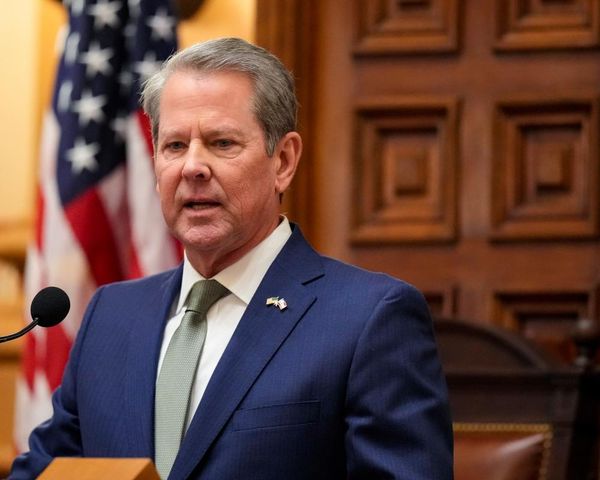
Legislators were called to the capitol by Governor Brian Kemp to manage a legal problem with QR codes on ballots that lingered over from the regular session, and tacked on redistricting as an additional effort.
That effort appears to have been quashed after Republican lawmakers questioned the political risks ahead of what is expected to be a bruising general election in a swing state.
More to follow.
Updated
Why did Trump delay Clayton's nomination? He wants the controversial Save America Act passed
Going back to Jay Clayton’s postponed nomination, Donald Trump said he would not approve the renewal of Fisa section 702 without passage of his Save America Act, which would require Americans to provide proof of citizenship when registering to vote, a provision critics say would strip millions of Americans of their right to vote, the Associated Press reported.
Trump has previously said the controversial act would deliver his Republicans a “guaranteed” win in November’s midterm elections.
With Trump’s approval rating dropping, polls show that his party will struggle to keep their slim control of the House and Senate when Americans head to the polls this year.
Updated
Trump says he is looking forward to a “very special” dinner with Macron as he wants to see the Palace of Versailles, because it “has a lot of gold”.
He then says he hopes Europe will “find its way”, as it is “having a lot of hard times” with energy and immigration.
And curiously, Trump also thanks Russia’s Vladimir Putin and China’s Xi Jinping for staying neutral on Iran, saying otherwise “they could have made it much more difficult for us”.
Updated
'I think they both want to do something,' Trump says after talking to Zelenskyy and Putin
Meanwhile at the G7 press conference, Trump has moved on to Ukraine.
He says he had “a productive conversation” with Ukraine’s Zelenskyy and then Russia’s Putin on the phone.
He suggests “something is going to happen”, as he says Russia is losing more soldiers than Ukraine.
He says he had “a very good conversation” with Putin and “a very, very good conversation with Zelenskyy”.
“I think they both want to do something. They just don’t know how to do it.”
He then swiftly moves on to international aid and the Ebola outbreak in Africa.
Updated
What's at stake with Clayton's delayed nomination? An expired powerful surveillance power
The Associated Press has succinctly summarized the stakes of the intelligence director nomination, and why even Republicans are wary of Trump’s interference in today’s hearing:
Hanging in the balance is not only the director of national intelligence, but also section 702 of the Foreign Intelligence Surveillance Act (Fisa), which permits spy agencies to collect without a warrant the communications of targeted foreigners located outside the United States.
National security officials across both major political parties have for years described section 702 as vital for gathering intelligence that can disrupt terror attacks and espionage operations, though some lawmakers and civil liberties advocates have raised concerns over the government’s use of information about Americans that is incidentally collected through the program.
Clayton’s Senate confirmation hearing was expected to be fast-tracked because of the program’s lapse. Democrats had said they would not renew Fisa until Trump withdrew the selection of Bill Pulte.
Trump’s post suggested that debate to revive section 702 could be indefinitely postponed.
Updated
GOP senator: 'mistake' to cancel Clayton hearing, blames administration for not 'dialing the president in'
The Republican senator Thom Tillis, who is retiring from his North Carolina seat at the end of his term in 2027, told Punchbowl reporter Laura Weiss that Jay Clayton was on track to have a good hearing before Donald Trump interfered with the proceedings.
“Now we’re in a posture where it may be the reason 702 doesn’t get reauthorized,” Tillis said. “That’s a mistake.”
But Tillis also doesn’t think Trump is intentionally creating an issue. “I think somebody’s not dialing the president in to the complexities of what he’s done.”
Updated
It’s worth noting a slight sense of Trump’s frustration with Israel’s Benjamin Netanyahu as he says he “gets a little excited sometimes”, and they “have a little dispute over Lebanon”.
“Bibi, you don’t have to knock down a building every time somebody walks into it that’s from Hezbollah,” he says.
Updated
Meanwhile, Trump is still on Iran.
He says the deal will be signed shortly; maybe tomorrow, maybe Friday.
Updated
Jay Clayton’s nomination hearing canceled after Trump directs him not to appear
We’re going to quickly pivot from Trump’s press conference to share that Jay Clayton’s nomination hearing has officially been canceled for Wednesday, according to the Senate intelligence committee chair, Tom Cotton.
Trump directed Clayton to not appear at the hearing scheduled for this afternoon, according to Cotton. The Republican senator, a staunch ally of the president, called the order “regrettable” in rare public criticism of Trump.
In a post on X, he wrote:
It’s regrettable that the president has directed Jay Clayton not to appear at his confirmation hearing today. Mr Clayton is a patriot and a highly qualified nominee, as the president has said repeatedly. While today’s hearing is now unfortunately postponed, I look forward to proceeding with his confirmation in the near future.
Updated
Trump touts Iran deal in G7 press conference: 'achieves everything we set out to accomplish'
Donald Trump has begun his press conference at the G7 summit in Évian-les-Bains, France.
The US president swiftly pivots to Iran, saying his deal “achieves everything we set out to accomplish and … much more.”
“If we didn’t do this deal, we could have dropped more bombs for another three weeks, two weeks, four weeks, two years … you would never have the Hormuz strait open, you would never have success,” he says.
He pats himself on the back for killing the high-ranking Iranian military officer Qassem Suleimani in 2020.
He says the G7 summit was “a chance to discuss the details of this historic agreement”, and says he kept getting praise for it from all leaders he met.
Updated
Kash Patel accused of directing $1m to ‘slush fund’ to pay bonuses to loyalist agents
FBI director Kash Patel has been accused of directing more than $1m in taxpayer-funded bonus payments to a small circle of loyalist agents as part of a “personal slush fund” that may have violated federal law.
Representative Jamie Raskin of Maryland, the ranking member of the House judiciary committee, alleged Patel had authorized substantial recurring payments to agents in his inner circle and security detail.
According to information received by the House judiciary minority committee, some agents received payments of nearly $8,000 every two weeks, despite already earning at the federal salary ceiling. While the exact total received by each individual remains unclear, the committee says it can confirm a number of agents received at least five such payments in consecutive pay periods, amounting to close to $40,000 per person.
The pace of disbursements was so rapid, the committee says, that FBI reserve accounts set aside for bonus payments were drained dry, causing some payments to bounce back from exhausted funds.
“Why are these agents receiving extra pay simply for doing their jobs?” Raskin wrote in a 15 June letter to the FBI director. “Are they, in fact, collecting bonus compensation for engaging in actions outside of their duties and outside of the law?”
He added: “We write to find out precisely how much slush fund largess you have put on the American taxpayer’s tab.”
The FBI did not respond to a request for comment. As the minority, Democrats have no authority to compel the bureau to hand over documents, though they would gain that power if they retake the House in November’s midterm elections, as some forecasts suggest they may.
The main beneficiaries, according to Raskin, were agents serving on Patel’s “Director’s Advisory Team”. The unit was created in 2025 and tasked with examining internal documents and government materials to expose and discredit federal law enforcement officials who had investigated Trump and his allies.
Here’s Joseph’s report:
Donald Trump is due to hold a news conference soon to cap off his participation in the G7 summit in Évian-les-Bains, France, before heading to a dinner at Versailles with European leaders.
I’ll bring you all the key lines from that once it gets under way, though Trump offered a little preview on his Truth Social platform a short while ago:
The trip was a Great Success but, mostly what people wanted to talk about, is the fact that Iran will not have a Nuclear Weapon, and that the Strait of Hormuz will immediately be opened!
Updated
The US senator Raphael Warnock of Georgia said Republicans called a special legislative session to consider redistricting a distraction from issues that affect Georgia voters.
Republicans “do not want to be held accountable for doubling the healthcare premiums of Georgians all across the state”, Warnock said. “Not doing anything to address the housing affordability crisis we have in our state. Meanwhile, utilities are going up. And this is the result of the Republicans’ policies.”
Though the US Senate is in session, Warnock came to Atlanta to address observers at the state capitol.
He said later at a press conference organized by the voting rights advocacy organization Fair Fight:
Today is a dark day in Georgia history. All of this was made possible by a supreme court ruling … The supreme court has taken a side in a partisan fight. To say that you cannot have majority-minority district, but to say at the same time you can have partisan gerrymandering, ignores why we have a Voting Rights Act in the first place.
We’ve come today with a very clear message. This is Georgia. We know our history. This is the state of John Lewis.
Warnock is pastor of the Ebenezer Missionary Baptist church, home of Martin Luther King Jr. Warnock took a dim view of legislators who would gerrymander away the voting power of Black voters while invoking King’s legacy on his birthday.
Keep Dr King’s name out of your mouth while you’re doing it. You cannot remember Dr King and dismember his legacy at the same time.
Updated
Thune on why Trump is derailing Clayton hearing: ‘Good question’
The Senate majority leader, John Thune, has reiterated that the intelligence committee chair, Tom Cotton, will move forward with Jay Clayton’s confirmation hearing for the position of director of national intelligence today, after Donald Trump abruptly said he was “cancelling” the hearing in the early hours of this morning.
“All I know is that Chairman Cotton is planning to proceed, as you all know, with the hearing,” Thune told reporters. “And then from there on, we’ll just have to take it a day at a time until we get more clarity on kind of what the White House position is, I guess.”
Asked why he thinks Trump is doing this, Thune replied bluntly: “Good question.”
Updated
In bizarre comments earlier, Donald Trump referred to India’s prime minister, Narendra Modi, as a “beautiful-looking man” and “an angel”.
Telling reporters the US and India were close to reaching a trade deal, Trump added that Modi was a “killer” and a tough negotiator. “He’s tough as they come, so he gets you by surprise,” he said of Modi.
And glossing over tensions between the two countries over the last year (from the punitive tariff Trump slapped on India for buying Russian oil to the recent deaths of three Indian seafarers in US strikes on commercial tankers in the strait of Hormuz), Trump said of his relationship with Modi: “We cannot be closer.”
Strikingly, Trump also said that if anyone were to attack India, the United States would be there to help them, “without having a contract”. That is a pretty bold statement to make, particularly in Europe, where the Trump has questioned whether the US would come to its Nato allies’ collective defense and threatened to leave the alliance.
“If they were attacked, we would be there to help them,” Trump said, when asked about the US-India defense relationship. “If anybody attacks that man, we’re going to be there,” Trump said of Modi. “Now, if there’s a new leader, I’m not sure about it.”
Updated
Donald Trump also said that the US would have to “start the process again” if Iran does not agree to a final deal resolving nuclear issues.
“I would think they would do it,” Trump said speaking alongside the Indian prime minister, Narendra Modi, on the sidelines of the G7 summit, then asked about the prospects for a deal. “If they don’t, then that’s, you know, that’s OK. We’ll have to start the process again, and we don’t lose.”
He added that the memorandum of understanding is a “strong one”.
Updated
Further to that, Donald Trump told reporters at the G7 meeting in France just now that he will not sign the Foreign Intelligence Surveillance Act, which is currently being debated in Congress, unless his bill implementing national voting changes is included.
“I’m not going to sign Fisa unless it’s done,” Trump said.
Senate committee defies Trump 'cancelling' Clayton confirmation, saying hearing will go ahead as planned
The Republican senator Tom Cotton of Arkansas, who chairs the Senate intelligence committee, has said that the committee intends to go ahead with Jay Clayton’s hearing as scheduled – defying a surprise announcement by Donald Trump that the hearing was “cancelled”.
Cotton wrote on X:
Jay Clayton is a pending nominee before the Intelligence Committee. We will proceed with his hearing as scheduled unless the president directs him not to appear or withdraws his nomination.
Trump abruptly derailed the confirmation process for Clayton as the US’s top intelligence chief early today, in a move that will allow his controversial selection for acting director of national security, Bill Pulte, to assume the role and remain in place for at least several weeks until Clayton is confirmed.
The president had pushed the Senate to confirm Clayton after his appointment of Pulte as acting DNI sparked bipartisan pushback and stalled his administration’s push for renewal of a key power of the controversial Foreign Intelligence Surveillance Act (Fisa).
In a surprising post on Truth Social in today’s early morning hours, Trump declared “we are cancelling the Senate Hearing RE: DNI Today”. The president doesn’t technically have the power to cancel a Senate hearing, and Cotton has signalled it will go ahead unless Trump intervenes.
Trump said that Republicans had rushed the Clayton nomination so quickly that “Pulte would be gone before the Dumocrats would vote on FISA”.
He also said he wanted to see Clayton’s replacement as US attorney completed before Clayton became DNI, and further complicated the situation by asserting he did not want the surveillance act approved unless it included the Save America Act, a controversial and restrictive voting bill.
Here’s more from my colleague Cate Brown:
Updated
Having made it to the final day of the G7 summit (unlike last year), Donald Trump is scheduled to have a private dinner with Emmanuel Macron at the opulent Palace of Versailles tonight.
“The French president, who happens to be a very nice man, invited me to dinner at Versailles,” Trump told reporters yesterday. “Versailles is not a gold leaf, Versailles is the real deal.”
Updated
Donald Trump also denied (again) that the memorandum of understanding includes a $300bn fund for Iran, and denied that he had asked the Gulf states to commit funding.
“It’s false,” Trump told reporters as he sat alongside Egyptian president Abdel Fattah al-Sisi. “You can invest if you want. What am I going to do, say no one is ever allowed to invest? We’re not investing, we’re not putting up 10 cents and people can decide to do it. That’s up to them.”
His vice-president JD Vance yesterday told CBS that Iran could gain access to a $300bn fund backed by Gulf states “if they honor their end of the obligation [of the deal with the US]”. Vance also insisted no US taxpayer dollars would be put up for the fund.
Reuters reports today that the private fund is designed to trigger investment in Iran, and more than half the sum has been committed.
The fund is a private investment vehicle, not a reconstruction or reparations programme and will not include any government money or grants, Reuters’ source said, adding that private companies based in the US, the Gulf Arab states, Asia, South America and Africa have agreed to commit financing.
Updated
Vance says text of US-Iran MoU could be released before Friday
Speaking on CBS this morning, JD Vance said the text of the memorandum of understanding with Iran “will come out at the latest on Friday”.
He claimed that the Pakistani and Qatari mediators “asked us not to release the full text for a little while,” while the US, he said, was pushing for it to be released today.
“We’re actually trying to push them to get it out today, because we want to tell the American people what’s in this deal,” Vance said.
Seeking to clarify what the deal does, he went on:
In short, what it does is it opens the strait of Hormuz immediately … It also provides a framework whereby if the Iranians give us what we need – on stopping the funding of terrorism, on no longer pursuing a nuclear weapon – then they can get some benefits, be re-invited into the world economy.
“When I say benefits, I’m talking about sanctions relief on their economy,” he added.
“We’ve destroyed their nuclear programme, but one of the things the president is trying to do is give them the incentive not to try to rebuild that programme for the long haul.”
Updated
The G7 leaders are now meeting with tech CEOs, with Donald Trump seated with OpenAI CEO Sam Altman, DeepMind CEO Demis Hassabis and Anthropic CEO Dario Amodei for a working lunch discussion on the future of artificial intelligence.
It comes in a tense moment after the US ordered Anthropic to suspend access to its most advanced AI models for foreign nationals, citing national security concerns, a move which surprised many in Europe.
According to a text of her prepared remarks Ursula von der Leyen, president of the European Commission, stressed the room for future collaboration: “It is in our mutual interest that our citizens and companies can safely use the best AI models.”
Updated
Donald Trump was almost an hour late to the first working session of the final day at the G7 summit in Évian-les-Bains.
As he walked to his seat he stopped at the head of the table and joked, “I’m the boss.” He then also joked with press that they could stay for the (closed press) meeting, “It’s okay with me.”
Trump also complained about the room being “too hot” and asked if there would be air conditioning, to which French president Emmanuel Macron replied, “Yeah, we will have.”
A senior White House official told NBC News that the US president was late because he was “on some very important calls with people back in the States”. That would have been between 3.30 and 4.30am ET.
Updated
Iran memorandum of understanding is 'not final', says Trump
Donald Trump warned Iran he was ready to resume military action if Tehran did not abide by its obligations, two days ahead of the signing of an accord to end the war between the foes.
“No it’s not final. It’s a memorandum of understanding,” Trump told reporters at the G7 summit, referring to the agreement expected to be signed in Switzerland on Friday.
“If I don’t like it we will go back to shooting at them,” he added alongside Egyptian president Abdel Fattah al-Sisi.
If they don’t behave, we’ll go right back to dropping bombs right smack in the middle of their head.
Trump added: “It’s a very strong deal. Nobody knows what it is, but it’s very strong, and most people seem to be very happy.”
And, ever the diplomat, the president claimed that the Iranians “laughed at Obama” and “said he is a stupid son of a bitch”.
Updated
Trump delays Clayton's nomination for intelligence director to push Congress on voter ID bill
President Donald Trump has said that he was delaying federal prosecutor Jay Clayton’s nomination to lead the US intelligence community in a bid to force Congress to act on a voter ID bill that currently lacks enough support for passage.
The Republican president said in a social media post just hours before Clayton’s scheduled confirmation hearing that he will keep Bill Pulte, a top US housing official, as acting director of national intelligence.
Democratic and Republican lawmakers had opposed Trump’s selection of Pulte, citing his lack of known experience in intelligence and his use of his current role to target perceived adversaries of the president - resistance that last week forced Trump to turn to Clayton.
He wrote:
The Republicans agreed with Dumocrats to remove very fair, and talented, William Pulte, from serving as Acting DNI in return for getting FISA approved by the Dumocrats. However, the Republicans moved so fast with the hearings of the Great Jay Clayton, current U.S. Attorney for the Southern District of New York, that Pulte would be gone before the Dumocrats would vote on FISA. Now, the Dumocrats are saying they will vote against FISA — So, the Republicans wound up having fulfilled their commitment, but Dumocrats broke the Deal.
In addition, the newly nominated U.S. Attorney, Jamie McDonald, must be confirmed and blue slipped. Because of the ridiculous views of Republicans on blue slipping (Dumocrats are often willing to nix it), I may not be able to get the extraordinary Sullivan & Cromwell Partner, Jamie, approved, and I don’t want to take Jay Clayton away from the great job he is doing until Jamie is in place. Therefore, to add a slight bit of intrigue but, for the Good of the Nation, and the People of our Country, I will not approve FISA without THE SAVE AMERICA ACT going along with it.
Trump added:
Not complicated, actually, the Republicans fell into a trap. Regarding the approval of our Great Patriot, Jay Clayton, we are cancelling the Senate Hearing RE: DNI today, and will not be going forward until Jamie McDonald is approved to be U.S. Attorney. In the meantime, Bill Pulte will remain as the Acting Director of National Intelligence.
Updated
January 6 defendants pursue millions in claims through obscure federal process
January 6 defendants who assaulted police officers are pursuing legal claims for millions in compensation from the Trump administration using an obscure federal process with minimal oversight, but which offers the Trump administration a way to compensate those responsible for violence even after scrapping its “anti-weaponization fund”.
The defendants are pursuing their claims using the Federal Tort Claims Act (FTCA), which allows individuals wronged by the government to file claims for monetary damages. The justice department has complete and unchecked discretion over whether to settle the claims, giving the Trump administration a powerful vehicle to reward those responsible for violence on January 6.
The claims would be paid out from the judgment fund, a perpetual appropriation allowed for by Congress and the same pot of money Trump’s $1.8bn slush fund was going to draw from. All of the defendants seeking compensation received a pardon from Trump.
There was fierce bipartisan pushback to the “anti-weaponization fund” proposed by the administration last month after Trump reached a settlement with the Internal Revenue Service. In particular, members of Congress were concerned that people who harmed law enforcement officers on January 6 might receive compensation. “If you’ve been convicted of assault on a cop ... doesn’t seem to me like people who are victims,” Josh Hawley, a Republican senator from Missouri, told NBC News.
While the “anti-weaponization fund” appears to be on ice for now, FTCA claims and lawsuits could provide another avenue for payouts.
“It risks turning the judgment fund into exactly the sort of slush fund that the ‘anti-weaponization’ was going to be,” said Rupa Bhattacharyya, a former director in the civil division’s tort branch at the justice department, who worked on FTCA claims and now is the legal director at the Institute for Constitutional Advocacy and Protection at Georgetown Law.
“If the treasury department is not going to enforce the restrictions on the use of the judgment fund, which is to settle impending or imminent lawsuits where there’s some risk of liability, then there’s no limit on what you can use that judgment fund money for, so long as someone files a bogus claim,” she said.
The justice department agreed to settle FTCA claims filed by Michael Flynn, a former national security adviser, and Carter Page, Trump’s foreign policy adviser, for $1.25m each earlier this year.
Updated
Republicans push for swift confirmation of Trump's intelligence director nominee, Jay Clayton
Republicans are pushing for swift Senate confirmation of president Donald Trump’s nominee to lead US intelligence, Jay Clayton, but Democrats said they would wait until his nomination hearing on Wednesday before deciding how to proceed.
Trump nominated Clayton, the top US attorney for Manhattan, to be Director of National Intelligence (DNI) less than a week ago, amid a political firestorm over the loyalist he had picked to fill the role temporarily, Reuters reported.
That close ally, Federal Housing Finance Agency director Bill Pulte, has no national security experience. Even some Republicans expressed concerns that he could “weaponize” top-secret intelligence to target Trump’s perceived political foes.
Trump’s decision to pick Clayton to oversee the nation’s 18 intelligence agencies was greeted with relief. Clayton lacks extensive national security experience but is broadly respected by Democrats and Republicans.
Democrats said on Tuesday that they intended to question Clayton closely, but held off on passing judgment before his Senate Intelligence Committee hearing.
“I favor a full vetting... a thorough examination of all of the issues,” senator Ron Wyden of Oregon, a senior Democratic member of the panel, told reporters.
Senate minority leader Chuck Schumer of New York said Democrats would decide how to proceed only after the hearing.
Senate majority leader John Thune of South Dakota and other Republicans want Democrats to agree to waive Senate rules to allow a vote on Clayton as soon as this week.
Thune told a news conference on Tuesday that Clayton is “eminently qualified” and that his position as US attorney meant that he deals with intelligence matters.
Updated
Most Americans believe civil liberties like the right to vote are under threat, according to a new AP-NORC poll, while also continuing to agree that the rights expressed in the nation’s founding documents are still core to American identity.
The survey from the Associated Press-NORC Center for Public Affairs Research finds that most Americans across demographics believe the right to vote, the right to free speech and freedom of religion are integral to the country.
But they were more divided on the importance of the right to bear arms, and few - about one-third or less - saw those rights as safe from threats.
The survey, which was conducted 16-20 April - before the Supreme Court’s recent ruling that winnowed a section of the Voting Rights Act – highlights an enduring consensus among Americans that personal freedoms are vital to the country’s national identity.
But it also reveals deep anxieties about the nation’s trajectory on the cusp of a summer filled with celebrations of the country’s semi-quincentennial birthday.
Trump-backed candidate wins primary to face Jon Ossoff in Georgia midterms
Hello and welcome to the US politics live blog.
Donald Trump’s pick to face rising Democratic star Jon Ossoff in Georgia’s midterm election for senator later this year swept to victory last night.
The state’s Republican primary runoff voters chose US representative Mike Collins over former college football coach Derek Dooley to face Ossoff in November.
They also selected billionaire healthcare executive Rick Jackson over Trump-backed lieutenant governor Burt Jones to face Democratic gubernatorial candidate Keisha Lance Bottoms in November, after a bruising election campaign that led to libel litigation and federal challenges to Georgia election law.
Ossoff, who has represented Georgia in the US Senate since 2021, has made waves this year by delivering a series of caustic takes on Donald Trump’s administration. He will now face Collins in the race to retain the competitive seat.
Collins, a trucking executive and one-time “freedom caucus” conservative endorsed by Trump, has served in the US House of Representatives since 2023. His father, Mac Collins, served in the House from 1993 to 2002.
An anti-abortion hardliner with a history of incendiary social media commentary, Collins has vigorously denied the legitimacy of the 2020 election and defended January 6 rioters.
Dooley is the son of legendary University of Georgia football coach Vince Dooley. After earning a law degree from UGA, he began working his way through the college coaching ranks, eventually taking the University of Tennessee to three consecutive losing seasons before being fired.
Dooley is close friends with outgoing governor Brian Kemp, who had backed Dooley with his endorsement, political staff and fundraising appeals.
Jackson will represent the GOP in the Georgia gubernatorial contest.
Read the full story:
In other developments:
-
Donald Trump laid into Benjamin Netanyahu, telling a news conference at the G7 summit in France that the Israeli prime minister “has to be more responsible with respect to Lebanon”.
-
The Republican-led US Senate on Tuesday narrowly failed to advance a war powers resolution introduced by Democrats that would have directed the president to end hostilities with Iran, by a vote of 48-47.
-
The justice department announced charges against five men for an alleged plot to carry out an attack to kill government officials at the White House UFC event on Sunday.
-
Kash Patel, the FBI director, reportedly surprised and angered US Secret Service officials by announcing an alleged plot to attack the White House UFC event on social media early Tuesday before about 10 suspects had been arrested.