Singer D4vd had a multimillion-dollar recording deal, an executive at his former label testified on Wednesday, as prosecutors sought to establish the musician had a financial motivation to kill Celeste Rivas Hernandez.
The scope of how much Interscope Records was paying the singer, born David Anthony Burke, came into clear view on the second day of a hearing to determine whether there was probable cause for him to stand trial for the murder and sexual abuse of Rivas Hernandez. The label terminated his contract in December 2025.
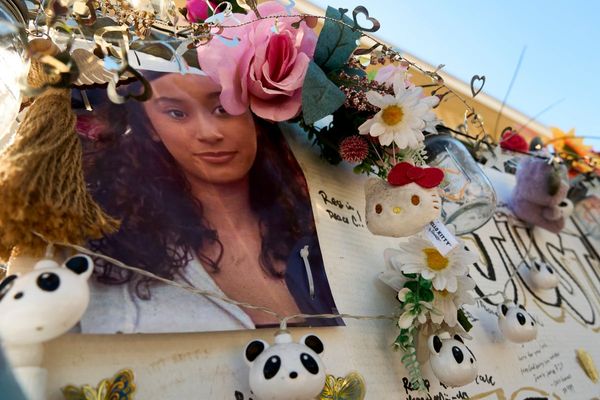
The teenager’s body was found last year in gruesome conditions in a car registered to the musician.
Prosecutors accuse Burke of stabbing Rivas Hernandez, 14, to death at his Los Angeles residence to silence her from divulging the sexual nature of their relationship as his career was on the rise.
Burke has pleaded not guilty to charges that include first-degree murder, “lewd and lascivious acts” with a child under the age of 14, and the mutilation of human remains. His defense team has said their client “was not the cause” of Hernandez’s death.
From 2022 to 2025, Interscope paid Burke and affiliated entities more than $7.2m, a figure that encompassed legal fees and a trust mandated by California law for underage entertainers, according to a summary of payments exhibited to the courtroom.
Details of Burke’s compensation followed a testy exchange in the morning, as prosecutors countered the defense’s suggestion that their client was not privy to his finances.
Attorneys for Burke repeatedly objected to questions from deputy district attorney Beth Silverman about whether the singer’s former financial manager, Benjamin Gregor, knew of Burke arranging tickets for Rivas Hernandez to travel to London and his home in Texas.
Rivas Hernandez’s parents, Jesus Rivas and Mercedes Martinez, returned to court on Wednesday. Dressed in all black, the two sat in the first row, accompanied by their lawyer.
Martinez dropped her head and wiped her eyes in the early afternoon, when prosecutors presented a photograph of her daughter’s passport, which a Caltrans employee discovered in January 2026 in a dirt embankment off State Route 154 in Santa Barbara.
“Once he found the card, he Googled the name to try and see if it was someone that lived locally in the area. He began seeing articles and news stories and when he realized what he had found, he called our dispatch,” Sean Buenrostro, a California highway patrol officer, said on the stand.
The first day of hearings on Tuesday featured graphic evidence. Prosecutors showed photos of the dismembered and decomposing body of Rivas Hernandez, and alleged the singer had severely mutilated her body. They also sought to show that the singer used his credit cards to purchase chainsaws, a body bag and a shovel.
On Wednesday, Chelsea Murillo, a criminalist with the Los Angeles police department’s forensic science division, spoke about her examination of the Tesla that contained Rivas Hernandez’s remains.
A layer of dust coated the vehicle’s exterior, she said, which suggested it had been outside for a long period of time. She observed insect activity in the front trunk and a strong odor resembling a decomposing body.
The preliminary hearing is expected to last from three to five days.
Burke, now 21, was arrested in April and has been held in custody since then without bail.
If convicted of murder, he could face the death penalty, or life in prison without the possibility of parole.
Prosecutors have not yet announced whether they will pursue capital punishment.
After Burke’s arrest in April, the family said in a statement: “Celeste was a beautiful, strong girl who loved to sing and dance. Every Friday night was movie night and we spent wonderful times together. We love her very much and she always told us that she loved us. We miss her deeply. All we want is justice for Celeste.”
The Associated Press contributed to this report