There is just one road that leads to the Estadio Akron, the stadium home to Mexican club Chivas de Guadalajara, which is scheduled to host four group matches at this year’s World Cup. As the tournament approaches, traffic has been the main concern about the stadium.
On Sunday, there was a different issue. A little more than a mile away, near the go-kart track named for Mexican Formula One driver Sergio “Checo” Pérez, a burning bus blocked the road.
That did not make it unique Sunday morning in the state of Jalisco. In response to a federal operation that saw their leader Nemesio “El Mencho” Oseguera Cervantes killed, members of the Cártel de Jalisco Nueva Generación (CJNG) put blockades all over the region – from central Guadalajara to the coastal city of Puerto Vallarta. In addition to buses and taxis being commandeered and lit on fire – a common tactic known as “narcobloqueos” – shops ranging in size from a Costco in Puerto Vallarta to corner stores also continue to be targets for arson and destruction.
The city activated a red alert protocol, effectively freezing activity for ordinary citizens and encouraging them to stay home. Bars and restaurants closed. Sports, too were affected: Sunday’s Clásico Nacional between the women’s teams of Chivas and Club América was postponed. So was a men’s Liga MX contest more than 200 miles away in Querétaro. While no narcobloqueos had been confirmed there at time of writing, the wide-reaching CJNG operation and its affiliates had reportedly blocked roads in at least eight states.
It all brings to the forefront long-simmering questions about what authorities will do to make sure fans are safe and this summer’s tournament goes off without incident in Mexico. The idea that a World Cup match in this soccer-loving country would be targeted is something that has concerned political officials, soccer directors and fans for decades.
In August 2011, a gun battle outside Santos Laguna’s Estadio Corona sent players sprinting off the field to the locker room during a match against Monarcas Morelia. Panicked fans hit the ground, hiding under their seats. After more than a minute passed, many jumped on to the field and also sought shelter in the locker room area.
While the shooting later was confirmed to be outside the stadium, and everyone inside was safe, it was exactly the type of moment the Mexican league had been pushing against. Liga MX strives to market itself as a family-friendly product and to attract top talent from around the world. Players running for their lives or trying to find their families in the stands to protect them wasn’t what the league needed, especially when Mexico already fights against a stereotype of being a dusty desert filled with cartel warfare.
Dorados, a second-division club in the state of Sinaloa, have not played a true home match since October 2024 because of violence between warring factions of the Sinaloa Cartel – the team have temporarily relocated to another state, Baja California –though the local baseball team has played home matches without incident.
That conflict is different, largely being fought between groups of organized crime rather than the state against the criminals. Still, the lessons learned in Sinaloa have resonated. In 2019, authorities tried to capture Ovidio Guzmán López, son of Joaquin “El Chapo” Guzman, to fulfil a US extradition request. The Sinaloa Cartel responded with a show of force, setting up narcobloqueos and firing weapons all over town until Guzmán was released, an incident that became known as the Battle of Culiacán or the Culicanazo.
With that context, plenty in Mexico had wondered what the government would do about security heading into this year’s World Cup. A manoeuvre like the one made Sunday to cut off the head of the snake could lead to long-term insecurity, destabilizing a region and leading to more concerns that cartel violence could afflict the thousands of visitors – and thousands of Mexicans – who will head to the stadiums this summer.
Indeed, Mexican national security and organized crime columnist Óscar Balderas has claimed that a high-level source told him that Mexico had “asked the United States not to take any action to capture or eliminate … ‘El Mencho’ in 2026 because of the violence it could cause in World Cup cities – a Culicanazo in the style of the CJNG while the eyes of the world are on our country would be disastrous for Mexico’s reputation.”
The decision to go after “El Mencho” this week shows that the two governments ultimately went with a different strategy – or that a different opinion won out. Unconfirmed reports in Mexico are emerging that the Americans put pressure on Mexico to lock up El Mencho prior to the tournament.
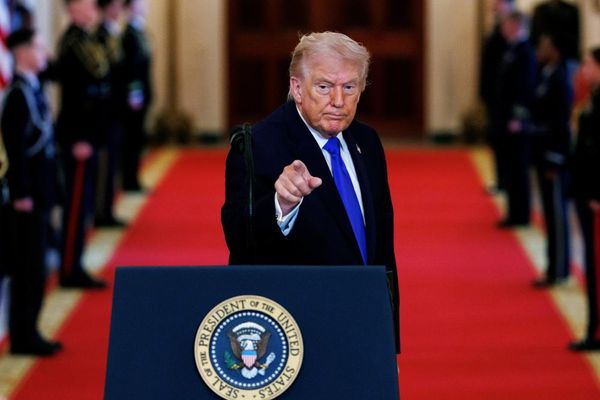
Mexico’s president, Claudia Sheinbaum, has been balancing domestic interests with Donald Trump’s whims since the start of his second term. It’s a tightrope Fifa also has been walking, as its president Gianni Infantino pals around with Trump.
Fifa had seemed to be a source of common ground for the North American leaders, with Trump and Sheinbaum meeting in person for the first time when they were brought together by the World Cup draw. Yet for as much influence as Fifa wields, the governing body is at the mercy of its hosts when it comes to keeping fans safe and warding off the chance of a mass-scale city shutdowns at the hands of organized crime. In front of the cameras, Fifa has expressed confidence.
”Fifa’s Mexico office has been working for three years with the federal government, and all levels of the government, on the topic of security,” Fifa’s executive director in Mexico, Jurgen Mainka, said in November 2025. “We’re very sure, very confident that all the protocols and all the plans that are being implemented for the World Cup will give us the security framework necessary for all fans, all teams and all referees in 2026.”
State officials in Jalisco said before a 2025 friendly that they plan to add thousands of security cameras, purchase new law-enforcement vehicles and utilize technology aimed at preventing drones from entering restricted areas.
“Security is being worked on,” Sheinbaum said this past fall. “It has been worked on in a very coordinated manner, with police departments in the host cities, the host states and the [federal] secretary of security and civilian protection, and there’s really important work being carried out.”
But that was all before Sunday’s images went across social media, shocking for many around the world – perhaps including fans of South Korea, Colombia, Uruguay and Spain who are among fans planning trips to see their team in Jalisco. Yet, the images were all too familiar for many in Mexico who recall the Culicanazo.
With simmering problems boiling over, Mexican politicians must prove they can keep their citizens safe – and along the way avoid repeating the moments of August 2011 when the stranglehold organized crime has had on the country spilled over into a soccer stadium.